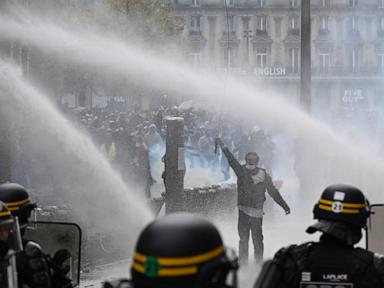
Classified as intermediate force meant to disperse crowds without lethal outcomes, French crowd-control munitions routinely produce severe trauma when operational distance, angle of incidence, or blast confinement deviate from narrow design assumptions.
Standard news coverage lists the hardware—foam-round launchers, sting-ball and sound grenades, tear gas, batons, and strobe shields—alongside familiar disputes between interior officials and human rights monitors. That inventory misses the underlying mechanics. A weapon's nominal classification reflects a controlled testing envelope rather than a chaotic street environment where crowds compress, visibility drops, and officers operate under time pressure. To evaluate why injuries occur and what policy changes actually alter risk, the issue must be analyzed across four structural dimensions: force transfer mechanics, doctrinal drift, accountability bottlenecks, and tactical alternatives.
Three Pillars of Intermediate Force Harm
Intermediate crowd-control tools fail in predictable ways when deployed outside their intended operating parameters. Rather than treating every injury as an isolated anomaly, analysts can trace severity to three interacting mechanisms.
- Kinetic Energy Concentration: Kinetic impact projectiles, such as foam rounds launched from multi-shot or single-shot launchers, rely on blunt force to induce pain and compliance rather than penetrate tissue. Injury severity scales nonlinearly with impact velocity, mass, and surface contact area at the moment of strike. When a round strikes a rigid, poorly padded structure—the orbit of the eye, the jaw, the skull, or the neck—energy transfers into brittle bone and delicate ocular or neural tissue instead of dissipating across larger muscle groups. Firing from elevated vantage points, engaging at short range, or skipping rounds off hard pavement alters trajectory and increases the probability of off-target strikes above the torso.
- Blast Overpressure and Fragmentation: Stun and sting-ball devices are engineered to generate intense acoustic and visual shock to disrupt crowd cohesion. In open urban streets surrounded by facades, walls, and vehicles, pressure waves reflect and focus rather than dissipating freely. Devices containing rubber or elastomer pellets add secondary high-velocity projectiles whose dispersal pattern cannot be tightly aimed once initiated. Holding, kicking, or standing within the immediate overpressure zone of an exploding munition exposes hands, limbs, ears, and eyes to catastrophic blast and fragment trauma.
- Chemical Plume Dispersion and Crowd Compression: Chemical irritants such as tear gas act by irritating mucous membranes and driving rapid egress. In dense or cornered street formations, rapid movement toward limited exits creates crush hazards, while wind shifts and canyon effects in narrow avenues trap irritant clouds at ground level. Direct impact from a launched canister or grenade adds a blunt-force hazard on top of chemical irritation.
Doctrinal Drift and the Cost Function of Escalation
Public debates over French policing often frame the issue as a binary choice between permissive restraint and aggressive crackdown. A sharper lens examines how tools migrated across mission profiles and how institutional incentives shape deployment.
Arms researchers have noted that several munitions used in street demonstrations originated in military training, counter-terrorism, or specialized tactical scenarios before becoming routine public-order assets. That migration introduces a mismatch between weapon design and crowd dynamics. Tactical munitions assume small numbers of identified adversaries in controlled spaces, whereas urban demonstrations mix peaceful marchers, high school or university students, bystanders, journalists, and small subsets of violent actors or looters within the same spatial footprint.
The operational cost function explains why authorities still reach for these tools during high-friction protests. French public-order doctrine requires formal dispersal warnings—known as sommations—before force is used, yet commanders face intense political and operational pressure to prevent property destruction, blockades, and assaults on officers when tensions spike. From a command perspective, intermediate munitions offer standoff distance and rapid crowd dispersal without escalating immediately to firearms.
The hidden cost sits downstream. Severe injuries to teenagers, bystanders, or journalists generate prolonged judicial scrutiny, civil compensation claims, heightened public anger, and deeper distrust toward law enforcement. What looks like short-term tactical containment during a clash can fuel larger subsequent mobilizations and long-term institutional friction.
Why Accountability Breaks Down in High-Density Policing
Even when rules of engagement restrict head targeting or require graduated escalation, enforcement on the ground faces severe attribution barriers.
- Traceability Gaps: Unlike rifled firearms that leave distinct ballistic signatures on casings and projectiles, foam rounds and blast munitions typically leave no unique identifier linking a specific round or canister to an individual launcher or officer.
- Chaotic Visual Conditions: Smoke from tear gas, flashbang discharge, rapid movement, and dense crowds obscure line-of-sight video and witness accounts, making it difficult for investigators to establish exact firing angles, distances, or preceding warnings.
- Parallel Legal Tracks: Victims and families often navigate separate criminal investigations and administrative compensation procedures, where evidential thresholds and timelines differ and can leave both sides dissatisfied.
Without reliable attribution, training rules and proportionality standards lose deterrence. Officers operating in volatile environments face ambiguous accountability, while injured citizens face high evidentiary hurdles to prove fault.
Comparing Reform Levers and Their Operational Limits
Calls to curb protest injuries generally cluster around four policy levers, each carrying distinct trade-offs in effectiveness and feasibility.
Hardware Bans and Munition Restrictions
Removing explosive stun grenades or kinetic launchers eliminates specific injury mechanisms outright—most notably blast amputations and high-velocity eye or facial trauma from those specific devices. Comparative cases, such as jurisdictions shifting away from older rubber-bullet systems toward stricter kinetic protocols, show that equipment changes can coincide with lower injury rates when paired with disciplined deployment. The limitation is that banning one tool does not automatically resolve crowd control challenges; if officers lack alternative standoff options during violent riots, commanders may rely more heavily on close-quarters baton charges or mass arrests, which carry their own blunt-trauma and escalation risks.
Aiming Rules, Distance Floors, and Elevation Limits
Enforcing strict torso-only aiming, minimum engagement distances, and bans on firing from elevated positions directly targets the physics of severe blunt trauma. In theory, constraining angle and distance reduces off-target head and neck hits. In practice, maintaining exact range and posture during fast-moving street clashes is difficult, and human error still occurs under stress.
Traceability and Chain-of-Custody Controls
Proposals such as stamping batch or serial markings on munitions, logging launcher assignments, and tightening body-worn or unit camera protocols aim to close the attribution gap at relatively low unit cost. Traceability improves investigative clarity and encourages greater care in firing decisions. Its limitation is evidentiary rather than preventive: identifying who fired a round after an injury occurs does not prevent the initial strike, and smoke or crowd cover can still complicate identification.
De-escalation and Containment Doctrine
Separating peaceful marchers from violent actors through intelligence, perimeter management, negotiated routes, and targeted arrest teams rather than broad-area munitions reduces collateral harm to non-violent participants. This approach requires high manpower, strong command discipline, and time. During sudden outbreaks of rioting or looting, pure containment can strain available units and face political pushback if perceived as too slow.
Strategic Play for Policymakers and Security Planners
No single prohibition or technical fix eliminates protest injuries in dense urban environments. The highest-leverage move for interior ministries and oversight bodies is to treat crowd-control force as a coupled system of equipment selection, strict deployment envelopes, and verifiable traceability rather than debating isolated weapons in the abstract. Specifically, authorities should retire explosive and fragmenting grenades from routine crowd control first, enforce non-negotiable aiming and standoff rules backed by launcher-level assignment logs and munition markings, and pair those controls with clear public reporting on injury types and investigations. Reducing severe trauma while preserving lawful public order depends on aligning what a munition physically does in a crowded street with strict rules that can actually be audited afterward.