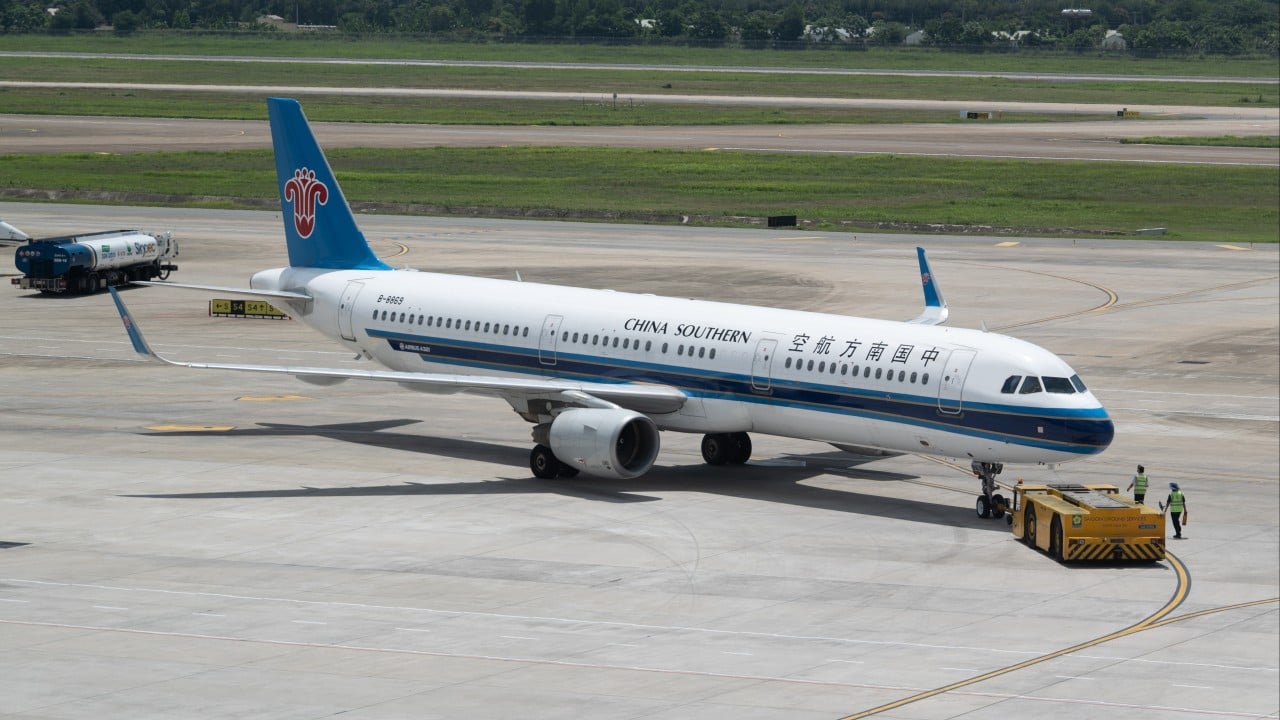
Airplanes are built to get struck by lightning. Passengers rarely understand this design principle, which explains why an incident involving a China Southern Airbus A321 taking twenty distinct lightning strikes while taxiing instantly triggers global panic.
When a commercial aircraft absorbs massive electrical discharge on the tarmac, the immediate public reaction focuses on fear. The reality is far more clinical. Modern commercial jets act as sophisticated Faraday cages, engineered to channel tens of thousands of amperes of electrical current harmlessly around the cabin and out through extremities like wingtips and tail cones. If you liked this article, you might want to read: this related article.
Yet finding twenty discrete strike marks on a single airframe during routine ground operations is an unusual statistical anomaly. It forces aviation safety authorities to look beyond standard weather protocols. It raises difficult operational questions about airport ground positioning during severe convective weather, the limits of static wick dissipation, and the invisible stress placed on composite materials during low-altitude electrical storms.
Anatomy of an Atmospheric Discharge
Lightning does not randomly select its targets. It follows the path of least resistance between a positively charged ground and a negatively charged cloud base. When an Airbus A321 sits on a taxiway, its aluminum and composite skin effectively becomes an elevated, grounded conductor sitting in an active electrical field. For another angle on this event, see the latest update from AFAR.
The physics governing these encounters are well documented. An average lightning bolt carries roughly thirty thousand amperes, though exceptional strikes can peak at over two hundred thousand amperes. To prevent this raw energy from frying avionics or melting structural joints, engineers wrap the aircraft skeleton in continuous electrical pathways.
Older aircraft relied heavily on thick aluminum skins that naturally conducted electricity. Modern narrowbody airframes, including variants of the A321, incorporate significant amounts of carbon fiber reinforced polymer to save weight and improve fuel efficiency. Composite materials do not conduct electricity as efficiently as bare metal.
To compensate, manufacturers embed a fine bronze or copper mesh, or an aluminized foil layer, directly into the outer skin layers. When lightning hits, this conductive mesh spreads the thermal and electrical energy across a wide surface area, preventing localized burn-through. Finding twenty separate strike marks means the dissipation system worked twenty times over, but it also signals that the aircraft lingered too long in an intense electrical gradient.
The Taxiway Vulnerability Window
Cruising at thirty thousand feet, pilots actively avoid convective activity using onboard weather radar. Severe turbulence and electrical cells are mapped and circumnavigated hours before arrival. The ground environment presents a different operational trap.
Aircraft on a taxiway rely on air traffic control clearances, ground congestion management, and stationary weather patterns. They cannot simply divert around a sudden microburst or an isolated cumulonimbus cloud sitting directly over the airfield.
Ground infrastructure often lacks the advanced localized lightning detection networks that give flight decks real-time tactical awareness. When a ramp area experiences rapid atmospheric charging, parked or slowly moving aircraft become stationary lightning rods.
Ground crews face immediate risks during these events, but the aircraft itself absorbs the brunt of the kinetic and electrical shock. An Airbus A321 taxiing through a high-potential gradient can trigger leader steps from the ground upward, connecting with downward stepped leaders from the cloud. Twenty distinct entry and exit points indicate that the aircraft moved through multiple localized discharge zones or sat stationary while a continuous, pulsing storm cell discharged repeatedly against the airframe.
Inspecting the Invisible Damage
Surface burn marks tell only half the story. The true test of structural integrity begins long after the passengers have disembarked and the media has moved on.
When high-intensity electrical currents travel through an airframe, they must find a path to exit. This journey can cross structural fasteners, fuel tank access panels, and control cable runs.
The Fastener Challenge
Every mechanical fastener on an aircraft skin represents a potential point of electrical resistance. If a fastener is slightly loose or contaminated with sealant degradation, the immense current passing through it can create an internal micro-arc.
Micro-arcs generate intense localized heat. Inside a fuel tank environment, even a microscopic spark can lead to catastrophic failure if fuel vapor concentrations fall within the flammable range. This is why modern fuel systems feature extensive lightning protection design, including thick sealant barriers, specialized spark-resistant fasteners, and rigorous bonding checks.
Composite Delamination
Unlike metal, which deforms or melts under extreme heat, composite materials can suffer from internal delamination. The resin binding the carbon fibers together can vaporize or fracture when subjected to extreme electrical currents, creating hidden structural weakness invisible to the naked eye.
Maintenance technicians inspecting an aircraft with twenty strike marks cannot rely on a simple visual walkaround. They must deploy advanced non-destructive testing methods. Ultrasonic testing, eddy current inspection, and thermography become mandatory tools to peer beneath the paint and composite plies, searching for microscopic fractures that could propagate under standard pressurization cycles at cruising altitude.
Regulatory Blind Spots and Operational Protocols
Aviation safety regulations mandate that all commercial aircraft must be certified to withstand severe lightning strikes without loss of control. The Federal Aviation Administration and the European Union Aviation Safety Agency set rigorous testing standards for airframe manufacturers.
Yet ground operations protocols during severe weather lag behind airborne standards. Airlines and airport operators often rely on subjective visual assessments or general lightning advisories that halt ramp fueling operations but allow taxiing to continue until conditions cross arbitrary thresholds.
An incident involving twenty strike marks on a single airframe highlights a systemic gap in ground-to-cockpit communication. Why was the aircraft permitted to taxi through a localized storm cell generating such high electrical frequency?
Meteorological data is rarely integrated directly into ground movement decision-making software in real time. Dispatchers and station managers look at regional forecasts rather than live electrostatic field mapping on the tarmac.
The financial pressure to maintain on-time departures compounds the risk. Airlines operate on razor-thin margins where every minute spent holding short of a runway translates to lost revenue and cascading schedule delays. This commercial reality can inadvertently nudge flight crews and ground controllers into taking calculated risks with marginal weather.
The Cost of Comprehensive Maintenance
When an airframe undergoes the intensive inspection required after multiple severe lightning strikes, the economic toll is immediate. Grounding a narrowbody workhorse like the A321 for specialized non-destructive testing disrupts fleet rotations and cancels connecting flights.
Specialized engineering teams must painstakingly map every single scorch mark, measure the depth of surface pitting, and verify the electrical resistance across every bonding jumper in the flight control surfaces. If damage is found in critical load-bearing composite structures, repairs require specialized curing processes that can take days.
Insurance adjusters and airline risk management departments review these events with acute interest. While structural engineering guarantees that the plane will not simply fall out of the sky, the cumulative wear and tear on electrical grounding paths reduces the long-term fatigue life of specific components.
The engineering community remains confident in the fundamental physics of the Faraday cage, but twenty strikes serve as a stark reminder that nature retains the capacity to overwhelm routine operational assumptions. The storm does not care about the timetable, and the physics of atmospheric discharge demand absolute respect long before the wheels ever leave the ground