Cold rain in East Anglia has a way of sinking straight through heavy canvas, down past the collar, and settling right between your shoulder blades.
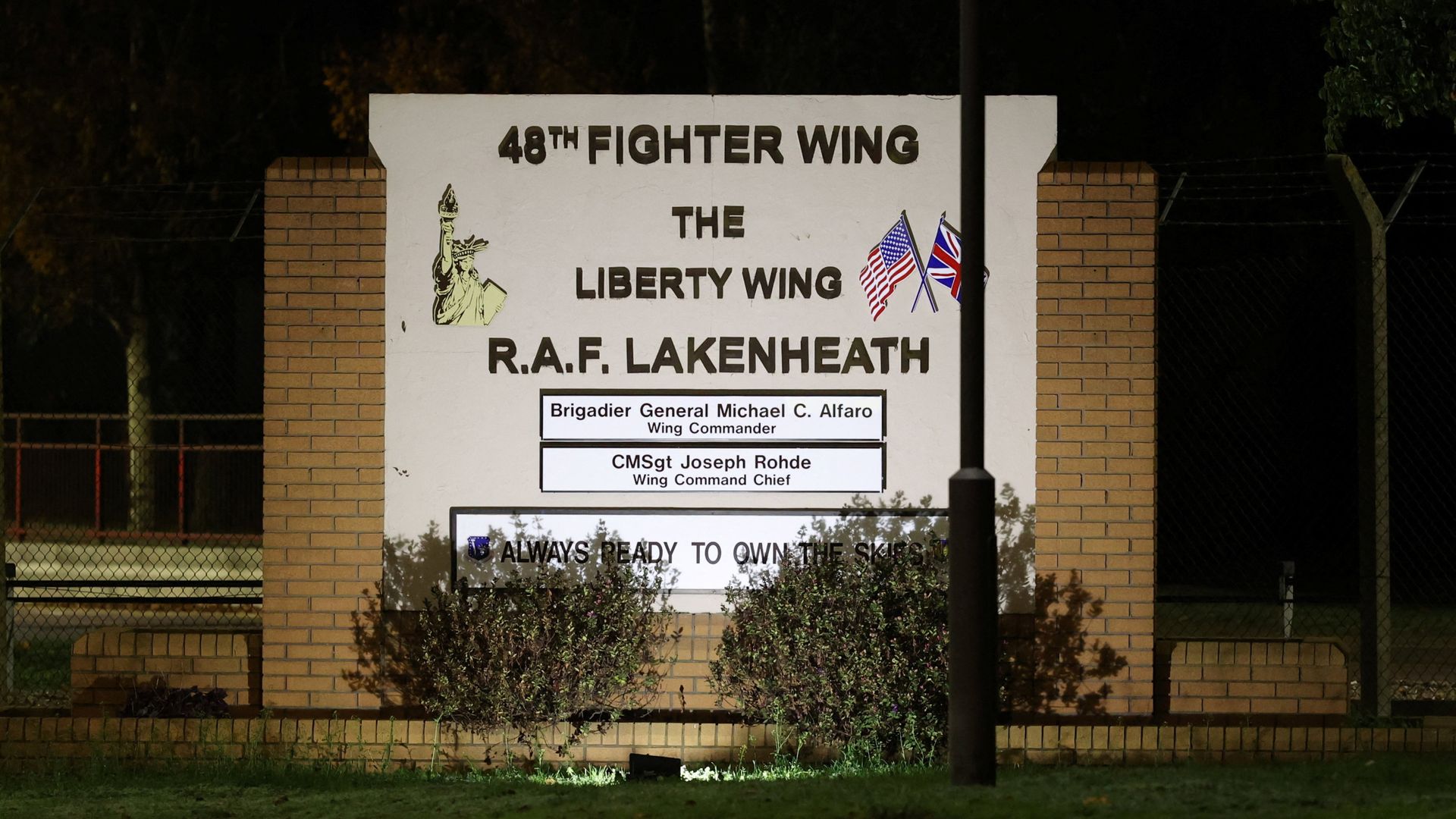
Imagine, for a moment, a hypothetical night shift on the perimeter of RAF Lakenheath—a sprawling Royal Air Force base in Suffolk that houses the United States Air Force's 48th Fighter Wing. Let us call our observer Staff Sergeant Miller. It is November 2024. The flat fens of eastern England are swallowed by a thick, impenetrable fog that smells faintly of wet peat and aviation fuel. Across the tarmac sit machines worth tens of millions of dollars each: F-15E Strike Eagles and F-35A Lightning II stealth fighters, the sharp edge of Western air superiority. Miller is walking the fence line, listening to the rhythmic hum of runway lights and the distant rattle of wind through leafless oaks.
Then he looks up.
Hovering just beyond the perimeter, silent and unbothered by the biting wind, is a cluster of small, blinking lights. Not a bird. Not a commercial airliner descending toward Stansted. Something small, agile, and entirely out of place.
Buzz.
That single, low-frequency vibration—the sound of a commercial-grade quadcopter rotor cutting through damp air—has become the defining soundtrack of modern military anxiety. When the United States Air Force in Europe officially confirmed that small unmanned aerial systems had been spotted over three UK bases—RAF Lakenheath, RAF Mildenhall, and RAF Feltwell—between November 20 and November 22, 2024, the press releases read like dry bureaucratic boilerplate. Officials stated they were monitoring the situation, protecting personnel, and maintaining the right to defend installations.
The public read the headlines, nodded, and scrolled past. Most people hear the word "drone" and picture a kid in a suburban park filming a sunset, or a plastic toy tangled in a maple tree.
We have gotten the threat of small drones completely backward.
To understand why a handful of battery-powered rotorcraft hovering over the Suffolk countryside triggered an emergency response from both the Pentagon and British defence forces, you have to look past the plastic shells and see the invisible architecture of modern warfare. You have to step out of the warm living room and stand in the freezing mud alongside people whose job it is to guard the sky against an enemy that costs less than a used sedan.
The Illusion of the Fortress
For eighty years, military bases were built around a simple, physical logic. You put up high chain-link fences topped with razor wire. You post armed guards at reinforced gates. You install radar domes capable of spotting a supersonic bomber hundreds of miles away across the North Sea. The bigger the threat, the easier it was to see coming.
I remember the first time I watched an automated perimeter defense drill at a joint air facility a few years back. The sheer scale of the hardware was intoxicating—massive concrete revetments, roaring jet engines that rattled your teeth from half a mile away, and radar screens glowing like emerald constellations. You walk away from a place like that feeling invincible.
That feeling is a trap.
Consider what happens when an adversary bypasses the front gate, ignores the razor wire, and flies straight under the sweeping beam of long-range air defense radar. Traditional military radar is designed to filter out small, slow-moving objects so operators are not blinded by flocks of geese or windblown debris. To a multimillion-dollar radar array built to track MiGs and ballistic missiles, a carbon-fiber drone weighing four pounds looks like a pigeon.
Think of it like a castle fortress equipped with massive cannons aimed at the horizon, only for the defenders to realize that swarms of wasps are flying straight through the arrow slits.
During those tense nights in late November 2024, the intrusions were not isolated, one-off accidents by careless hobbyists. According to official statements from US Air Forces in Europe, the number of systems fluctuated, and they varied in size and configuration. They appeared over Lakenheath, which hosts the only US F-35 wing in Europe; over Mildenhall, a vital hub for aerial refueling and special operations; and over Feltwell, a nearby housing and logistics site where military families sleep.
Pause and let that last detail sink in.
Feltwell is not a hardened missile silo. It is a community. It has schools, commissaries, and quiet residential streets where American service members and their children live thousands of miles from home. When unidentified aircraft hover above the roofs where families are trying to put their kids to sleep, the abstract chessboard of geopolitics suddenly drops straight into the living room.
Who Flies in the Dark?
Whenever unknown aircraft appear over sensitive military sites, the immediate question from the public is always the same: Who is behind it?
The honest, uncomfortable answer is that in the immediate aftermath, nobody knows for sure. And that uncertainty is the entire point.
In military intelligence, this is known as gray-zone warfare—actions that sit deliberately below the threshold of open armed conflict, designed to probe, rattle, and exhaust an opponent without triggering a full-scale military retaliation. Look at the timeline of events leading up to the Suffolk sightings. Throughout 2023 and 2024, similar mysterious drone swarms were reported over Langley Air Force Base in Virginia, over nuclear power plants in France, and near critical North Sea energy infrastructure.
We cannot say with absolute certainty who launched the drones over East Anglia. British authorities deployed roughly sixty military personnel, including specialists from the Royal Air Force Regiment, to assist the Americans in hunting down the operators. The Ministry of Defence emphasized that they take threats seriously and maintain strict security measures.
Yet the terrifying brilliance of an anonymous drone incursion lies in its plausible deniability. Was it a foreign intelligence service mapping the electromagnetic signatures of F-35 fighter jets? Was it a state-sponsored proxy testing how fast British police and US security forces communicate across jurisdictional lines? Or was it a coordinated group of domestic activists trying to disrupt military operations?
Until someone kicks down a door and finds a controller with warm batteries still inside, every hypothesis remains on the table.
The Legal Handcuffs Over Peacetime Skies
Here is the part of the story that rarely makes it into breaking news alerts, yet it keeps base commanders awake at night.
If an unauthorized drone flies over a US base in a active combat zone like Iraq or Syria, the response is immediate and kinetic. Soldiers fire electronic jamming rifles, launch interceptor drones, or shred the target with automated autocannons.
Suffolk is not a war zone. It is a peaceful English county dotted with historic churches, pub gardens, and busy country lanes.
When a drone hovers five hundred feet above RAF Lakenheath, a security commander cannot simply open fire with heavy machine guns. Every bullet fired into the air has to come down somewhere—potentially through the roof of a farmhouse in Mildenhall village or onto the windshield of a family car on the A11. Even electronic warfare tools, like high-powered radio-frequency jammers designed to sever the link between a drone and its pilot, carry massive risks in peacetime. Blast enough electromagnetic noise into the sky to drop a rogue quadcopter, and you might simultaneously scramble the navigation systems of a commercial passenger jet descending into London, or knock out local emergency radio networks.
Furthermore, the legal jurisdiction around overseas bases is a tangled web of bilateral agreements and domestic aviation law. While US forces have the inherent right to self-defense inside their perimeter, the moment a drone slips fifty yards outside the fence over British farmland, chasing, jamming, or neutralizing it requires tight coordination with local UK police forces and aviation regulators.
Imagine trying to swat a mosquito inside a crowded glass shop using a sledgehammer, while asking three different managers for permission before you swing. That is the daily reality of counter-drone defense in peacetime Europe.
What the Drones Are Actually Looking For
A common misconception is that an unarmed drone cannot do any real damage. People assume that if it is not carrying an explosive payload, it is merely a nuisance—a high-tech prank.
That assumption ignores the currency of twenty-first-century conflict: data.
Suppose, as a hypothetical scenario, a hostile reconnaissance team launches three commercially modified drones on a foggy night in East Anglia. They do not need to drop a single gram of explosive to score a massive intelligence victory. Simply by forcing the base to react, the drones have already succeeded.
Every time security forces scramble, they turn on radars. They transmit orders over encrypted radio channels. Guards rush to specific defensive choke points. Anti-drone units power up electronic sensors. To an adversary sitting two miles away in a parked van with a passive radio receiver, the base suddenly lights up like a Christmas tree on the electromagnetic spectrum.
By watching how the base responds to a cheap drone, an opponent learns:
- How many minutes it takes for quick-reaction teams to reach the perimeter.
- Which radio frequencies are used for emergency coordination between US and UK authorities.
- Where the blind spots are in the base’s low-altitude sensor coverage.
- How long F-35 flight operations are delayed or rerouted when unauthorized objects enter the airspace.
It is the military equivalent of throwing pebbles at a house at three in the morning just to see which bedroom lights turn on, how fast the front door opens, and whether the homeowner comes out carrying a flashlight or a shotgun.
Even without electronic eavesdropping, high-resolution thermal and optical cameras available on the open market can capture astonishing detail from a thousand feet up. Images of aircraft parked on the apron, maintenance crews working on specific airframes, or the precise layout of newly constructed storage bunkers—such as the facilities upgraded at Lakenheath in recent years—can be stitched together into high-precision targeting packages.
The Asymmetric Trap
Step back and look at the economics of what happened over Suffolk.
An F-35A Lightning II costs roughly eighty million dollars. Maintaining it requires an army of specialized technicians, secure supply chains, and billions of dollars in research and development. A high-end commercial drone, stripped of its factory geofencing software and fitted with an extended-range battery pack, costs around two thousand dollars.
You can buy forty thousand of those drones for the price of a single fighter jet.
This staggering imbalance is reshaping global security faster than any treaty or defense budget can keep up. We spent decades building exquisite, hyper-expensive systems designed to fight an enemy that looks just like us. Now, anyone with a credit card, a soldering iron, and access to encrypted messaging apps can purchase off-the-shelf components and project power into the restricted airspace of the world's most advanced military alliance.
During those nights in November, US officials noted that the drone activity did not impact base residents or critical infrastructure, and that the F-35s and F-15s remained safe. Technically, that is true. No planes were damaged. No personnel were injured.
Yet the psychological and operational toll is real. Every time sirens wail or alert statuses jump in the middle of the night, airmen lose sleep. Maintenance schedules get pushed back. Security forces spend hours combing freezing ditches and hedgerows with flashlights instead of focusing on their primary missions. Multiply that friction across dozens of bases over months and years, and you begin to see how small, cheap disruptions slowly grind down the readiness of a superpower.
Reclaiming the Invisible Sky
So how do you stop a ghost that flies under the radar, costs pennies to replace, and vanishes into the fog before police cruisers can even turn down the country lane?
The answer is forcing a quiet revolution inside both the Pentagon and the British Ministry of Defence. For years, counter-unmanned aerial systems—known in military shorthand as C-UAS—were treated as a niche specialty, a problem primarily for troops deployed to the Middle East. The intrusions over Suffolk shattered whatever lingering complacency remained about the safety of home-station airspace.
Defense engineers are now racing to deploy layered defenses that look nothing like the heavy artillery of the past. Instead of relying on a single giant radar dish, bases are stitching together networks of passive acoustic sensors that listen for the distinct whine of drone propellers, paired with radio-frequency scanners that sniff out the control signals linking a pilot to their aircraft.
When an intrusion happens, the goal is no longer just to shoot the drone out of the sky—it is to reverse-engineer the signal in real time, triangulate the exact ditch, rooftop, or parked car where the operator is standing, and put handcuffs on them before they can pack their gear into a trunk.
At the same time, policymakers are being forced to untangle the legal knots that bind peacetime defenders. Agreements between host nations and visiting forces are being rewritten to ensure that when unidentified aircraft cross a perimeter fence, security teams do not waste precious seconds wondering whose jurisdiction starts at the edge of the tarmac.
Still, technology and paperwork can only close the gap so far. Every time engineers invent a better radio jammer, drone operators switch to pre-programmed GPS waypoints that require zero radio contact. Every time defenders deploy better radar, adversaries build airframes out of foam and balsa wood that absorb radar waves almost entirely.
It is an endless, exhausting game of cat and mouse played out in the dark, three hundred feet above the ground.
After the Fog Lifts
Eventually, the November storms over East Anglia blew out toward the North Sea. The skies above Lakenheath, Mildenhall, and Feltwell grew quiet again, save for the familiar, thunderous roar of F-35 afterburners tearing through the morning chill.
The news cycle moved on to the next crisis. The sixty British specialists packed up their gear and returned to their home units. To a casual driver passing the perimeter fence along the A1065, everything looked completely normal—just another grey English morning, another quiet air base tucked behind rows of pine trees.
Yet out along the damp fence line, the airmen walking patrol look up a little more often now. They listen closer to the wind, straining to separate the rustle of dry leaves from the faint, unmistakable buzz of plastic blades spinning in the dark.