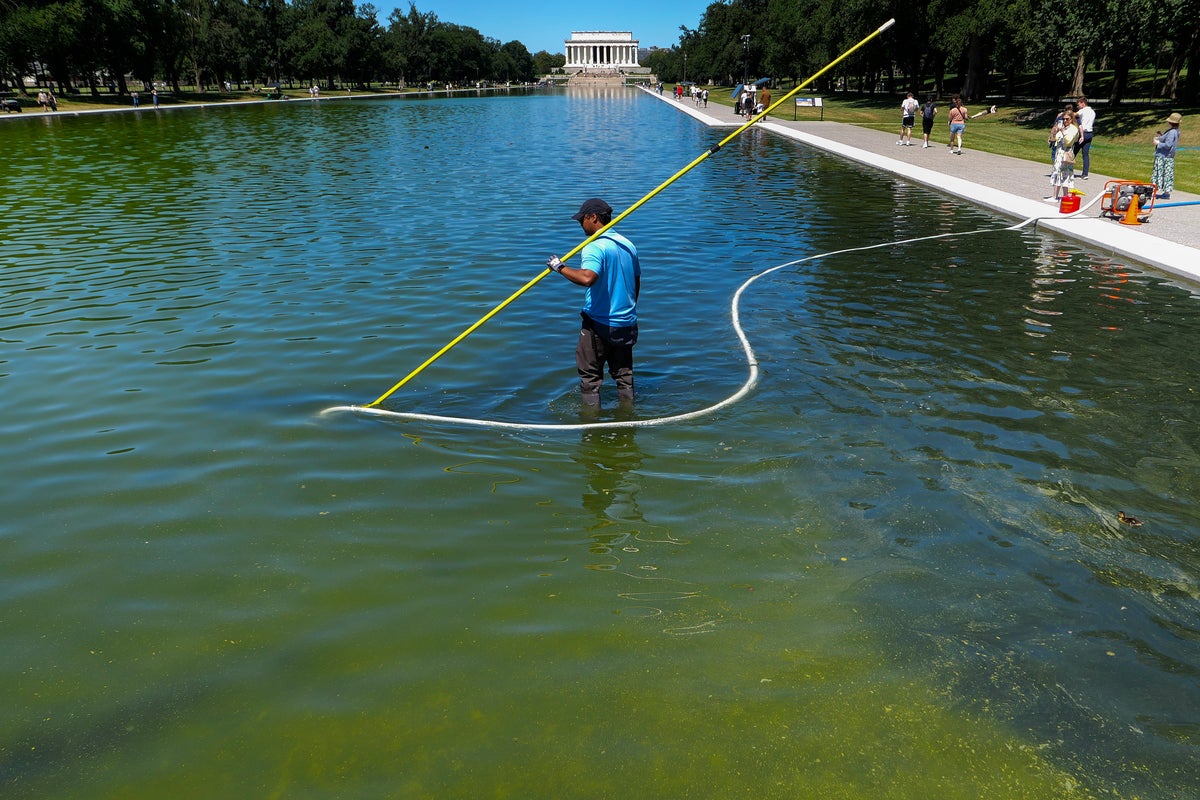
The Lincoln Memorial Reflecting Pool is a national stage designed to mirror the sky, but for years it has consistently mirrored a stagnant swamp instead. When millions of visitors arrive in Washington to stand where Martin Luther King Jr. spoke, they are frequently greeted by a thick, pea-green carpet of microalgae rather than a pristine sheet of glass. The federal government response to this recurring embarrassment has always relied on brute force engineering. The National Park Service regularly dumps chemical algicides into the water, deploys specialized skimming boats, or completely drains all six million gallons of water to manually scrub the concrete bottom. This endless cycle of chemical dependency and resource waste highlights a deeper failure in how modern institutions manage urban ecosystems.
A biological alternative exists, but it sits buried beneath layers of bureaucratic risk aversion. Ecological researchers have pointed out that the reflecting pool is essentially a giant, shallow, unshaded concrete bowl. It captures intense sunlight and accumulates heavy nutrient loads from urban runoff and migratory waterfowl. Instead of fighting these natural inputs with industrial chemicals that strip the water of all life, ecological engineering suggests introducing a keystone grazer. Daphnia magna, tiny freshwater crustaceans commonly known as water fleas, can consume their own weight in microalgae daily. They act as microscopic water purification plants. By establishing a managed population of these native organisms, the capital could transition from a costly, toxic maintenance cycle to a self-sustaining ecosystem.
The refusal to adopt biological management is not a failure of science. It is a failure of institutional imagination.
The Mechanics of the Green Sludge
To understand why the reflecting pool keeps failing, one must look at its design through the lens of limnology. The pool is exceptionally shallow, averaging only about three feet in depth. This shallow profile means that sunlight penetrates completely to the bottom, heating the water rapidly during Washington humid summer months. Warm water accelerates metabolic rates in photosynthetic organisms.
Nutrients fuel this engine. Hundreds of ducks and geese utilize the pool daily, depositing massive quantities of nitrogen and phosphorus directly into the system. High winds blow organic debris from the surrounding National Mall into the basin. When the federal government spent 34 million dollars to modernize the pool, the project updated the water supply system but failed to account for basic ecological realities. The system relies on a continuous intake of domestic city water, which is heavily treated with ozone to kill bacteria. This ozone treatment sanitizes the water initially, but it also creates a biological vacuum.
When algae spores inevitably arrive via wind or avian transport, they find an environment entirely free of competition. There are no plants to absorb the excess nutrients. There are no native zooplankton to graze on the nascent colonies. The algae population explodes exponentially. Within days, the water transforms from clear to opaque green. The high-tech filtration systems installed during the modernization phase quickly choke on the sheer volume of organic matter. The machinery was designed to filter out sediment, not a living, multiplying biomass.
The Chemical Carousel and Environmental Costs
The traditional engineering mindset views nature as something to be subdued through chemistry. When an algae bloom takes over, the immediate reaction is to apply chemical algicides, primarily copper sulfate or synthetic compounds. These chemicals work by disrupting the cellular walls of the algae, causing them to die and sink to the bottom.
This creates a hidden crisis at the base of the monument. As tons of dead algae decompose at the bottom of the pool, the process consumes vast amounts of dissolved oxygen. This sudden drop in oxygen levels can trigger localized ecological collapses. In past years, visitors have witnessed dead ducklings floating in the green scum, victims of avian botulism and toxic conditions fostered by stagnant, chemically treated water. The decomposing mass also releases the very nutrients that caused the bloom in the first place, ensuring that the next generation of algae has an abundant food supply the moment the chemical concentrations dissipate.
The financial cost of this approach is staggering. Draining six million gallons of municipal water is an exercise in environmental excess. It requires immense pumping power, thousands of man-hours of manual labor with pressure washers, and millions of gallons of fresh, treated drinking water to refill the basin. This cycle occurs multiple times a year. In a region that frequently faces summer drought warnings and water conservation mandates, the casual dumping of a small lake worth of treated water just to clear up an aesthetic blemish is unsustainable.
The Power of the Microscopic Grazer
The solution lies in shifting from chemical eradication to ecological balance. In natural ponds and lakes, clarity is maintained not by filters and chlorine, but by a complex web of predator and prey relationships. Daphnia sit at the center of this web. These organisms are filter feeders that use their specialized thoracic appendages to create a constant current, pulling water through their bodies to strain out suspended particles.
A single adult Daphnia can filter up to several milliliters of water per hour. When multiplied by millions across the surface area of the reflecting pool, the collective filtering capacity dwarfs that of the expensive mechanical systems currently housed in the underground pump rooms. They consume the exact species of single-celled green algae that turn the pool into an eyesore. As long as there is algae to eat, the population grows. When the food supply drops, their reproduction slows naturally.
This method has been tested successfully in urban water management across Europe and in various industrial wastewater treatment facilities. By utilizing biological control, managers can achieve long-term clarity without the spikes in toxicity associated with chemical applications. The water fleas convert the nuisance algae into animal biomass, which then becomes a harmless food source for local wild fish or birds, integrating the reflecting pool into the broader ecosystem of the Potomac river basin rather than keeping it isolated as a sterile, failing monument.
Why the Bureaucracy Chooses Waste
If the science behind bioremediation is so well-established, one must ask why the National Park Service continues to rely on hoses and chemicals. The answer lies in the nature of federal contracting and bureaucratic risk management.
Government agencies prefer predictable, mechanical solutions because they can be written into standardized service contracts. A contract can specify exactly how many pounds of chemical to dump or how many hours a crew must spend operating pressure washers. These are tangible, auditable metrics. Biological systems, by contrast, require nuance. They demand a shift from rigid scheduling to active ecological stewardship. If a population of Daphnia crashes due to a sudden temperature spike, a manager cannot simply sue the provider; they must understand the underlying water chemistry and adjust the environment accordingly.
There is also an aesthetic bias deeply ingrained in public works management. To a traditional facility manager, a pool filled with millions of tiny crustaceans sounds like an infestation. The idea of introducing "bugs" into a national monument goes against a century of training dedicated to keeping public spaces sterile and paved. This mindset conflates ecological health with artificial cleanliness. It assumes that a pool must be dead to look beautiful.
A New Blueprint for Public Spaces
Adopting a biological approach to the Lincoln Memorial Reflecting Pool would serve as a powerful demonstration of modern ecological engineering on a global stage. The transition would require minor modifications to the current infrastructure, such as creating small, protected zones along the edges of the pool where the zooplankton could shelter from extreme currents and breed safely.
The financial savings would be immediate. The cost of introducing a self-sustaining biological community is a tiny fraction of the annual expenditure required for chemical treatments and massive water changes. More importantly, it would eliminate the recurring public relations disaster of draining a national landmark during the peak of tourist season.
The capital cannot afford to keep fighting nature with a blank check. The persistent green sludge in the reflecting pool is a reminder that concrete and chemicals cannot override biological imperatives. By stepping away from the chemical carousel and allowing natural systems to do the work, the federal government could finally deliver a reflecting pool that truly reflects the ideals of the nation. It is time to let the water fleas do their job.