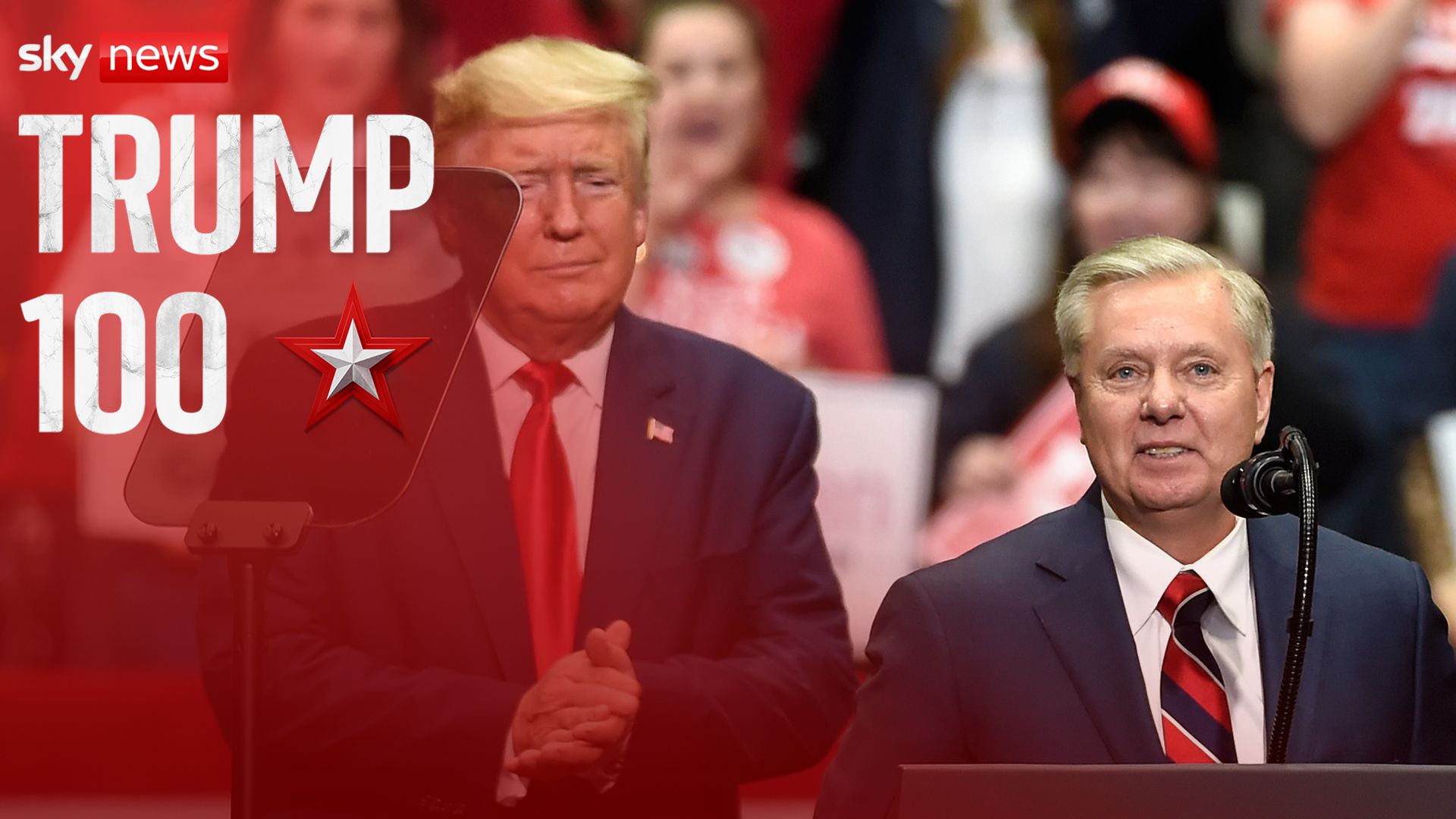
The unexpected death of Senator Lindsey Graham on July 11, 2026, strips Donald Trump of his most effective backchannel diplomat, legislative fixer, and political buffer. Graham was the rare political figure who successfully bridged the deep chasm between traditional Republican internationalism and the isolationist "America First" movement. His sudden passing leaves a massive vacuum in the administration's foreign policy apparatus, removes a critical shield for foreign allies like Ukraine and Israel, and leaves Trump uniquely vulnerable to the unmoderated, highly aggressive isolationist instincts of his own inner circle.
The Loss of the Golfer Diplomat
For nearly a decade, the relationship between Donald Trump and Lindsey Graham defied the laws of political gravity. They started as bitter enemies. During the 2016 primary campaign, Trump publicly broadcast Graham's private cell phone number to a raucous crowd, while Graham openly denounced Trump as a "jackass" and "unfit for office". Yet, when Trump took the oath of office, Graham did not retreat to the sidelines with his best friend and fellow hawk, the late John McCain. Instead, he made a cold, pragmatic calculation: to influence the president, one must have his ear.
He chose golf. Over hundreds of rounds, Graham mastered the art of managing a notoriously volatile president through strategic validation and proximity. He understood that Trump's decisions were rarely driven by rigid doctrine, but by personal loyalty and the last conversation he had with someone he trusted. Graham positioned himself to always be that last voice.
He is gone. The immediate vacuum left by his sudden death will not be easily filled by any aspiring neoconservative, because Graham's influence was never about ideological purity, but rather about a highly calculated, deeply personal style of persuasion that resonated with the president. Where other traditional Republicans lectured Trump on the liberal international order, Graham spoke the language of transactions, polls, and personal legacy. He convinced Trump that supporting key alliances was not a matter of global altruism, but a way to look strong on the world stage.
Without Graham, Trump is left without his primary translator. The remaining crop of congressional Republicans consists of two camps: those who are terrified of Trump's base and will nod along to any foreign policy decision, and those who actively want to dismantle America's global commitments. Graham was the only figure who could tell Trump "no" in a way that sounded like "yes."
The Collapse of the Ukraine Support Network
Nowhere is the panic more acute than in Kyiv. Just hours before his aortic dissection on Capitol Hill, Graham had returned from his tenth trip to Ukraine since the 2022 Russian invasion. He had just finalized a complex, fragile understanding with the Trump administration to advance a new package of Russia sanctions. Ukrainian President Volodymyr Zelenskyy, who spent years cultivating Graham as a lifeline to the Republican party, recognized that Graham was the crucial lever holding back the isolationist tide in Washington.
The deal is dead. Without Graham's tireless advocacy, the coalition of traditional defense-minded Republicans in the Senate is leaderless and fractured. He was the chief architect of the argument that arming Ukraine was a cost-effective way to degrade the Russian military without spilling American blood—an argument designed specifically to appeal to Trump's transactional worldview.
With Graham removed from the equation, the path of least resistance for the administration is to freeze or drastically curtail aid to Kyiv. Vice President JD Vance has made his opposition to Ukraine funding a cornerstone of his political identity. In the past, Graham served as a massive counterweight to Vance in the Oval Office, arguing that abandoning Kyiv would make Trump look weak—the one outcome Trump fears above all else. Now, Vance and the isolationist wing have an open field. The traditional Senate defense establishment, led by figures like John Thune and Mitch McConnell, lacks the personal rapport with Trump required to win these backroom debates.
Israel and the Middle East Without a Guardian
In Jerusalem, the reaction to Graham's death was one of profound, quiet dread. Prime Minister Benjamin Netanyahu lost his most reliable champion in Washington, a man who could bypass the State Department and the National Security Council to deliver messages directly to the president's cell phone. Graham was a fierce proponent of maximum pressure on Iran, frequently pushing for aggressive diplomatic cover for Israeli military operations.
The channel is broken. While Trump remains publicly supportive of Israel, his personal relationship with Netanyahu has been notoriously mercurial since 2020. Graham was the diplomat who smoothed over these personal rifts, ensuring that personal friction did not translate into a reduction in security assistance or diplomatic backing.
More importantly, Graham was the architect of the congressional push to expand the Abraham Accords. He spent years traveling to Saudi Arabia, meeting with Crown Prince Mohammed bin Salman to negotiate a trilateral deal that would normalize relations between Riyadh and Jerusalem in exchange for a U.S. defense treaty. This was an incredibly complex diplomatic jigsaw puzzle that required selling a defensive treaty to a skeptical Republican base. Graham was the only senator with the credibility among conservatives to pull it off. Without his legislative muscle and diplomatic maneuvering, the grand bargain in the Middle East is likely to stall, leaving Trump's regional strategy without a clear anchor.
The Internal Balance of Power Shifts to the New Guard
The true significance of Graham's passing lies in the shifting dynamics of the Republican party. For decades, the party was defined by an aggressive, interventionist foreign policy. Graham was the last surviving member of the "Three Amigos"—alongside John McCain and Joe Lieberman—who championed this globalist vision of American power. With all three now gone, the transition of the GOP into a purely populist, protectionist party is virtually complete.
The new guard has arrived. Figures like JD Vance, Kash Patel, and a host of populist commentators now command the narrative surrounding foreign intervention. They view the post-World War II alliance system not as an asset, but as a burden. Graham's presence in Trump's ear was a constant irritation to this faction because he possessed the unique ability to unravel their arguments in a single golf outing.
This shift will manifest in concrete policy changes. We are likely to see a rapid acceleration of attempts to scale back the U.S. presence in NATO, a more permissive attitude toward Russian expansionism, and a chaotic approach to trade tariffs that ignores the warnings of traditional economists. Graham understood that global stability was directly tied to American economic prosperity. The new populist advisors surrounding Trump view global instability as someone else's problem, failing to realize how quickly regional conflicts can drag the United States into broader economic and military crises.
The Legislative Mechanics That Can't Be Replaced
Beyond the high-stakes foreign policy debates, Graham was a master of the mundane, grinding work of the Senate. He knew where the levers of power were located and how to pull them to get Trump's nominees confirmed and his legislative agenda passed. His performance during the Brett court confirmation hearings in 2018 is legendary within the party—a display of raw, furious partisan defense that single-handedly saved a supreme court nomination on the brink of collapse.
That institutional memory is gone. The Senate is increasingly populated by performance-art politicians who are highly skilled at generating viral social media clips but completely illiterate when it comes to the actual drafting of legislation. Graham knew how to write a bill, how to trade a committee assignment for a vote, and how to use the budget process to fund defense priorities.
South Carolina Governor Henry McMaster will appoint a temporary successor to fill Graham's seat, and a special election will follow. But a newly appointed senator cannot inherit Graham's decades of accumulated relationships, his deep knowledge of the tax code, or his seat on the Senate Judiciary and Budget committees. Trump has lost his legislative battering ram. The administration's domestic agenda, already facing a narrow and fragile majority in the upper chamber, just lost its most effective captain.
The tragedy of Graham's political career was his willingness to sacrifice his long-held principles on the altar of access. He believed that by staying close to the flame, he could control the fire. Now that he is gone, the fire burns unchecked, and the presidency he sought to guide is left to navigate a dangerous, fragmented world entirely on its own.