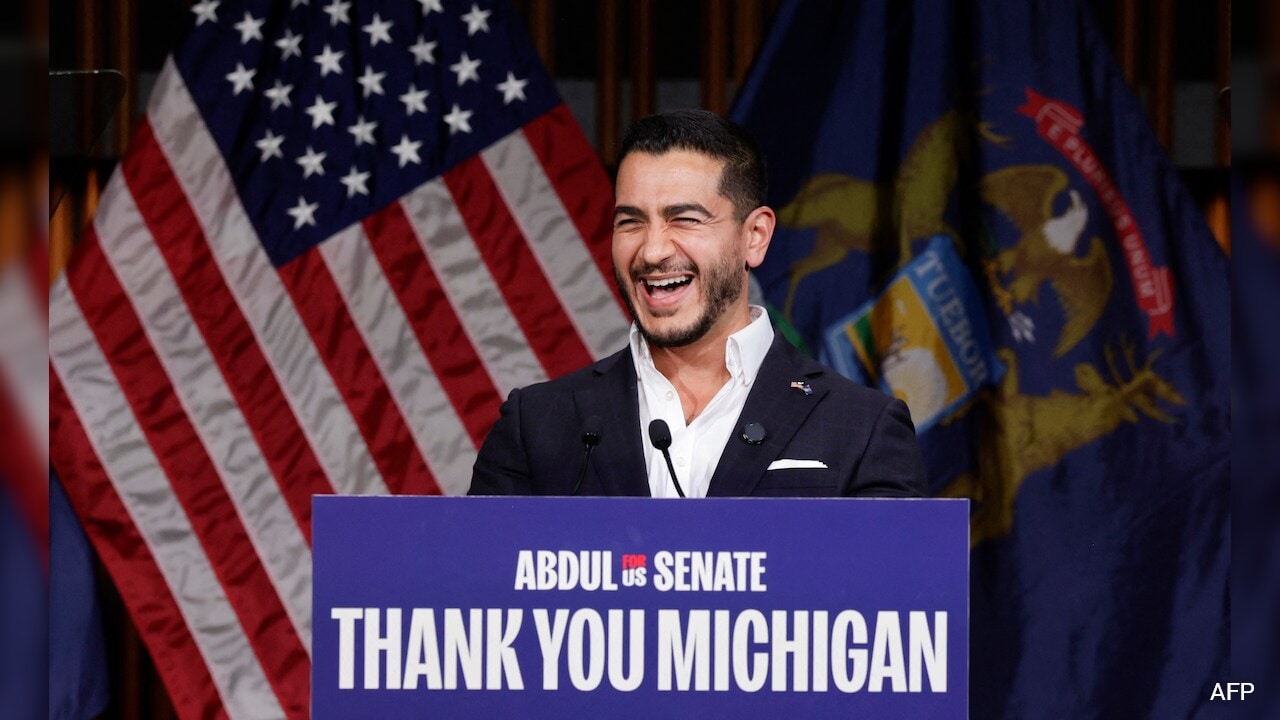
Political rhetoric during high-stakes midterm cycles functions primarily as an asymmetric signaling mechanism designed to consolidate base turnout while provoking unforced errors from opposition leadership. When progressive figure Abdul El-Sayed deployed the phrase "JD, Habibi" toward Vice President JD Vance following a midterm electoral victory, the remark operated far beyond casual internet banter. It executed a deliberate cultural framing strategy that converts complex demographic and ideological tensions into a single, easily replicated linguistic unit.
Most political coverage treats viral post-election jibes as ephemeral media spectacles. That analytical failure misses the structural mechanics of modern campaign communication. A targeted, culturally specific salutation directed at a sitting Vice President serves three distinct operational functions: it asserts demographic legitimacy within contested battleground states, it forces the target into a lose-lose communicative bind, and it bypasses traditional editorial gatekeepers through algorithmic amplification.
The Architecture of Asymmetric Cultural Signaling
To understand why a two-word jibe generates disproportionate political friction, analysts must examine the mechanics of in-group signaling versus out-group provocation. In political communication theory, signals are categorized by their cost and their target audience. A low-cost signal—such as a standard policy talking point—carries minimal risk but yields negligible organic reach. A high-contrast cultural signal carries elevated risk of alienating unaligned voters, yet it generates immediate solidarity among core constituencies.
In-Group Consolidation Through Vernacular Adoption
The Arabic term habibi—literally translating to "my love" or "my dear," and functioning colloquially across Middle Eastern and South Asian communities as an expression of warmth, familiarity, or wry affection—carries specific socio-political weight in states like Michigan. Arab American and Muslim voters represent a decisive swing bloc in Midwestern electoral math, particularly in Wayne and Oakland counties.
By addressing JD Vance—a figure whose political brand relies heavily on Rust Belt cultural populism and strict national identity framing—with an Arabic colloquialism, El-Sayed accomplished two immediate objectives:
- Status Inversion: Traditional political hierarchy places the sitting Vice President in a position of institutional dominance. Addressing that officeholder with a term of casual, familiar affection flattens the power dynamic, framing the national executive as a peer subject to local cultural norms rather than an unassailable authority.
- Constituency Validation: Following electoral cycles marked by intense friction between Arab American communities and national party establishments over foreign policy and domestic rhetoric, the public deployment of native vernacular on a national stage signals unapologetic cultural presence. It tells a specific demographic bloc that their linguistic identity is an asset in victory rather than a liability to be muted during general elections.
The Double-Bind Mechanism for the Target
The strategic efficiency of a culturally coded jibe lies in the asymmetry of the response options available to the target. When a national figure like Vance is addressed with "JD, Habibi" in the wake of a Democratic midterm win, his communications apparatus faces a constrained decision tree with no optimal exit:
- The Dismissal Option: Ignoring the remark allows the framing to circulate unchallenged across digital ecosystems, reinforcing the narrative of momentum and cultural confidence for the opposing coalition.
- The Literal Counter-Attack: Responding aggressively to the use of an Arabic term risks validating opposition claims of cultural intolerance, providing adversaries with fresh material to mobilize minority and younger voters in subsequent cycles.
- The Ironic Co-optation: Attempting to mirror the vernacular often reads as inauthentic to core populist supporters while failing to persuade the demographic that originated the term.
This structural trap explains why insurgent political communicators favor culturally specific humor over conventional policy critiques. Policy debates allow the target to retreat to prepared talking points and favorable statistical framing. Cultural jibes force the target to navigate terrain governed by tone, authenticity, and social subtext—variables that traditional political messaging teams struggle to control.
Electoral Geography and the Rust Belt Context
Abstract communication theory only matters when mapped onto physical electoral terrain. The intersection of Abdul El-Sayed’s political base and JD Vance’s regional portfolio creates a specific geographic friction point: the industrial Midwest.
Vance’s elevation to the vice presidency was predicated on his ability to lock down working-class voters across Pennsylvania, Michigan, and Wisconsin. His political identity is anchored in the narrative of the forgotten heartland, a framing that traditionally treats urban, multicultural coalitions as fundamentally distinct from the authentic Rust Belt electorate.
El-Sayed, operating out of Michigan as a physician, public health official, and progressive organizer, represents a direct counter-narrative to that demographic sorting. His political brand merges standard economic populism—universal healthcare, labor protections, corporate accountability—with an explicitly pluralistic cultural identity. When a figure embodying that synthesis claims victory in a midterm cycle and directs a culturally coded remark at the administration's primary Rust Belt messenger, the subtext is territorial. It challenges the premise that Midwestern populism belongs exclusively to cultural conservatives.
The Shift from Defensive Assimilation to Offensive Framing
Historically, minority candidates in statewide or national contests operated under a doctrine of defensive assimilation. Strategic orthodoxy dictated minimizing linguistic, religious, or cultural markers that differed from the historical median voter to prevent opposition campaigns from weaponizing "otherness."
Recent midterm dynamics demonstrate an inversion of that doctrine. Three structural shifts explain why defensive assimilation is losing strategic viability:
- Fragmentation of the Mass Audience: The decline of monolithic broadcast television means candidates no longer need to optimize every utterance for a single, homogeneous audience. Micro-targeted digital distribution rewards high-contrast cultural markers that drive engagement within specific networks.
- The Authenticity Premium: Modern electorates exhibit acute sensitivity to focus-grouped, sanitized speech. Voters across ideological lines increasingly equate unvarnished cultural expression with authenticity, even when they disagree with the speaker's policy platform.
- Demographic Realignment: In key swing districts, turnout differentials among younger and non-white voters often exceed the total margin of victory. Mobilizing these cohorts requires affirmative cultural signaling rather than cautious neutrality.
El-Sayed’s remark operates squarely within this post-assimilation framework. Rather than softening his cultural background to appeal to traditional swing voters, he weaponized it as an instrument of political confidence following a measurable electoral win.
Algorithmic Amplification and the Attention Economy
A post-election remark only achieves national relevance if it survives the filtering mechanisms of modern media distribution. The phrase "JD, Habibi" succeeded because it was engineered—intentionally or intuitively—for maximum velocity across both algorithmic social platforms and legacy political press.
Compression Ratio in Political Messaging
In digital media environments, message survival depends on its compression ratio: the amount of ideological, emotional, and cultural context packed into the fewest possible syllables. Long-form policy arguments suffer from high friction; they require sustained reader attention and are easily distorted when excerpted.
A two-word salutation achieves near-zero friction. It fits effortlessly into headlines, social media captions, and broadcast chyrons. At the same time, it carries high semantic density. To an uninitiated observer, it reads as a quirky, personalized greeting. To an engaged political participant, it encapsulates debates over foreign policy, domestic inclusion, Rust Belt populism, and the balance of power following a midterm election.
Earned Media Arbitrage
Campaigns spend tens of millions of dollars attempting to purchase name recognition and frame narratives through paid advertisements. Paid media, however, suffers from declining conversion rates due to voter ad fatigue and platform fragmentation.
Earned media arbitrage occurs when a political actor generates millions of dollars in equivalent broadcast and digital exposure through a zero-cost communicative act. By pairing a high-profile target (the Vice President) with an unexpected cultural signifier (habibi) immediately after a concrete news hook (a midterm victory), the statement satisfies every criterion of modern newsroom selection:
- Conflict: It establishes an immediate interpersonal clash between a rising progressive voice and a sitting national executive.
- Novelty: The juxtaposition of standard American political titles with Arabic colloquialism breaks the predictable cadence of post-election statements.
- Visual and Audio Hook: The phrase is phonetically distinct and easily repeatable in broadcast segments, ensuring high retention among passive news consumers.
Limitations and Strategic Risks of Viral Provocation
While culturally coded jibes offer substantial short-term advantages in attention capture and base mobilization, treating them as a comprehensive electoral strategy introduces severe structural vulnerabilities. Rigorous political analysis requires separating tactical wins from long-term strategic durability.
The Ceiling of Base Mobilization
Viral moments excel at increasing enthusiasm among voters already inclined to support the speaker. They perform poorly at persuading undecided or cross-pressured voters who prioritize economic stability, governance competence, or specific legislative outcomes. If a political movement relies disproportionately on cultural signaling at the expense of material policy delivery, it risks hitting an insurmountable demographic ceiling in statewide or national contests.
Polarizing the Persuasion Electorate
In tightly contested districts, victories depend on capturing a narrow slice of moderate or politically disengaged voters. High-contrast cultural rhetoric can inadvertently alienate these cohorts if they perceive the messaging as exclusionary or overly focused on identity dynamics rather than shared economic concerns. The same linguistic marker that generates intense solidarity within an in-group can trigger skepticism among out-group voters if not paired with universalist material appeals.
Ephemeral Attention vs. Institutional Power
Digital virality decays rapidly. Within seventy-two hours, the news cycle moves to new controversies, legislative battles, or economic indicators. A clever jibe creates a momentary spike in name recognition, but it does not build precinct-level organizing infrastructure, secure committee assignments, or pass legislation. Political actors who confuse algorithmic engagement with durable institutional power consistently underperform in subsequent cycles when opponents adjust their defensive posture.
Operationalizing Post-Midterm Rhetorical Momentum
For political strategists and communication directors analyzing the fallout of this exchange, the lesson is not to manufacture artificial catchphrases. Forced vernacular invariably backfires, exposing the speaker to ridicule and eroding credibility. Instead, the operational takeaway lies in how cultural confidence is integrated into broader campaign architecture.
To convert a high-visibility rhetorical moment into sustained electoral advantage, political operations must execute a three-stage conversion process immediately following the initial media spike:
- Anchor the Signal to Material Policy: Within twenty-four hours of a viral cultural moment, follow-up communications must pivot directly to concrete economic or governance issues—healthcare costs, infrastructure investment, or labor protections. The cultural jibe opens the attention window; the policy message justifies the audience's continued engagement.
- Capture the Data Exhaust: High-engagement social moments generate massive spikes in profile visits, video views, and secondary shares. Digital teams must deploy immediate list-building infrastructure—petitions, rapid-response fundraising appeals, and volunteer sign-ups—to convert passive observers into owned contact records before the news cycle shifts.
- Establish Narrative Discipline Across Surrogates: Once a framing achieves traction, allied communicators should avoid over-explaining or apologizing for the vernacular. Over-analysis strips the remark of its effortless confidence. Surrogates should treat the cultural expression as entirely normal while keeping formal interviews focused on the substantive electoral mandate demonstrated by the midterm results.
Political communication in polarized environments will increasingly favor actors who can navigate multiple cultural registers without losing strategic focus. The deployment of "JD, Habibi" in the wake of a midterm victory illustrates that linguistic authenticity, when timed to coincide with concrete electoral success, remains one of the most efficient tools for disrupting established power hierarchies and capturing the modern attention economy.