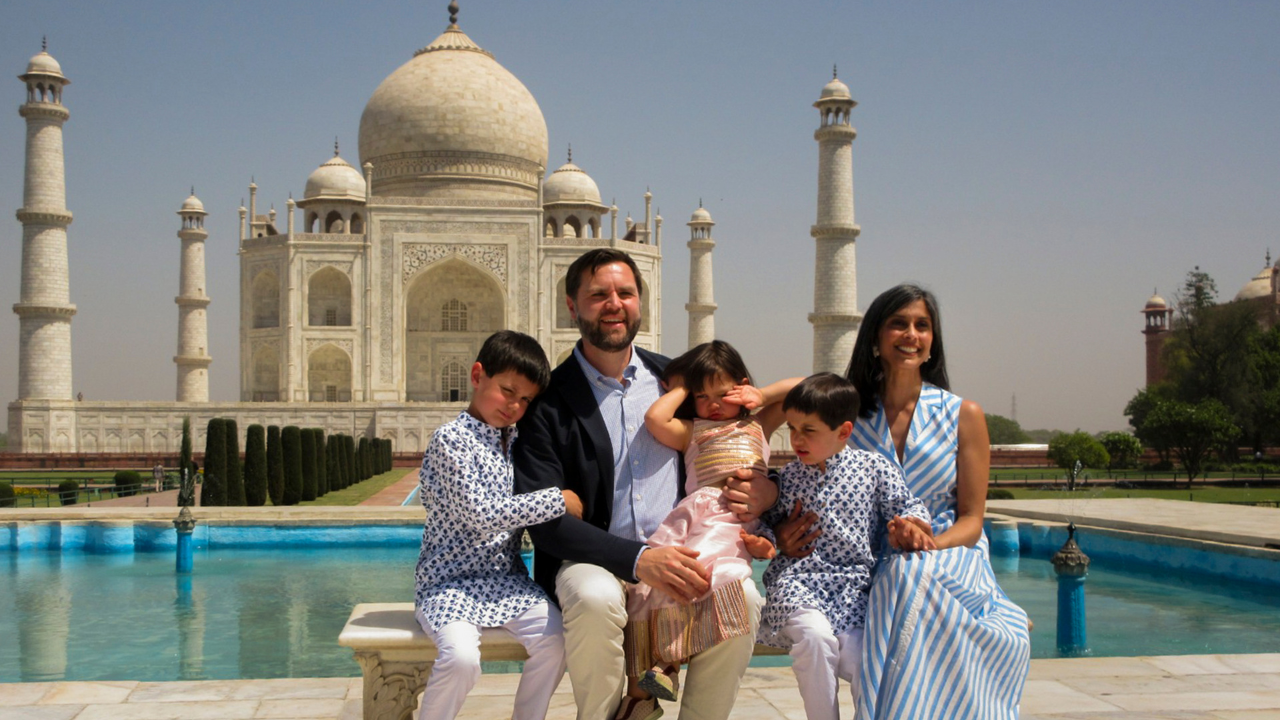
The scent of turmeric and cumin doesn't care about the strictures of a political platform. It drifts from the kitchen, clings to the curtains, and settles into the fibers of a sweater regardless of whether the person wearing it is drafting a memo on border security or arguing about the federal deficit. This is the quiet reality of the American dinner table. It is where the macro-level abstractions of "immigration policy" and "national identity" collide with the micro-level reality of a mother-in-law’s cooking.
JD Vance, a man whose public persona is often defined by a sharp, populist edge, lives in this collision every single day.
When he speaks about his wife, Usha Chilukuri Vance, and her immigrant parents, the rhetoric of the stump speech softens into something far more intimate. He isn't just talking about statistics or labor markets. He is talking about the people who helped raise his children. He is talking about the "great contributors" who happen to be his family. This isn't a mere political pivot; it’s a window into the messy, beautiful, and often contradictory way we actually live our lives in a globalized age.
The Paperwork and the Pulse
To understand the weight of the current immigration debate, one must look past the grainy footage of border crossings and the sterile halls of DC. Look instead at a suburban living room. Picture a hypothetical family—let’s call them the Kumars. They arrived in the eighties with two suitcases and a degree that didn't quite translate to American credentials. They spent a decade working double shifts, navigating the labyrinth of the H-1B visa, and worrying that a single clerical error could send them back to a life they no longer recognized.
This is the "merit-based" ideal often cited in policy papers. But for the Kumars, it wasn't an ideal. It was a marathon. When Vance speaks of his in-laws, he is nodding to this specific demographic: the highly educated, high-achieving Indian-American community that has become a pillar of the American professional class.
Yet, there is a tension here.
Vance has built a political identity on the idea that the American working class has been left behind by a globalist elite. He has campaigned on the necessity of tight borders and the protection of the domestic labor pool. Critics often point to this as a contradiction. How can you be the champion of "America First" while your own home is a testament to the success of global migration?
The answer lies in the distinction Vance draws between the system and the individual. In his view, loving his Indian-origin in-laws isn't a betrayal of his base; it is an affirmation of what he believes the system should produce. He sees them not as "immigrants" in the abstract, but as people who bought into the American contract and over-delivered on their end of the bargain.
The Cultural Ledger
We often speak of immigration in terms of economics—tax bases, GDP growth, and social services. These are the cold facts. But there is a cultural ledger that is much harder to quantify.
Consider the "in-law factor." In many traditional cultures, the extended family isn't an optional add-on; it is the foundation of the home. When Usha Vance’s parents enter the picture, they aren't just guests. They are a bridge to a history that stretches back thousands of years, offering a counterweight to the often-rootless nature of modern American life.
Vance has often written about the chaos of his own upbringing, documented famously in his memoir. For a man who grew up in the shadow of addiction and familial instability, the structured, achievement-oriented, and deeply connected nature of his wife’s family must feel like a revelation. It is a different kind of American dream—one that values stability and tradition over the frantic reinvention of the self.
This creates a fascinating irony. The "traditional values" that many conservative voters crave are often most visibly practiced by the very immigrant communities that those same voters are told to fear.
The Stakes of the Conversation
The danger of the current immigration debate is that it tends to flatten human beings into two-dimensional characters. On one side, you have the "invader." On the other, the "victim." Neither is true.
The reality is more like the Vance household: a blend of heritage, ambition, and the daily grind of domestic life. When Vance defends his in-laws against the more vitriolic elements of his own movement, he is performing a delicate balancing act. He is trying to hold onto a populist mandate while protecting the people he loves.
It is a reminder that policy is never just about numbers. Every visa approved or denied is a change in the chemistry of a neighborhood. Every debate about "merit" is a debate about who we think deserves to sit at our table.
Logic dictates that a country must have borders. A nation that cannot define its edges cannot define itself. But the human heart dictates that once someone is inside those borders, once they have woven their story into the national fabric, they are no longer "the other." They are the grandmother teaching a child a word in a different language. They are the neighbor who brings over a dish you can't quite pronounce but can't stop eating.
The Invisible Bridge
Vance’s position is an attempt to build a bridge between two seemingly irreconcilable worlds. On one side is the rust-belt resentment of a forgotten workforce. On the other is the soaring success of the immigrant professional class.
He is betting that he can convince his followers that these two groups aren't natural enemies. He is trying to argue that the "great contributors" like his in-laws are the partners of the American worker, not their replacements.
It is a difficult sell.
In a world of soundbites and social media outrage, nuance is a liability. It is much easier to be purely for or purely against. But life doesn't happen in the extremes. It happens in the middle, in the quiet moments of shared meals and mutual respect.
The invisible stakes of this debate aren't just about who gets to come here. They are about what kind of people we become based on how we treat those who do. If we lose the ability to see the "great contributor" in the stranger, we lose a part of the American soul that has always been our greatest strength.
Vance sits at his table, perhaps watching his children interact with their grandparents. He sees the confluence of the Ohio River and the Ganges. He sees the struggle of the hillbilly and the ambition of the immigrant meeting in a single DNA strand.
The debate will continue. The rhetoric will sharpen. The polls will fluctuate. But the smell of the cooking in the kitchen remains. It is a stubborn, fragrant reminder that before we were a census report, we were a family.
We are still trying to figure out how to be both.
The sun sets over a house where two worlds have become one, and the only thing that matters is the weight of the child sleeping in a grandfather’s arms, oblivious to the fact that his very existence is a political statement.