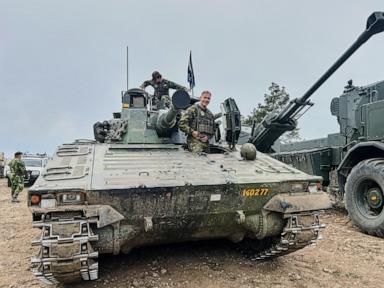
The North Atlantic Treaty Organization currently faces a dual-axis stress test that exposes the gap between political rhetoric and operational friction. This friction is not merely a byproduct of Russian kinetic aggression but a structural failure in the "Just-in-Time" defense model adopted by Western powers post-1991. The ongoing war games—specifically focused on the Suwalki Gap and the Nordic corridors—serve as a diagnostic tool for three critical vulnerabilities: the reliability of the United States as a primary security guarantor, the atrophy of European heavy-lift logistics, and the integration of autonomous attrition technology.
The Triad of Modern Attrition Warfare
Western defense strategy has historically prioritized technological overmatch to achieve rapid, decisive victories. Current theater simulations indicate this model collapses in high-intensity, protracted conflicts where mass precedes sophistication. To understand the current NATO maneuvers, one must evaluate them through a framework of three distinct pillars:
- The Logistics Bottleneck (The Pavement Variable): The ability to move heavy armor (M1 Abrams, Leopard 2) across European rail networks that are often incompatible with modern weight requirements or standardized gauge systems.
- The Credibility Discount (The Political Variable): The mathematical probability of U.S. intervention based on shifting domestic isolationist sentiment, which forces European allies to price in a "sovereign defense premium."
- The Electronic Warfare (EW) Horizon (The Technical Variable): The degradation of GPS-dependent munitions in a contested electromagnetic environment, rendering high-cost precision strikes less effective than low-cost, high-volume saturation.
Strategic Depth and the Suwalki Constraint
The Suwalki Gap—a 60-mile strip of land along the Polish-Lithuanian border—remains the most volatile geographic chokepoint in the European theater. It represents a binary outcome: if the Gap is closed by Russian forces in Kaliningrad and Belarus, the Baltic States are effectively severed from land-based reinforcements.
NATO’s current simulations aim to solve for the Time-to-Force-Closure (TFC). This is the duration required to move a Brigade Combat Team (BCT) from staging areas in Germany to the front lines in Poland. The primary constraint is not speed, but throughput. European infrastructure—bridges, tunnels, and railheads—has a finite weight capacity. Most German bridges are rated for Military Load Class (MLC) 70, yet a fully up-armored M1A2 SEPv3 Main Battle Tank exceeds this when factoring in the heavy-equipment transporter. This creates "Logistical Dead zones" where armor must be rerouted, extending TFC and allowing the adversary to consolidate gains.
The Calculus of U.S. Disengagement
The European "Pivot to Self-Reliance" is no longer a theoretical exercise but a forced response to the erosion of the U.S. security umbrella. Defense analysts use the Strategic Reliability Index to measure the likelihood of a guarantor fulfilling Article 5 obligations. When the U.S. signals a shift toward the Indo-Pacific, the "deterrence value" of its stationed troops in Europe decreases.
European allies are responding by diversifying their procurement away from purely U.S.-centric platforms. The acquisition of South Korean K2 Black Panther tanks by Poland serves as a case study in supply chain de-risking. By diversifying the manufacturing base, Poland reduces its exposure to U.S. Congressional gridlock. The war games are designed to test if these non-standardized fleets—comprised of American, German, British, and South Korean hardware—can actually communicate via Link 16 or other tactical data links. Incompatibility in these systems creates "Data Silos," where units are unable to share target acquisition data in real-time, leading to fratricide risks and operational paralysis.
The Kinetic-Digital Convergence
Modern warfare has transitioned from a contest of platforms (tanks vs. tanks) to a contest of kill chains (sensor-to-shooter loops). Russia’s integration of long-range precision fires with Orlan-10 UAVs has forced NATO to rethink its deployment density.
In previous decades, NATO relied on centralized Command and Control (C2). Current maneuvers test Distributed Command, where small, autonomous units operate under mission command principles without constant uplink to headquarters. This is a direct response to Russian Electronic Warfare (EW) capabilities, which can triangulate high-power radio emissions within seconds.
The technical challenge lies in the Signal-to-Noise Ratio in contested environments. If an infantry squad cannot use encrypted satellite communications (SATCOM) due to jamming, they must revert to high-frequency (HF) radio or physical runners. This regression in communication speed drastically increases the "OODA Loop" (Observe, Orient, Decide, Act) timing, giving a localized advantage to an aggressor who is willing to accept higher attrition rates.
The Economic Barrier to Sustained Readiness
A critical failure in the competitor’s analysis is the omission of the Defense Industrial Base (DIB) capacity. Readiness is not just a function of soldiers in the field; it is a function of "Shell-per-Day" production.
- Consumption vs. Production: At the height of recent conflicts, the daily consumption of 155mm artillery shells exceeded the monthly production capacity of the United States and Europe combined.
- Stockpile Atrophy: Decades of peace dividends led to the decommissioning of manufacturing lines for Stinger and Javelin missiles. Restarting these lines involves "Cold-Start Friction," where specialized labor and rare-earth mineral supply chains must be rebuilt from scratch.
The war games provide a stress test for the Interoperability of Munitions. Historically, a 155mm shell from a French Caesar howitzer might not function perfectly in a German PzH 2000 due to differing propellant charges or fuzing mechanisms. NATO is now pushing for "Interchangeability," a higher standard where every member’s munitions are 100% compatible across all platforms. Without this, logistics becomes a fragmented nightmare where specific shells must find specific guns across a 1,000-mile front.
The Nordic Expansion and the Arctic Flank
The accession of Finland and Sweden has fundamentally altered the Baltic Sea’s maritime geometry. What was once a contested waterway is now effectively a "NATO Lake," but this creates a new set of requirements for sub-arctic warfare.
The Nordic Defense Model emphasizes "Total Defense," where civilian infrastructure is pre-integrated into military planning. Unlike the U.S. model, which relies on dedicated military bases, the Finnish model utilizes highway strips for fighter jet sorties and civilian warehouses for ammunition caches. NATO maneuvers in the High North are currently testing how to scale this decentralized model to larger multinational forces.
The Arctic environment introduces the Thermal Degradation Factor. Battery life for drones, sensors, and communication gear drops by 40-60% in sub-zero temperatures. Lubricants in small arms and vehicle engines thicken, leading to mechanical failures. If NATO cannot solve for "Extreme Cold Weather Operations" (ECWO), its presence in the Arctic remains a seasonal capability rather than a year-round deterrent.
Asymmetric Threats and the Gray Zone
Russia’s strategy often bypasses kinetic confrontation in favor of "Gray Zone" tactics—actions that fall below the threshold of open conflict but erode social and structural stability. This includes:
- GPS Spoofing: Interfering with commercial aviation and maritime navigation in the Baltic Sea to create economic friction.
- Undersea Infrastructure Vulnerability: The targeting of fiber-optic cables and gas pipelines (e.g., Nord Stream, Balticconnector).
- Instrumented Migration: Using human flows to overwhelm border security and trigger political instability in frontline states.
NATO’s current exercises are beginning to incorporate these non-kinetic variables. The challenge is that Article 5—the "an attack on one is an attack on all" clause—is legally ambiguous regarding cyber or hybrid attacks. If a Russian state-sponsored actor shuts down the Polish power grid during a troop mobilization, does that constitute an act of war? The lack of a defined "Cyber Threshold" creates a strategic vacuum that the Kremlin is actively exploiting.
The Intelligence Paradox in the Age of Transparency
Open-source intelligence (OSINT) has moved the "Fog of War" from a lack of information to an overabundance of it. During the maneuvers, every tank movement is tracked by commercial satellite imagery and shared on social media in near real-time. This eliminates the possibility of operational surprise.
NATO is now forced to adopt Signature Management as a primary tactical discipline. This involves:
- Multispectral Camouflage: Hiding the heat signature of vehicles from thermal sensors.
- Emissions Control (EMCON): Strict silence on all electronic devices to prevent detection by signals intelligence (SIGINT).
- Decoy Proliferation: Using inflatable or low-cost robotic decoys to force the adversary to waste high-cost munitions on false targets.
The cost-exchange ratio here is vital. If NATO can use a $5,000 decoy to draw a $2 million Kalibr cruise missile, it wins the economic war of attrition even if it loses the physical asset.
Tactical Realignment and Future Procurement
The data gathered from these war games suggests a mandatory shift in European procurement. The era of the "Peace Dividend" is over, and the "Efficiency-First" model of military logistics is dead. To maintain a credible deterrent, European powers must transition to a Resilience-First model.
The strategic play is the immediate federalization of European defense production. Individual nations can no longer afford to maintain bespoke platforms. Standardization must move from a suggestion to a requirement. This includes the development of a unified "European Main Battle Tank" and a standardized "Long-Range Strike Missile" to reduce dependency on the U.S. Foreign Military Sales (FMS) program.
Furthermore, the integration of AI-driven logistics is necessary to manage the complexity of a 32-nation supply chain. Predictive maintenance algorithms can identify vehicle failures before they occur, reducing the "Down-Time" of critical armor. However, this creates a new vulnerability: the "Data Backbone." If the AI managing the logistics is compromised by a cyber intrusion, the entire reinforcement schedule collapses.
The final strategic move for NATO is the establishment of "Permanent Forward Deployment" in the Baltic region. The current "Tripwire" strategy—where a small force is meant to be sacrificed to trigger a larger response—is no longer sufficient given the speed of modern Russian "A2/AD" (Anti-Access/Area Denial) capabilities. Only a "Defense-by-Denial" posture, where the territory is never lost in the first place, can counter the current Kremlin calculus. This requires a permanent shift of the NATO center of gravity from the Rhine to the Vistula.