The pre-dawn air in Toronto on an early June morning carries a specific, fleeting stillness. It is the brief window where the city pauses, caught between the late-night hum of the highway and the first rattle of the morning streetcars. Most people are asleep, completely unaware of the invisible lines connecting their neighborhoods to global flashpoints thousands of miles away.
But at 5:40 a.m. inside an apartment building near Trethewey and Black Creek drives, that stillness shattered.
Gunfire in a fourth-floor hallway ended the life of Constable Marc Pinizzotto. He was 43 years old, an 18-year veteran of the Toronto Police Service, a former professional hockey player in Europe, and a father to 14-year-old twins. When he walked out of his home the night before, his family expected him to return for breakfast. Instead, his name became the latest entry in a grim, expanding ledger of local lives claimed by geopolitical fractures.
To understand why an Emergency Task Force officer died on Martha Eaton Way, you have to trace a line back to March. You have to look at the reinforced glass and limestone facade of the United States Consulate on University Avenue.
The Echo of the First Shot
Geopolitics is often treated as an abstraction. We read about shifting alliances, international sanctions, and military conflicts on our screens, viewing them as distant storms. Consider what happens when those storms drift across borders.
In late February, military actions involving the United States, Israel, and Iran sent shockwaves through international diplomatic circles. In Toronto, those shockwaves materialized as physical violence. Within a single week, gunfire targeted two local synagogues. Then, at 4:30 a.m. on a quiet March morning, a white Honda SUV pulled up outside the U.S. Consulate. Two figures stepped out, fired multiple rounds into the diplomatic building, and sped away into the dark.
No one was hurt that morning. The damage was confined to shattered glass and scarred stone. The public moved on, viewing it as an isolated act of vandalism or a reckless protest.
But federal and local investigators recognized the underlying current. The U.S. Department of Justice eventually linked the consulate attack to a broader web of extremism, including an Iraqi national accused of orchestrating hostilities across Europe. What seemed like a localized incident was actually the visible edge of a vast, submerged network.
When international tension spills into a metropolitan suburb, someone has to stand between the friction and the public. That responsibility falls on local law enforcement. They do not write foreign policy. They do not engage in international diplomacy. Yet, they are the ones who ultimately absorb the impact when global anger ignites on local streets.
Inside the Fourth Floor
The execution of a high-risk search warrant is a highly calculated exercise in managed chaos. In Canada, the law dictates that search warrants should generally be executed during daylight hours. To enter a home in the darkness of the early morning, the justification must be absolute. The risk must be deemed immense.
The team that arrived at 15 Martha Eaton Way knew the stakes. They were executing one of several simultaneous warrants across the city, all tied to the ongoing investigation into the consulate shooting and a string of related firearms offenses.
Imagine the sensory reality of that moment. The heavy weight of tactical gear. The muffled sound of boots on institutional carpeting. The sharp, metallic click of breaching tools. Every officer relies on a combination of rigorous training and the unspoken trust that the person to their left and right will make it home.
When the door to the fourth-floor apartment opened, the calculations vanished. A 19-year-old suspect opened fire immediately.
Chaos.
Pinizzotto was struck. Another officer returned fire, hitting the suspect multiple times. Within seconds, the hallway transformed from a controlled tactical operation into a desperate race to save a colleague's life. An emergency run to Sunnybrook Hospital followed, the sirens cutting through the waking city.
But the damage was done. A 43-year-old man, who had spent nearly two decades navigating the city's toughest corridors, died in the hospital. The suspect survived the exchange and remains under heavy guard in critical condition, while Ontario's Special Investigations Unit steps in to piece together the forensic remains of the confrontation.
The Empty Seat at the Table
The institutional response to an officer's death follows a familiar, rigid choreography. Press conferences are arranged outside hospital doors. Police chiefs speak with strained composure. Politicians issue carefully worded statements expressing collective grief.
"There is a very heavy sorrow in our community right now," Toronto Police Chief Myron Demkiw told reporters, his voice carrying the weight of a leader who had just spent the morning with a devastated family.
But look past the uniforms and the podiums. The true tragedy of these events does not belong to the institution; it belongs to the living room. It belongs to two 14-year-old kids who suddenly have to learn how to navigate high school without a father. It belongs to a wife whose life was permanently altered in a single five-minute span before sunrise. It belongs to an elderly mother whose lifelong friend, Mayor Olivia Chow, had to publicly acknowledge a grief that defies political rhetoric.
The loss feels even sharper because of its timing. Only forty-eight hours earlier, the provincial policing community was plunged into mourning when Ontario Provincial Police Constable Tarun Bali was killed in the line of duty in northern Ontario.
"Just when you think you can't hurt anymore, something like this happens," said OPP Commissioner Thomas Carrique.
This is the hidden tax of public safety. It is paid in increments of absolute finality. The neighborhood around Martha Eaton Way has seen violence before. Investigators openly acknowledge it as a community that has long struggled with systemic issues and violent crime. But a line-of-duty death brings a specific, freezing clarity to the reality of the work.
The Outstanding Threat
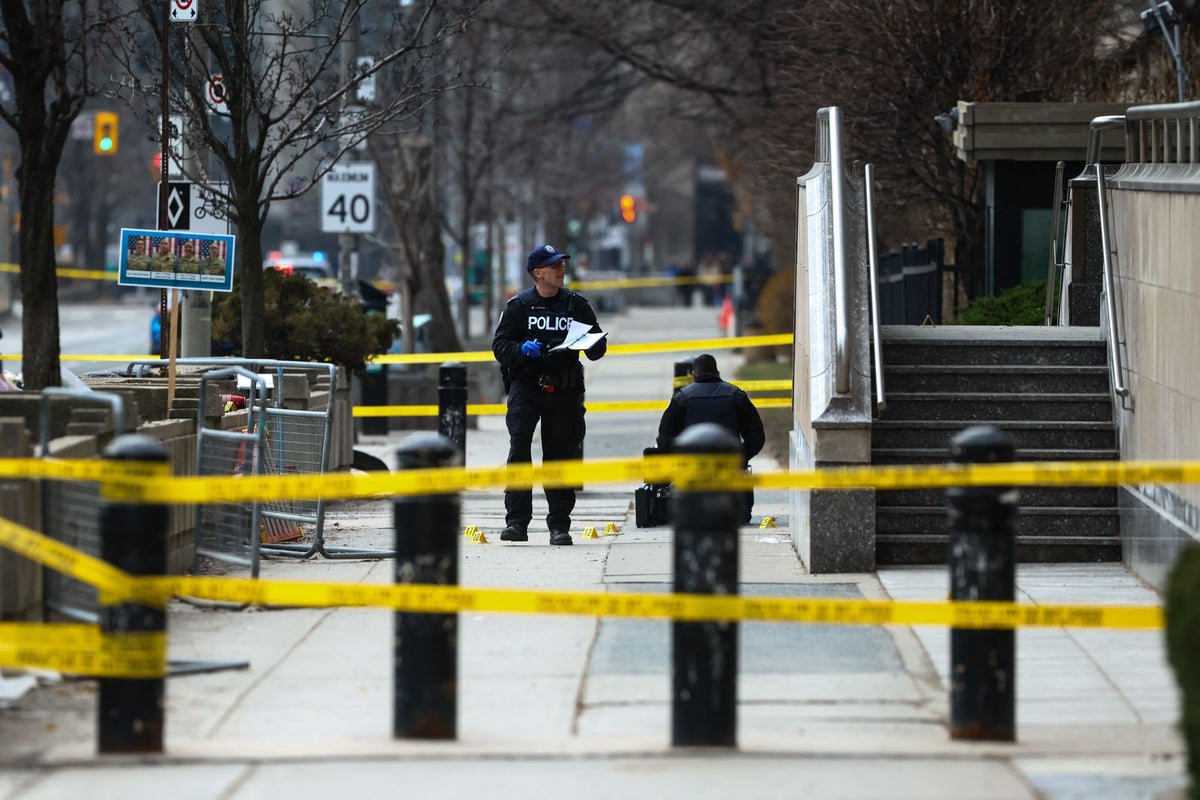
The yellow police tape wrapped around the North York apartment building will eventually be taken down. The forensic vans will pack up their cameras and evidence bags. The city will return to its routine because cities possess an immense, sometimes cruel capacity to keep moving.
Yet, the investigation remains wide open. While one teenager lies in a hospital bed under arrest, police are actively hunting for a second suspect: 19-year-old Zara Jabbi. He remains at large, considered armed and dangerous, a fugitive from a raid that transformed a local criminal investigation into an international tragedy.
"I urge you to turn yourself in," Chief Demkiw warned during his address, a direct appeal to a young man running out of places to hide.
The hunt for Jabbi serves as a stark reminder that the danger does not vanish when the sirens fade. The network that brought gunfire to University Avenue in March and to a residential hallway in June is still active, its components scattered across the geographic landscape of the city.
We often prefer to view our cities as safe havens, insulated from the violent ideological currents that dominate the evening news. We want to believe that the conflicts of the Middle East, the decisions of foreign intelligence agencies, and the radicalization of youth happen somewhere else.
The stained concrete of a North York apartment floor tells a different story. It tells us that the world is small, interconnected, and occasionally volatile. It tells us that the peace we take for granted is often preserved by a very thin, very vulnerable line of individuals who accept the risk of never coming home.
A hearse arrived at the office of the chief coroner in the early afternoon, carrying the body of Marc Pinizzotto. Outside, the Toronto traffic continued to crawl along the nearby highways, thousands of people rushing toward their own evenings, entirely unaware of the profound silence left behind in a home that will never be the same.