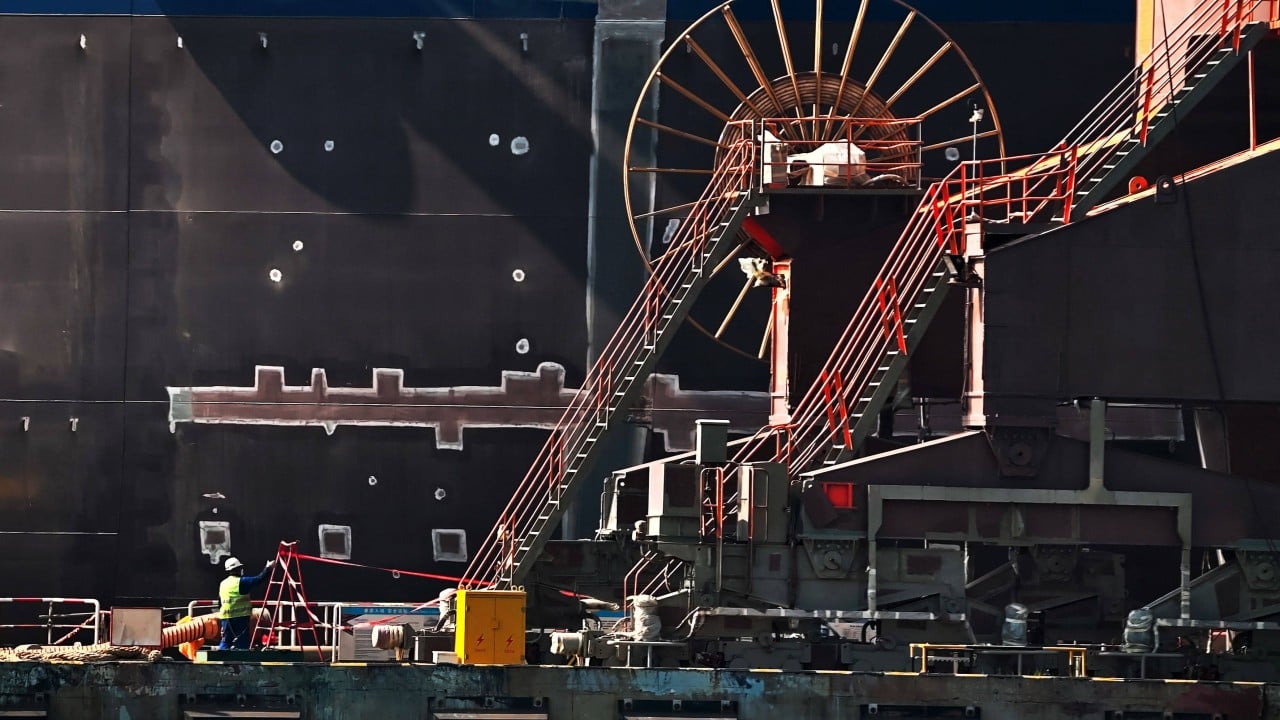
The air inside the vast assembly hall smells of ozone, hot flux, and scorched primer. Outside, the Huangpu River moves in a thick, grey coil toward the East China Sea.
For the men and women standing on the catwalks sixty feet above the concrete floor, a ship is never just a machine. It is a continent of welded steel. It is millions of pounds of high-grade alloy shaped by hand and laser, engineered to displace thousands of tons of seawater while moving at thirty knots. When engineers talk about dimensions—meters of length, tons of displacement, square footage of flight decks—they are describing a floating city. And right now, in shipyards along China’s eastern coastline, that city is growing longer.
To understand why length matters in naval architecture, you have to step away from the politics and look down at the physics.
A flat-top warship is essentially a floating runway. Every extra meter of flight deck is not merely for show; it is breathing room. It is the fraction of a second more that a heavily laden jet has to gather lift before its wheels leave the steel. It is the difference between launching a scouting patrol in a gentle morning breeze and recovering a stricken aircraft in the teeth of a gale.
Decades ago, naval designers learned that space on the deck is the most precious commodity on the planet. You can cram more radar arrays into a superstructure or spool more copper wiring through the bulkheads, but you cannot stretch a flight deck after the hull is welded shut. Whatever length you lay down on the blocks is the universe your pilots must live within.
Morning shifts at the yard begin before dawn. Sparks cascade from upper scaffolding like slow-motion fireworks, casting long, jittery shadows against towering curved plates.
Imagine a welder named Chen, twenty-eight years into a career spent inside cramped double-bottom hulls. His eyes are protected by a heavy fiberglass shield; his hands are steady even as the torch hisses and spits molten orange droplets. He does not think about defense white papers or international summits. He thinks about seam integrity. He thinks about the microscopic imperfections that cold pressure and saltwater can exploit over twenty years of service. If his bead fails, the hull weeps. If the hull weeps, the ship dies. That is statuesque, unromantic reality.
Behind the sparks and the noise lies a quiet, staggering industrial transformation.
For centuries, naval power was dictated by coal mines, iron ore deposits, and the sheer number of rolling mills a nation could keep burning. Today, it is dictated by modular construction techniques and drydock capacity. Giant gantry cranes—monolithic structures painted in industrial red and yellow—lift prefabricated modules weighing hundreds of tons each, slotting them together with the precision of watchmakers.
When satellite imagery began picking up the outlines of a massive new hull taking shape in Shanghai, military analysts did not immediately know what they were looking at. They saw the sheer scale of the berth. They measured the modular sections as they arrived by barge. They calculated the breadth of the assembly bays. The numbers pointed to a vessel that would dwarf its predecessors not just in tonnage, but in sheer linear reach.
Why build longer?
The answer lies in the evolution of naval aviation. Early carriers launched light, propeller-driven aircraft that required barely a hundred yards of deck. Modern heavy fighters, airborne early warning aircraft, and refueling drones demand massive rolling momentum. They need space to accelerate, space to abort, space to park, and space to maneuver without creating a catastrophic bottleneck on the flight deck.
When you look at the progression of Chinese naval design over the past two decades, you see a deliberate, step-by-step masterclass in learning by doing.
The first generation was a study in adaptation—taking a hull designed by another nation decades prior, stripping it down, and rebuilding it to understand the geometry of floating airfields. That vessel became a floating classroom. Thousands of technicians, officers, and deck crews learned the brutal, unforgiving rhythms of carrier operations on its steel deck. Every aborted landing, every snapped arresting wire, every rusted valve was a lesson paid for in time and concentration.
The second generation brought indigenous design. Gone were the foreign boiler rooms and cramped living quarters. In their place came cleaner lines, improved hangar layouts, and electronic combat management systems built from the ground up to integrate with modern defense networks. These ships proved that the shipyard could not only copy, but originate.
Yet, each generation revealed its own limitations.
Captains wanted more hangar space so maintenance crews could service engines without crowding the flight deck. Air wing commanders wanted heavier catapult payloads to extend the operational range of their strike groups. Power plant engineers wanted cleaner, more reliable generation capacity to run advanced sensors and electromagnetic launch systems without straining auxiliary grids.
That brings us to the present silhouette taking form under the gantry cranes.
To look at the construction photos is to witness scale that defies ordinary human intuition. A human being standing next to a bow section looks like an ant crawling across the shell of a tortoise. The thickness of the steel plating alone is a marvel—inches of high-tensile armor designed to absorb kinetic impacts and resist the crushing hydrostatic pressure of deep-sea operations.
The logistics required to feed a shipyard of this magnitude are invisible to the outside world. Thousands of tons of specialized steel must arrive by rail and barge every week. Electrical wiring by the mile, titanium piping for seawater cooling loops, ceramic thermal insulation for turbine exhausts, miles of fiber-optic cable—all of it must converge on a single coordinate on the map at the exact moment the schedule demands it.
When bottlenecks happen, they are solved not by algorithms, but by human stubbornness. Engineers work through the night in trailer offices smelling of stale instant noodles and damp concrete, recalculating load distributions when a single module arrives three millimeters out of alignment.
This is where the true narrative of modern naval expansion lives. It is not found in the grand pronouncements of televised briefings or the anxious editorials of foreign think tanks. It is found in the grit under a technician's fingernails. It is found in the silent concentration of a metallurgist running ultrasonic tests on a three-inch-thick weld seam at three in the morning.
Consider what happens next in the lifecycle of this colossal structure.
Once the hull is fully assembled and sealed, the drydock will be flooded. The river will rush in, reclaiming the concrete floor that has been dry for years. The ship will lift off its keel blocks, buoyant for the very first time. Tugs will nudge the massive bow away from the piers, guiding it out into the broader channel for dockside outfitting.
Then come the dock trials. Thousands of individual subsystems—fire suppression lines, steering gear, freshwater pumps, radar cooling loops, electrical distribution panels—will be powered up and tested under simulated stress. Every pipe will be pressurized. Every circuit will be short-test checked.
Months later, the vessel will put to sea under its own power for the first time.
The open ocean is an unforgiving critic. A ship can look magnificent in a protected basin, but put it in a force-eight gale in the South China Sea, and every structural weakness will find its voice. The hull will flex. The superstructure will groan. The inertial navigation systems will compensate for the relentless roll and pitch of the waves.
The crew will spend weeks chasing gremlins—vibrations in auxiliary turbine bearings, feedback loops in communications gear, minor leaks in secondary ballast tanks. This is the sea trial phase, where cold blueprints collide with the chaotic reality of ocean water and wind.
Why does any of this matter to someone sitting thousands of miles away, staring at a screen in a quiet room?
Because these ships are physical manifestations of national ambition, industrial capacity, and geopolitical gravity. They alter the balance of power across the globe’s most critical maritime corridors. When a nation expands its capacity to project power across blue water, every neighboring capital recalculates its defense budgets, its diplomatic postures, and its supply chain security.
The maritime trade routes that carry ninety percent of the world’s commerce—container ships laden with electronics, bulk carriers loaded with iron ore, tankers carrying crude oil—all pass through these contested waters. A carrier strike group is not just a weapon of war; it is a floating anchor of influence that dominates the geography around it.
Yet, looking at the workers welding away in the grey light of the riverbank, the grand geopolitical chess match feels distant.
For Chen and his crewmates, the horizon is measured in centimeters of weld, in pounds of torque, in the clean sweep of an overhead crane. They are artisans of the industrial age, working on a scale that few human beings will ever witness firsthand.
When the new carrier finally slips away from the pier and takes its place on the open ocean, it will carry thousands of sailors, dozens of aircraft, and the accumulated weight of a nation’s industrial might. But underneath all of that machinery, it will still be a collection of steel plates joined by human hands, battling the same ancient elements that sailors have fought since the first log was hollowed out and pushed into the surf.
The sea does not care about blueprints. The sea does not care about geopolitics. The sea only asks whether the welds were clean, whether the steel was true, and whether the people who built her respected the terrifying power of the water.
In the shipyards along the coast, the torches are still hissing. The sparks are still falling. And the long steel horizon continues to grow.