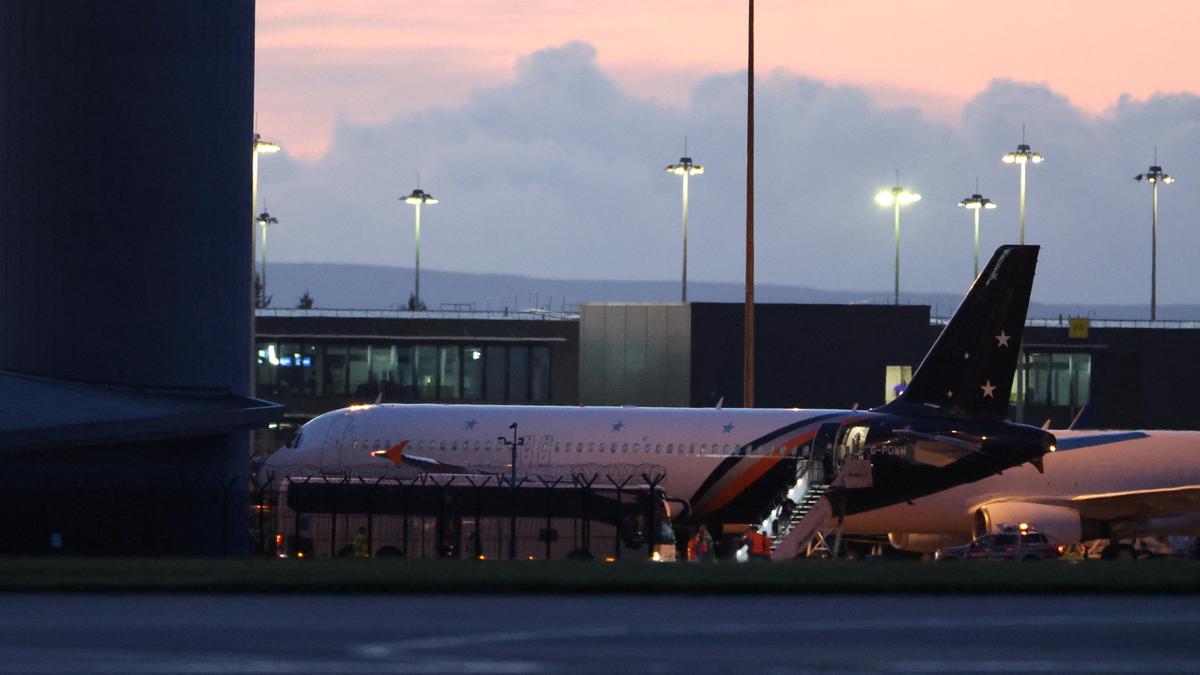
The cabin air on a long-haul flight usually smells of stale coffee and recycled expectations. But for the passengers touching down at Manchester Airport this week, the air felt heavy with something else. Silence. Not the comfortable silence of a red-eye flight where everyone is dreaming of home, but the taut, vibrating quiet of people who have spent days looking at their neighbors and wondering if a microscopic stowaway was hiding in their lungs.
They were British citizens coming home from a cruise ship that had become a floating laboratory of fear. The culprit wasn't the headline-grabbing viruses we’ve grown accustomed to over the last few years. It was Hantavirus. To the scientists in white coats, it is a rodent-borne pathogen. To the people in row 14, it was a ghost.
The Invisible Guest
When you book a holiday, you imagine the salt spray and the buffet line. You don't imagine the ventilation system or the history of the cargo hold. The passengers on this particular vessel found themselves at the center of a medical mystery that began with a few shivering bodies and ended with a chartered flight into a high-security isolation protocol.
Hantavirus is a strange, reclusive enemy. Unlike the flu, which leaps from person to person with the casual ease of a rumor, Hantavirus usually requires a more direct, grittier connection. It lives in the waste of rodents. When that waste is disturbed—perhaps during a deep clean of a long-dormant storage locker or through a fluke in the ship's maintenance—it becomes airborne. You breathe it in. You don't even know you’ve been invited to the dance until your bones start to ache.
Consider a hypothetical passenger we will call David. David is sixty-four, retired, and was looking forward to seeing the fjords. For David, the first sign wasn't a cough. It was a crushing fatigue that felt like his blood had turned to lead. He assumed it was the sea air or perhaps the late-night dancing. But then the fever spiked. On a ship, there is nowhere to run. The horizon is a circle, and the walls are steel. When word spreads that the infirmary is filling up, the luxury of the mahogany deck disappears. The ship becomes a cage.
The Logistics of Mercy
Bringing these citizens back to U.K. soil wasn't as simple as booking a group rate on a commercial carrier. Public health is a game of risk management played with human lives as the currency. The British government had to orchestrate a return that balanced the rights of the individuals with the safety of the millions waiting on the ground.
The plane that landed in Manchester was a bubble. Every surface, every interaction, and every breath was monitored. This wasn't just a flight; it was a transition from one form of quarantine to another. As the wheels hit the tarmac, the relief was palpable, but it was shadowed by the sight of ambulances waiting on the apron.
Manchester is a city used to rain and industry, but that afternoon, it was a sanctuary. The coordination between the UK Health Security Agency and local hospitals was a silent engine humming under the surface of the news reports. They weren't just treating a virus; they were managing a panic.
The Weight of the Unknown
We often think of medicine as a series of answers. You take a pill, the pain stops. You get a vaccine, the threat vanishes. But Hantavirus Pulmonary Syndrome (HPS) is a reminder of how much we still don't control. There is no specific cure. No magic bullet. The treatment is "supportive care," a medical euphemism for keeping the body alive long enough to fight its own war.
The stakes are high. HPS can lead to the lungs filling with fluid, a terrifying physiological betrayal where the very act of breathing becomes an act of drowning. Imagine being David, sitting in a specialized ward in the North West, watching the rain against the window and feeling his own breath rattle. The isolation is total. Your family is on the other side of a glass partition or a video screen, their faces blurred by pixels and tears.
The fear isn't just about the physical toll. It’s the stigma. There is a specific kind of loneliness that comes with being a "case." You are no longer David the grandfather or David the retired teacher. You are a potential vector. You are a data point in a briefing.
The Shore Behind Us
As the passengers are monitored and the news cycle inevitably shifts to the next crisis, we are left with the chilling realization of how fragile our global interconnectedness truly is. We live in an age where a mouse in a cargo hold on one side of the world can dictate the movements of a Boeing 747 on the other.
The Manchester landing wasn't just a logistical success. It was a somber homecoming. It served as a stark illustration of the thin line between a dream vacation and a biological emergency. For those who walked off that plane and into the waiting arms of the health service, the world has changed. The walls of their homes will feel different. The air will feel precious.
The cruise ship is still out there somewhere, being scrubbed and sanitized, its gold leaf and velvet being wiped clean of the microscopic shadows. But for the people in Manchester, the journey isn't over. They are still waiting to see if they brought the ghost home with them.
Somewhere in a quiet hospital ward, a monitor beeps. A nurse in a respirator checks a chart. A man takes a breath, slow and deliberate, and realizes that the most beautiful sound in the world is simply the air moving in and out of his lungs, unchallenged and free.