Los Angeles cried crocodile tears when Cole's French Dip locked its doors, and now the city is throwing a parade because the neon sign is buzzing again.
Drop the confetti. The reopening of a 118-year-old saloon on 6th Street is not a triumphant civic resurrection. It is a symptom of a toxic nostalgia loop that is actively suffocating the city's actual culinary culture.
Every food blog, local lifestyle vertical, and downtown booster is running the exact same script right now. They are selling you a comforting bedtime story: Legacy institution faces extinction, community mourns, valiant operators step in, heritage saved. It reads great over a morning oat milk latte. It is also complete economic fantasy.
I have spent fifteen years auditing hospitality turnarounds, dissecting P&L statements for distressed heritage brands, and watching restaurant groups burn eight figures trying to defibrillate ghosts. When a legacy dining room closes and reopens to applause, the applause almost always comes from people who hadn't bought a sandwich there in four years. They didn't miss the food. They missed the idea of the food. They missed knowing it was there while they ordered Sweetgreen on an app.
If you want to understand why Cole's closed in the first place—and why its shiny new "first look" honeymoon will hit a brick wall inside nine months—you have to stop looking at the mahogany bar and start looking at the unit economics of nostalgia.
The Myth of the "Beloved" Institution
Let's dismantle the primary lie in every single headline celebrating this reopening. A business does not shut down because it is "beloved." A business shuts down because love does not clear payroll on Friday afternoon.
In hospitality, there is a canyon between cultural equity and commercial viability.
Cultural equity is the warm, fuzzy feeling Angelenos get when they drive past the Pacific Electric Building and think about 1908. Commercial viability is turning a 200-seat dining room in the Historic Core at 1:30 PM on a Tuesday when commercial office vacancy in Downtown Los Angeles hovers north of 30 percent.
When Cole's shuttered, the obituary writers blamed the usual suspects: inflation, labor costs, post-2020 foot traffic. Those are real headwinds, sure. Nobody running a kitchen in California is having an easy time navigating the $20 minimum wage floor, skyrocketing general liability insurance, and commercial protein prices that look like crypto charts.
Here is the part the nostalgic puff pieces leave out: Cole's was already running on fumes as a museum piece long before the macro economy squeezed it.
Think about how people actually used Cole's during its last decade under Cedd Moses and the 213 Hospitality era. People didn't go to Cole's for a transcendent culinary experience. They went to Cole's to walk past the French dip counter, push through a nondescript door in the back, and drink $18 Old Fashioneds at The Varnish. The sandwich shop was the front-of-house cover charge for a speakeasy. Once The Varnish closed its doors, the emperor had no clothes. Without a high-margin craft cocktail engine subsidizing the square footage, a roast beef sandwich counter in a hollowed-out downtown district was exposed for what it was—a low-margin volume play in a neighborhood with no daytime volume.
Celebratory "first look" articles treat the reopening like a movie sequel where the original cast comes back and everyone wins. In reality, reopening a distressed heritage restaurant without fundamentally altering its revenue model is like putting fresh paint on a house with a cracked foundation. The curb appeal is fantastic for opening weekend. Six months later, the walls still split.
The Philippe's vs. Cole's Debate Is a Distraction
Whenever Cole's enters the news cycle, the internet immediately defaults to its favorite parlor game: Who invented the French dip, Cole's or Philippe the Original?
Stop asking this question. It is irrelevant, historically unprovable, and completely misses why one of these businesses prints money while the other is a perpetual restructuring project.
If you want a masterclass in legacy restaurant survival, look north toward Chinatown at Philippe's, not at the shiny press photos coming out of 6th Street.
Philippe's survives because it operates on a high-throughput, low-friction industrial model that respects the customer's time and wallet:
- Zero table service bloat: You walk up to a counter, a carver slices the meat in front of you, dunks the roll, and hands you a tray in ninety seconds.
- Compressed labor ratios: No host stand, no servers juggling four-tops, no bartenders muddling artisanal bitters for twelve minutes per ticket.
- Volume-driven pricing: They move thousands of units a day at a price point that feels like a bargain rather than a luxury splurge.
- Owned real estate: They aren't paying market-rate commercial leases to a private equity landlord praying for a retail rebound.
Cole's, by contrast, got trapped in the heritage gastropub middle. It wasn't fast enough to be a true blue-collar lunch counter, and it wasn't refined enough to command fine-dining check averages.
When a "first look" review gushes over the restored penny-tile floors, the original lighting fixtures, and the "elevated" bar program, read between the lines. Every historical restoration detail is a fixed capital cost. Every craft cocktail garnish is a labor cost. You cannot pay 2026 Los Angeles hospitality wages on 1990s diner margins, and you cannot charge $26 for a wet roast beef sandwich on a Tuesday afternoon to remote workers sitting in Silver Lake.
What "First Look" Journalism Refuses to Tell You
Look closely at the anatomy of a restaurant reopening piece. It follows a rigid, predictable formula designed to generate clicks from locals who love feeling proud of their city.
- The Emotional Hook: Remind the reader how sad they were when the doors locked.
- The Visual Tour: Describe the untouched vintage booths, the patina on the bar, the "timeless" atmosphere.
- The Menu Check: Confirm that the signature item—the French dip, the spicy mustard, the garlic fries—is "back and better than ever."
- The Civic Blessing: Frame eating a sandwich as an act of urban preservation.
Notice what is missing from that checklist? Any honest interrogation of why the business failed to sustain itself six months ago.
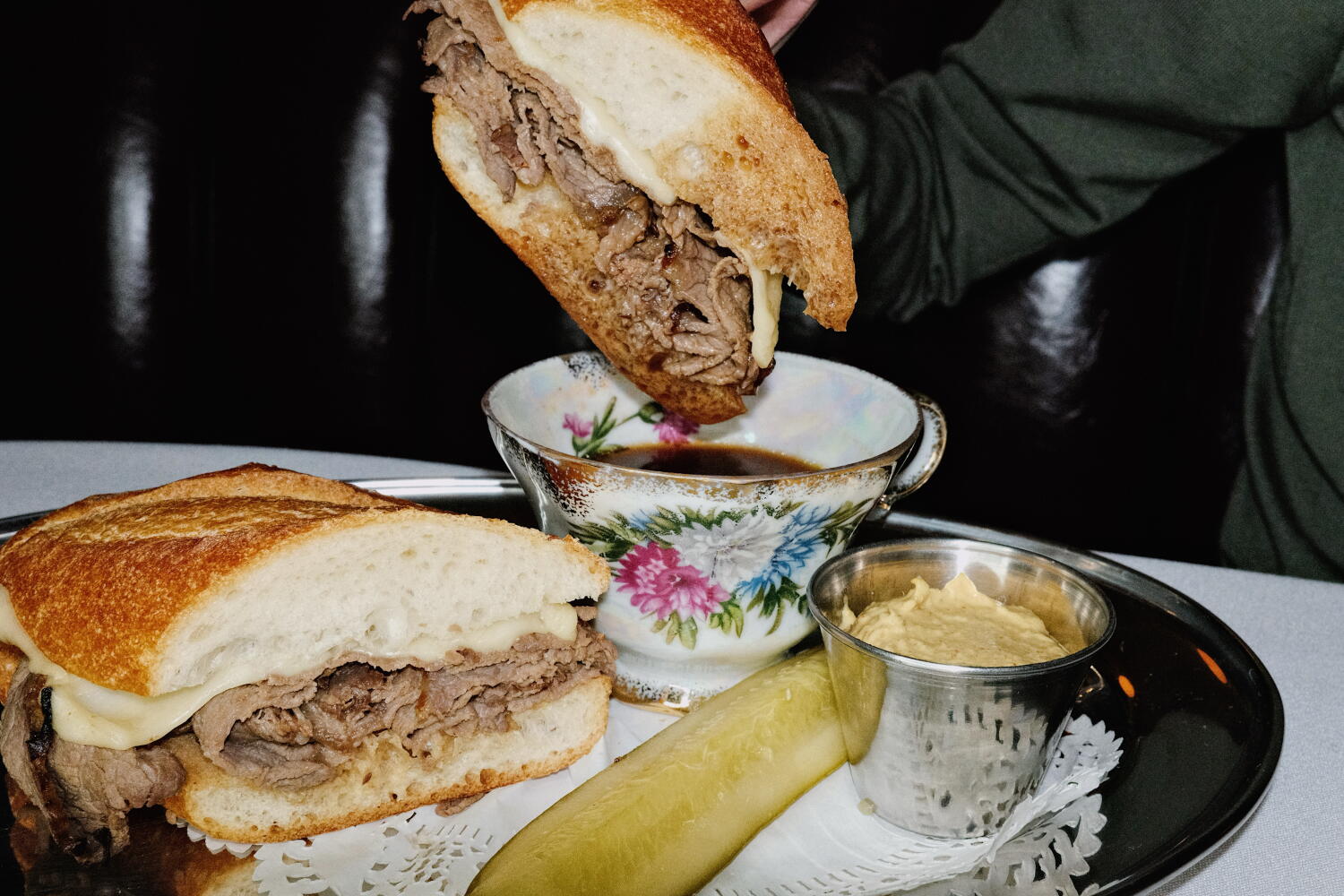
Food media operates as an unpaid public relations arm for restaurant openings because access is the currency of lifestyle journalism. If a writer gets invited to a pre-opening friends-and-family tasting, they aren't going to ask the new operators about their prime cost targets, their lease restructuring, or how they plan to survive a dead Monday night in January when it rains in Los Angeles and everyone stays home. They are going to take a well-lit photo of a dipped roll on a butcher-paper tray and call it a triumph.
Imagine a scenario where a tech startup burned through its Series B, laid off its entire staff, shut down its servers, and then relaunched six months later with the exact same product, the exact same user interface, and a slightly higher subscription price. Business reporters would tear them apart. They would ask what changed in the underlying mechanics.
In the restaurant industry, we put a vintage neon sign out front, call it "heritage," and suspend all critical thinking.
The Brutal Math of the Modern Legacy Restaurant
Let's talk real numbers, because the romanticism of old Los Angeles disappears the second you open a spreadsheet.
In classic restaurant accounting, your Prime Cost—the combined total of Cost of Goods Sold (COGS) and total labor, including payroll taxes and benefits—needs to sit at or below 60% of gross sales if you want a healthy, sustainable operation. In high-cost markets like Los Angeles, operators fight tooth and nail just to keep Prime Cost under 65%.
Now plug a traditional French dip operation into that equation:
- Protein inflation: Chuck roast, top round, and brisket—the workhorse cuts of the French dip—have seen brutal wholesale price spikes over the last five years. Even if you buy in bulk, your food cost on a meat-heavy sandwich is structurally higher than a pasta concept, a pizza joint, or a taco stand.
- Labor compression: Under California's wage structure, a single prep cook, carver, dishwasher, and bartender on a slow shift will eat through $120 to $150 an hour in burdened labor before you even turn on the oven hood.
- Occupancy and insurance: Downtown LA commercial insurance premiums have surged, and property owners in the Historic Core are desperately trying to service their own debt, leaving little room for generous tenant improvement allowances or percentage-rent deals.
To hit a 60% prime cost under those conditions, you have two levers: massive table turns or aggressive check averages.
You cannot get massive table turns in Downtown LA right now because the daytime office population isn't there. And if you pull the aggressive check-average lever—charging $22+ for a sandwich before fries, a drink, tax, and a 20% tip—you immediately alienate the exact blue-collar, everyday crowd that made the restaurant an "icon" in the first place.
You turn a neighborhood staple into a $45-per-person tourist attraction. Tourists don't keep a restaurant alive in February. Locals do. And locals don't drop $45 on a Tuesday lunch for roast beef and horseradish.
Why Nostalgia Is Bad for L.A.'s Food Scene
The biggest danger of this collective obsession with saving old restaurants isn't just that the turnarounds usually fail. It's what that obsession steals from the rest of the city.
Los Angeles has the most dynamic, creative, fiercely independent food culture in North America. Right now, across strip malls in the San Gabriel Valley, pop-up tents in Boyle Heights, and tiny counter-service spaces in Koreatown and Thai Town, immigrant families and young chefs are building the next century's icons. They are doing it without historic preservation societies, without glossy "first look" spreads, and without private hospitality groups underwriting their buildouts.
Yet every time a century-old dining room wobbles, the city acts like the sky is falling. We treat restaurant longevity as an inherent moral virtue, regardless of whether the food has been relevant in thirty years.
Let's be brutally honest: some restaurants are supposed to close.
Cities are living organisms, not taxidermy exhibits. When a neighborhood's demographics, work patterns, and culinary tastes shift over a hundred years, the businesses serving that neighborhood have to evolve or step aside so new concepts can take the lease. Freezing a 1908 saloon in amber because boomers and Gen Xers want to feel nostalgic about their twenties doesn't preserve the soul of Los Angeles. It turns Downtown into an open-air Epcot Center.
Look at what happened to other legendary L.A. institutions that got "rescued" by well-meaning nostalgia buyers:
- Pacific Dining Car: Shuttered, looted, burned, and left as an eerie monument to an era of steakhouse dining that stopped making economic sense decades ago.
- The Pantry: Saved repeatedly through civic willpower and union battles, only to remain locked in a perpetual struggle against the reality that a 24-hour diner model is nearly impossible to staff profitably in modern downtown economics.
- Clifton's Republic: Millions poured into turning a historic cafeteria into a multi-level experiential nightlife labyrinth, resulting in years of sporadic closures, identity crises, and operational headaches.
The pattern is undefeated. When you buy a legacy brand for its sentimentality rather than its cash flow, you aren't buying a business. You are buying an expensive hobby with a heavy lease.
How to Actually Save a Legacy Restaurant (If You're Crazy Enough to Try)
I am not saying it is impossible to revive an iconic restaurant. I am saying you cannot do it with the playbook being celebrated in the press right now.
If I were sitting across the table from the operators holding the keys to Cole's—or any legacy restaurant trying to survive 2026—here is the only blueprint that actually works, even though it would make the purists scream:
1. Kill the Sacred Cows on the Menu
The fastest way to go broke in a heritage restaurant is keeping forty legacy items on the menu because three regulars might complain if you cut the liver and onions. Slash the menu by 60%. Focus ruthlessly on the three high-margin, high-velocity items that define the brand, and engineer the prep so a lean kitchen crew can execute them blindfolded.
2. Ditch Full-Service Pretensions
If your core product is a sandwich, stop staffing the floor like a bistro. Move to a hybrid counter-order or QR-assisted model during lunch hours. Put every dollar of labor into food quality and speed at the carving station rather than paying servers to walk waters across a cavernous dining room.
3. Build a Real CPG and Off-Premise Engine
You cannot rely on four walls on 6th Street to pay the bills anymore. Look at how smart legacy brands like Rao's or Pink's monetized their equity: bottled sauces, branded mustard, stadium concessions, airport kiosks. If Cole's isn't aggressively licensing its spicy mustard and au jus mix into regional grocery chains, they are leaving their highest-margin asset sitting in a kitchen ramekin.
4. Own the Night—Honestly
Don't pretend a speakeasy is a secret in the era of TikTok. Build an unapologetic, high-energy late-night bar program tailored to the actual people who still come downtown at night: Crypto.com Arena crowds, theatergoers, and industry workers getting off shifts at midnight.
Admit the Downside
Here is the catch with this approach, and it's why most turnaround groups avoid it: if you modernize the operations enough to make the business profitable, the purists will accuse you of ruining the magic. You will get crucified on Reddit for changing the ordering flow or shrinking the menu. You have to choose between earning five-star nostalgia reviews from people who visit once a year, or running a solvent business that survives until 2036. You rarely get both.
What You Should Actually Do This Weekend
If you genuinely care about Cole's—or any other historic spot in your city—stop sharing "first look" articles on Instagram and congratulating yourself on saving local culture.
Social media applause has a conversion rate of zero.
If you want a legacy restaurant to exist next year, put your credit card on the bar on a dead Wednesday night in November when there is no grand reopening hype, no press photographer in the corner, and no novelty left. Order the sandwich. Buy two drinks. Tip 25% in cash.
And if you aren't willing to make that a regular habit because Downtown is too far, parking is a hassle, and $22 is steep for a roast beef roll? That's fine. Just have the honesty to admit that you didn't want a restaurant. You wanted a postcard.