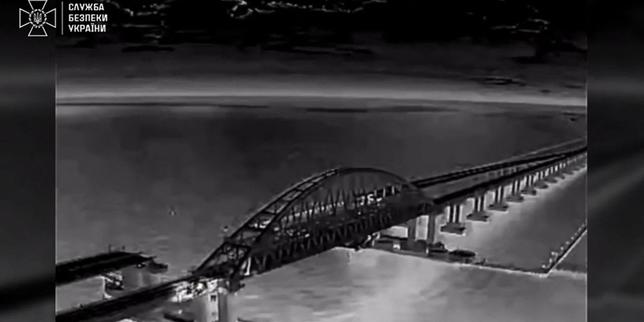
Headline writers love a collapse. Give them a twisted steel truss, a plume of black smoke, and a leader whose name starts with P, and the adjectives write themselves. Humiliated. Shattered. Doom.
It makes for great television. It makes for terrible strategic analysis.
Whenever a major logistics artery gets hit, the lazy consensus rushes to declare a decisive turning point. Analysts draw big red arrows on maps, circle a bridge, and treat an infrastructure strike like a checkmate. That habit mistakes spectacle for strategy.
I have spent years studying military logistics, supply chain resilience, and statecraft from the inside of defense planning rooms and crisis briefings. I have watched smart people blow millions of dollars chasing single-point-of-failure theories that fell apart the moment real friction hit the ground. War rarely works like a video game where destroying one shiny target ends the level.
When people ask whether losing the Kerch Bridge humiliates Vladimir Putin or breaks Russia's southern campaign, they are asking the wrong question. The real question is whether the bridge had already become a strategic liability disguised as a symbol.
The Myth of the Silver Bullet Chokepoint
Let's get the terminology straight before we go any further. In logistics and military theory, a chokepoint is a narrow passage where force concentration or movement bottlenecking creates decisive vulnerability. A line of communication is the full network of routes, both physical and digital, that moves troops, fuel, ammunition, and supplies from rear areas to the front.
The lazy consensus treats the Kerch Bridge as the sole lifeline holding Russian forces in southern Ukraine and Crimea alive. Destroy the bridge, the argument goes, and the entire southern front starves.
That argument ignores basic geography and redundant routing.
The Kerch Strait connects the Taman Peninsula in Russia to the Kerch Peninsula in Crimea. Yes, the bridge carries both road and rail traffic across water. Yes, losing a major crossing creates immediate friction, delays, and rerouting headaches. Any honest analyst admits that.
Yet logistics planners rarely rely on a single span without building backup options once a corridor faces sustained threat. Overland rail and road corridors along the Sea of Azov coast, combined with maritime sealift and ferry operations, give a large military machine alternative ways to push bulk cargo. A bridge collapse hurts throughput and raises cost. It does not magically evaporate hundreds of thousands of tons of fuel, artillery shells, and rations overnight.
Think about Carl von Clausewitz's warning in On War about friction in war: everything in war is simple, yet even the simplest thing is difficult. Friction cuts both ways. Attackers spend scarce precision munitions, intelligence assets, and operational tempo to hit a hardened target. Defenders absorb the shock, reroute cargo, and adapt.
Why "Humiliation" Is a Weak Analytical Metric
"Humiliation" sounds satisfying on cable news. In geopolitics, it is a mirage.
Authoritarian leaders and centralized security states do not measure success by Western editorial headlines. They measure control over domestic narratives, regime survival, and the ability to sustain operations over months and years. When an adversary strikes high-profile territory or infrastructure, a regime can frame the event around victimhood, escalation, or resolve just as easily as defeat.
I have seen intelligence assessments fail repeatedly because analysts projected their own emotional reactions onto an opponent. Assuming a leader feels "humiliated" the way a pundit does leads to bad predictions about what happens next.
What Happens When a Symbol Disappears
Symbols cut both ways. A massive bridge built at enormous cost is a triumph when intact. Once damaged or destroyed, that same structure becomes an expensive target that ties down air defense batteries, patrol vessels, electronic warfare units, and repair crews.
Imagine a scenario where a defense ministry has spent years pouring air-defense interceptors and radar coverage into protecting one flagship crossing while leaving secondary depots and rail junctions thinner. Losing the flagship hurts pride. It also frees up protective assets that were locked down guarding concrete and steel rather than maneuver forces or critical hubs.
That is the counter-intuitive twist nobody wants to hear. Removing a high-value static target can force a military to disperse its logistics and rethink brittle concentration.
The Hidden Trap of Infrastructure Obsession
Modern commentators suffer from an obsession with dramatic physical destruction. A collapsing span is photogenic. Quiet shifts in rail scheduling, barge loading, truck turnarounds, and warehouse staging are boring.
Wars are won in the boring parts.
Ask any seasoned logistics officer what actually breaks an army. It is rarely a single dramatic strike in isolation. It is sustained attrition across fuel distribution, spare parts, maintenance bays, ammunition dumps, and crew rest cycles over time. If a bridge goes down but alternative routes keep moving enough tonnage to sustain defensive lines, the operational effect is measured in friction, not collapse.
Conversely, if an attacker celebrates a bridge strike while overlooking how supplies still move by sea or coastal rail, the attacker risks mistaking a tactical success for a strategic breakthrough.
Dismantling the "People Also Ask" Premise
Search engines fill up with predictable questions after a major strike. Let's tear into the most common ones and see where the premise breaks down.
"Does losing the Kerch Bridge mean Russia can no longer supply Crimea?"
No. That premise confuses convenience and capacity with total impossibility.
Moving cargo without a major bridge is slower, costlier, and more exposed to weather and interdiction. Rail cars might need transloading or alternative routes. Trucks face longer drives and tighter bottlenecks. Ferries and cargo ships face maritime threats and weather limits.
All of that reduces volume and adds delays. None of it equals an instant airtight blockade unless every alternative route is simultaneously severed and kept severed. Treating "harder" as "impossible" is lazy thinking.
"Is this a decisive turning point in the war?"
Most turning points are only clear in hindsight, and very few come from a single structural hit without follow-on exploitation.
An infrastructure strike creates a window. A window only matters if forces on the ground or at sea can exploit the temporary disruption before the defender adapts. Without broader operational pressure, a strike on a crossing remains an important tactical blow rather than a war-ending shock.
"Why do headlines keep calling every strike a humiliation?"
Because outrage drives clicks. Nuance does not.
Writing "Strike degrades crossing capacity while alternative logistics routes absorb partial load" will never beat a headline shouting about humiliation and collapse. Media incentives reward certainty and drama over probabilistic assessment. Readers who confuse headline drama with strategic reality get blindsided every time the story drags on past week two.
Where My Contrarian Take Can Go Wrong
Honesty matters more than contrarianism. If you push a counter-narrative without admitting its blind spots, you just build a different kind of dogma.
Here is where this argument could fail:
- Cascading bottlenecks: Even if alternative routes exist on paper, real-world rail yards, ports, and highways have strict capacity limits. Pushing too much traffic onto secondary routes can trigger jams that cripple supply flow far worse than planners expected.
- Psychological shock inside the ranks: Leadership may spin a loss easily, yet front-line troops and logistics crews sometimes read major infrastructure damage as a sign of vulnerability or declining protection. Morale effects are messy and hard to model.
- Cumulative degradation: One strike may not break a logistics network, while repeated strikes over months on bridges, rail hubs, vessels, and depots can compound until the system crosses a breaking point.
- Political miscalculation: Even if a leader is not "humiliated" in the way pundits claim, domestic pressure or elite infighting can still push the regime into rash escalations or costly mistakes.
A sharp contrarian view respects reality enough to update when the facts shift. If supply volumes actually crater and front-line units run dry of shells and fuel, the data wins. Until then, do not confuse noise with collapse.
How Smart Analysts and Planners Should Read Strikes Like This
Stop cheering headlines and start auditing mechanics. Whether you are tracking geopolitical risk for a business, managing supply chain exposure, or studying modern conflict, apply four practical rules whenever a major artery gets hit:
- Map the full network, not the trophy. Identify every alternate road, rail line, port, pipeline, and air corridor serving the same region. Ask how much cargo each backup can realistically carry per day.
- Separate symbol value from throughput value. A structure can be high-symbol and medium-throughput, or low-symbol and high-throughput. Never conflate the two.
- Watch the second-order adjustments. Look at where air defenses move, how shipping lanes shift, and where queues form over the next two to four weeks. That is where real adaptation shows up.
- Price in time and friction, not miracles. Assume logistics degrades gradually through delays, wear, and cost rather than snapping like a twig on day one.
Classic military thinkers from Thucydides to B.H. Liddell Hart emphasized indirect approach, logistics, and realistic assessment of friction over wishful thinking. Modern analysts who ignore those fundamentals end up rewriting their predictions every few days.
A bridge falling makes a great picture. What keeps an army moving—or stops it cold—happens miles away from the cameras, long after the smoke clears.