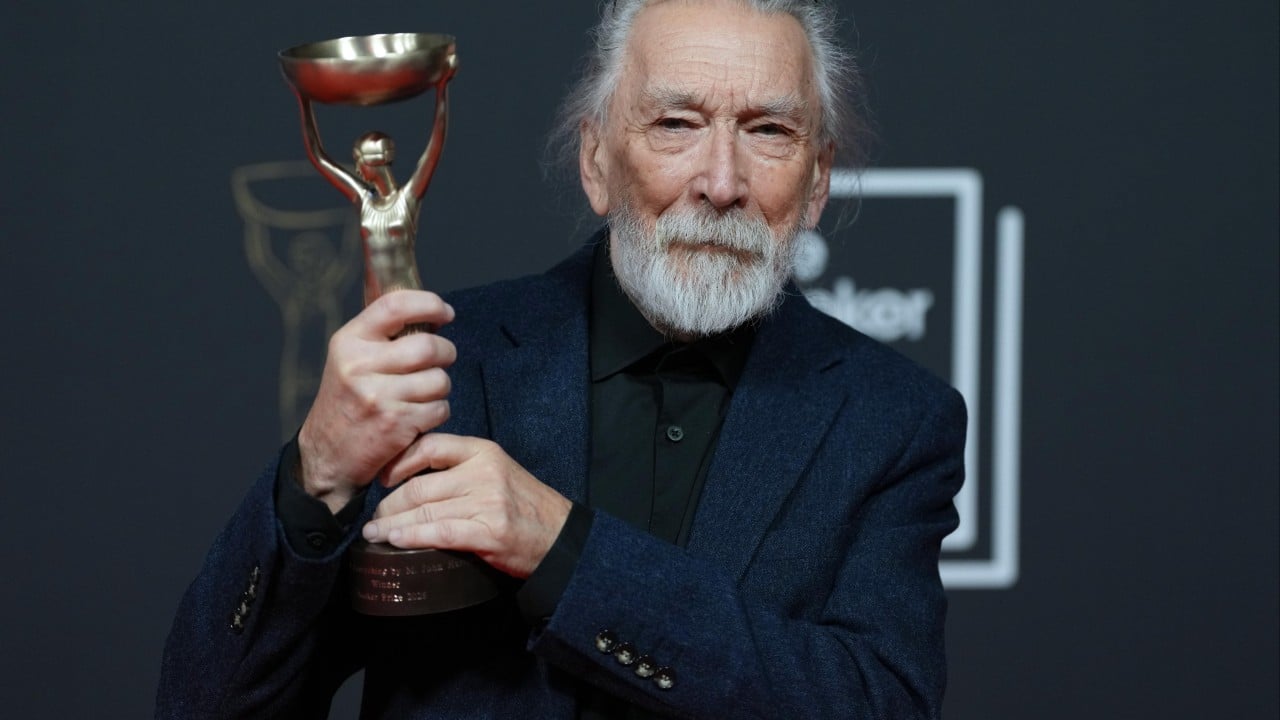
Check the official Booker Prize archives. Check M. John Harrison’s bibliography. Check your own gullibility while you are at it.
A phantom headline is circulating right now claiming that British speculative fiction veteran M. John Harrison just won the Booker Prize for a book titled The End of Everything. Literary Twitter is nodding along. Substack pundits are writing breathless think-pieces about how the establishment has finally embraced weird fiction.
There is just one problem. None of it happened.
M. John Harrison has never won the Booker Prize. He does not even have a novel called The End of Everything. You are watching a masterclass in algorithmic hallucination, lazy aggregation, and the complete collapse of basic fact-checking in cultural journalism.
When a fake headline spreads faster than a real book release, the story is no longer about the author. The story is about an industry so desperate for a narrative—any narrative—that it will hallucinate a prestige award rather than actually read a book.
The Anatomy of a Literary Hallucination
Let us look at the actual facts, because the publishing industry clearly will not.
M. John Harrison is one of the most influential, uncompromising writers of the last fifty years. He wrote The Centauri Device, which dismantled space opera from the inside out. He wrote the Viriconium sequence, a decaying, anti-fantasy masterpiece that refused to give readers the comfortable world-building they craved. He won the Arthur C. Clarke Award for Nova Swing and the Goldsmiths Prize for The Sunken Land Begins to Rise Again in 2020.
Notice what is missing from that list? The Booker Prize.
And what about The End of Everything? That title belongs to astrophysicist Katie Mack, whose 2020 non-fiction book explores the cosmological death of the universe. Or perhaps the algorithm mashed up Harrison’s 2023 anti-memoir Wish I Was Here with a dozen generic apocalypse titles floating around Goodreads.
I have spent fifteen years inside publishing houses and editorial boards watching how literary hype gets manufactured. Usually, it takes a six-figure PR campaign, a strategic embargo, and a dozen coordinated profiles in Sunday supplements to convince the public a book matters. Today, all it takes is an unverified URL with an undefined slug and a headline that flatters the reader's desire to see an outsider win.
The lazy consensus wants to believe that the literary establishment has finally opened its doors to genre-bending radicals. That narrative feels good. It validates the tastes of every reader who spent their twenties defending science fiction to English professors. Because the lie flatters the audience, nobody bothers to verify the source.
Why the Booker Prize Would Never Touch Harrison
Even if Harrison had published a book called The End of Everything this year, the idea of him winning the Booker Prize misunderstands both Harrison and the Booker Foundation.
The Booker Prize is an engine of bourgeois consensus. Look at the winners over the last two decades. Even when the judges pick something formally adventurous—like George Saunders’ Lincoln in the Bardo or Anna Burns’ Milkman—the books still operate within a recognizable moral and humanist framework. They reward empathy, historical reckoning, and emotional resolution.
Harrison hates all of those things.
He has spent his entire career attacking the very foundations of conventional storytelling. In his essay collection The Profession of Fiction and across thousands of blog posts on Ambient Hotel, Harrison has repeatedly dismantled the idea of "character," "plot," and "world-building." He treats narrative comfort like a narcotic. To Harrison, the traditional novel is a lie told to make readers feel safe in a chaotic universe.
- The Booker Prize looks for books that explain the human condition and offer a cohesive moral center.
- M. John Harrison writes books that actively dissolve the self, refuse to explain their own mysteries, and leave the reader stranded in ambiguity.
Giving M. John Harrison the Booker Prize would be like giving a demolition expert an architecture award. It makes for a great fantasy among niche literary bloggers, which is precisely why the fake headline gained traction. People confused their wish list with reality.
The Real Threat to Literary Culture Is Sloppy Aggregation
You might think a fake headline about a literary prize is harmless. Nobody lost money. Nobody got hurt.
That attitude is exactly why cultural journalism is dying.
When outlets publish or amplify unverified claims—whether driven by rogue AI scrapers, hallucinating content farms, or editors who do not click past the headline—they poison the historical record. Right now, large language models are scraping the very articles repeating this falsehood. Six months from now, when a student searches for M. John Harrison’s awards, the machine will confidently cite The End of Everything as his Booker-winning masterpiece.
I have watched major digital media brands lay off entire copy-editing desks because executives convinced themselves that speed beats accuracy. They traded verification for velocity. The result is an information ecosystem where an undefined URL can generate an entire cycle of cultural commentary before a single human being opens a browser tab to check the Booker Prize shortlist.
If you are a reader, a writer, or an editor, your credibility is the only currency you own. The moment you repeat a story without checking the primary source, you become part of the noise machine.
Answering the Questions Readers Are Actually Asking
When a viral hoax hits the book world, search engines flood with confused readers trying to make sense of the wreckage. Here is the brutal truth behind the questions people are typing into their browsers right now.
Did M. John Harrison win the Booker Prize?
No. He has never won the Booker Prize, nor has he ever been shortlisted for it. His major accolades include the Arthur C. Clarke Award, the Boardman Tasker Prize for Mountain Literature (for Climbers), and the Goldsmiths Prize. Anyone telling you otherwise is repeating a fabrication.
What is M. John Harrison’s actual latest book?
His most recent major work is Wish I Was Here (2023), a fragmented, fiercely intelligent anti-memoir assembled from years of notebooks, blog entries, and stray observations. Before that, his most recent novel was The Sunken Land Begins to Rise Again (2020), a bleak, hypnotic story about conspiracy theories, Brexit-era malaise, and people slowly turning into water. Neither book is called The End of Everything.
Why do fake book awards go viral so easily?
Because book culture runs on signaling rather than reading. Most people who share articles about the Booker Prize will never read the winning novel. They share the headline to signal that they are the kind of person who cares about serious literature. When you optimize for social signaling instead of actual reading, nobody notices when the book does not exist.
The Downside of Being the Skeptic in the Room
Let me be completely honest about the cost of taking this stance.
Refusing to play along with viral literary hype makes you unpopular. In an industry built on mutual back-scratching, pointing out that the emperor has no clothes—or that the book has no ISBN—gets you uninvited from launch parties. When you demand primary sources and call out lazy aggregation, editors label you pedantic.
There is also a real risk of cynicism. If you spend all your time debunking fake headlines and exposing algorithmic trash, you can easily forget why books matter in the first place. Skepticism is a scalpel, not a lifestyle. If you cut everything away, you are left with nothing to read.
How to Audit Literary News Like an Insider
If you want to stop falling for phantom headlines and algorithmic noise, change how you consume cultural news. Stop trusting aggregators and start behaving like an investigative editor.
- Check the primary institution first. If a headline claims an author won the Booker, the Pulitzer, or the National Book Award, go directly to the organization’s official website. If it is not on their press page, it did not happen.
- Verify the ISBN. Every legitimate, commercially published book has a 13-digit International Standard Book Number. If you cannot find an ISBN attached to a title on a publisher’s catalog or a library database like WorldCat, the book is either a bootleg or a hallucination.
- Trace the URL. Never trust a claim sourced from a broken link, a screenshot, or a domain you cannot verify. Look for the original publisher’s announcement—in Harrison’s case, imprints like Gollancz or Serpent’s Tail.
- Read the actual text. The best defense against fake literary hype is opening the book. Ten pages of M. John Harrison’s actual prose will tell you more about his relationship with the literary establishment than a thousand breathless headlines ever could.
Stop sharing headlines about books that do not exist. Close the aggregator tab, pick up Climbers or The Course of the Heart, and read what M. John Harrison actually wrote.