The desert has a way of swallowing history whole, erasing footprints with a single gust of wind. But some men build monuments too massive for the sand to bury.
On a quiet morning, the state news agency announced that Sheikh Hamad bin Khalifa Al Thani, the former ruler of Qatar, passed away at the age of 74. To the modern world, the notification on a smartphone screen was just another blip in a relentless news cycle. To those who understand the modern mechanics of global power, it felt like the closing of an impossible epoch.
Before the glittering glass towers of Doha pierced the Persian Gulf sky, there was a quiet, sun-baked peninsula where life moved slowly, measured by the tides and the memories of pearl divers. Hamad changed all of that. He did not merely govern a nation; he engineered an empire out of sheer will, turning a forgotten strip of sand into the richest pocket of land on the planet.
The Midnight Shift
To understand the scale of what was lost, you have to go back to 1995. Picture a humid summer night in Doha. The air is thick enough to chew. A young, ambitious crown prince watches his father board a plane for Europe.
Hamad did not wait for permission. In a bloodless, quietly executed coup that played out like a high-stakes political thriller, he took the throne while his father was mid-air. It was a move born not out of petty malice, but out of a desperate, burning impatience. The world was moving, and Qatar was standing still.
The country he inherited was broke. Literally. The treasury was virtually empty, and the nation’s vast offshore reserves of natural gas were deemed too expensive, too volatile, and too complicated to extract. The global consensus was clear: natural gas was a fool's errand. Oil was king, and Qatar didn't have enough of it to compete with its colossal neighbors.
But Hamad saw what others missed. He looked at the Liquefied Natural Gas (LNG) technology and saw a lifeline. He bet everything. He borrowed billions, putting the country in staggering debt to build the infrastructure required to super-cool gas into liquid and ship it across the oceans.
It was an insane gamble. If it failed, the Al Thani dynasty would be a footnote in history, a cautionary tale of royal overreach.
It did not fail.
Within a decade, the money began to pour in. Not as a trickle, but as a roaring, unstoppable deluge. The wealth transformed the daily reality of every Qatari citizen. Suddenly, a nation that once lacked basic paved roads was commanding the boardrooms of London, New York, and Paris.
The Audacity of Ambition
Money is loud, but influence is deafening. Hamad knew that wealth alone would not protect a tiny nation wedged between regional titans. It needed to become indispensable.
He launched Al Jazeera, a news network that shook the foundations of Arab media, infuriating kings and presidents across the region by broadcasting perspectives that had been censored for generations. He invited foreign universities to set up massive campuses in the middle of the desert. He bought iconic institutions—Harrods, chunks of Barclays, Paris Saint-Germain, and vast swathes of London real estate.
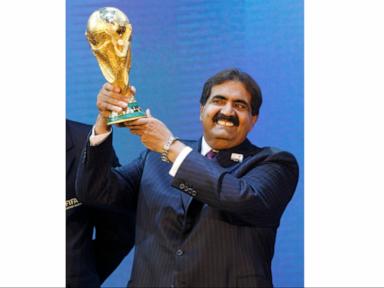
Then came the ultimate play: the 2022 FIFA World Cup. When the tiny desert nation won the bid, the world scoffed. How could a country with no football tradition and blistering summer heat host the world’s greatest sporting event? Hamad didn't care about the skepticism. He built the stadiums anyway, moving heaven and earth, reshaping the very topography of his country to prove that no dream was too large for his checkbook.
Yet, for all the global headlines, the true measure of the man was found in his final, most shocking act.
The Art of Stepping Away
In the Middle East, rulers rarely leave office voluntarily. Power is usually held until the final heartbeat.
But in 2013, at the absolute height of his influence, Hamad did something completely unprecedented. He sat before a television camera, his hair silvered by the stress of transforming a nation, and announced he was stepping down. He handed the keys of the kingdom to his 33-year-old son, Sheikh Tamim.
No coup. No bloodshed. No desperate clinging to the throne.
He became the "Father Emir," moving into a role of quiet counsel, watching from the wings as the architecture he built withstood blockades, global pandemics, and geopolitical storms. He showed that the ultimate expression of power is knowing exactly when to let it go.
Now, the architect is gone.
His legacy is not written in the obituaries of state media or the formal condolences of world leaders. It is written in the skyline of Doha, a city that did not exist in the imagination of the world until he decided it should. It is written in the quiet security of a citizenry that went from poverty to unimaginable luxury in a single generation.
The sand may try to claim everything, but Hamad bin Khalifa Al Thani left a footprint too deep for the desert to ever wipe away.