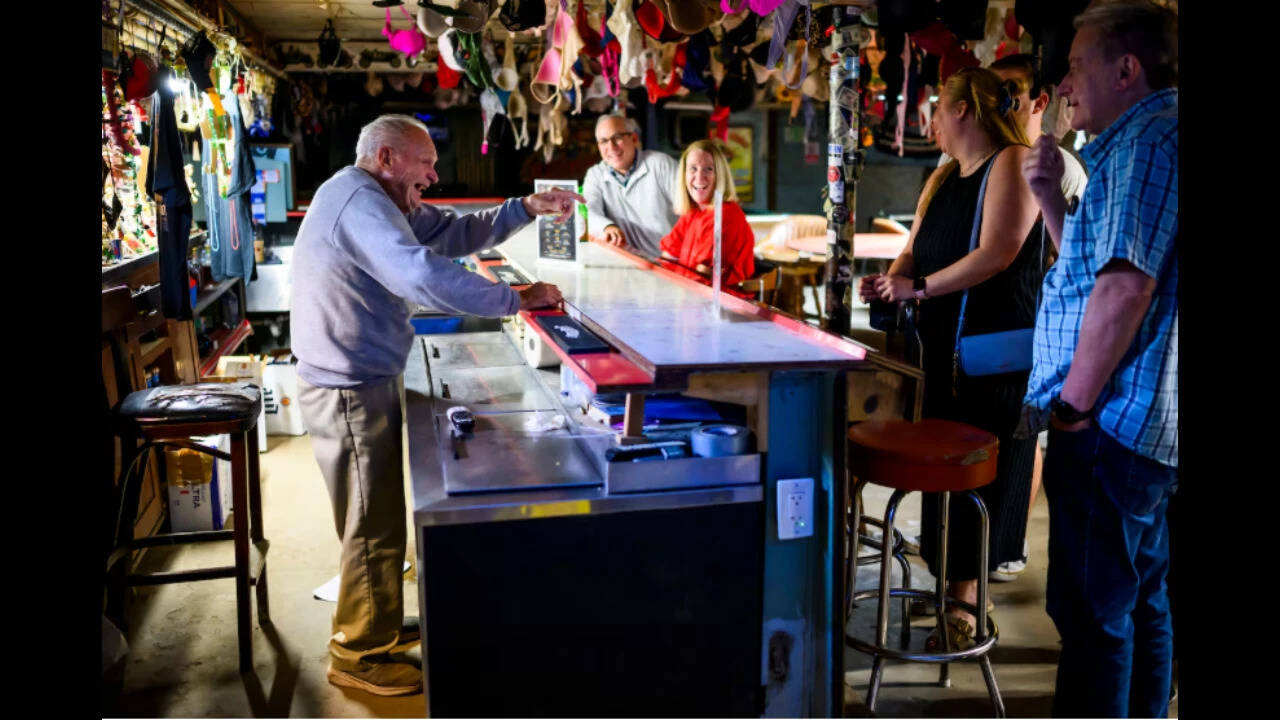
The world outside has grown loud, frantic, and aggressively digital. We trade in notifications, swipe past our neighbors, and build glass-and-steel fortresses designed to keep reality at arm's length. Yet down a winding suburban road in Pasadena, Maryland, tucked beneath a waterfront house built when William Howard Taft was in the White House, time stopped moving forward sometime around the mid-twentieth century.
Here sits Club Sunset Knoll, better known simply as Irv's Basement Bar.
At 103 years old, Irvin E. Koch is unfazed by the frantic pulse of modern life. He does not own a cellphone. He has never heard of an algorithm. He does not care about your credit card, because his establishment operates strictly on crumpled bills, loose change, and an ancient cash register that sings a satisfying metal bell chord with every transaction.
For more than six decades, Irv has been standing behind the same wooden counter. His hours are breathtakingly simple, born of an era before efficiency consultants and optimization metrics ruined our relationship with the clock.
"When the first one gets here, that's when it opens up," Irv explains.
And when does it close? Whenever the last patron wanders out into the Maryland night, or whenever Irv simply decides he has had enough standing for one day.
To understand how a clandestine neighborhood tavern managed to survive in a basement for over sixty years without being swallowed by modern municipal code, you have to look backward. The property was originally constructed in 1912 as a summer sanctuary for a prominent Baltimore meatpacking family before functioning briefly as an inn. By 1963, when Irv purchased the house, a small watering hole was already built into the subterranean foundation.
"This was up for sale. We needed a house, so we bought the house—and guess what? The bar came with it," Irv recalls with characteristic pragmatism.
He never left. What started as an unexpected architectural bonus turned into a lifetime vocation. While zoning laws shifted, insurance requirements tightened, and corporate conglomerates homogenized every street corner in America, Irv's hideaway remained entirely grandfathered into local history. County liquor-board lawyers have noted plainly that nobody could ever open such a venue today; the modern rulebook would crush it before the first keg was tapped. But history has a soft spot for places that refuse to break character.
Step inside, and you are immediately enveloped by decades of human residue. The walls, ceiling tiles, and chairs are covered in scrawled names, markers, and messages left by travelers who treat a trip down Irv's stairs as an essential pilgrimage. Old police patches adorn the wood. An aging jukebox hums old melodies into the dim, amber light. Perhaps most famously, a collection of decorated bras—starting with one left decades ago by a visitor named Amy—hangs suspended from the ceiling like strange, festive lanterns.
It is an environment born of pure authenticity. In an era where every restaurant is meticulously branded to look accidentally rustic, Irv's bar is casually, beautifully real.
Yet behind the cheap beer and the dim vintage bulbs lies a deeper, quieter human story. Long before he became a local legend, Irv was a teenager from a poor South Baltimore neighborhood who survived the crucible of the Great Depression and subsequently served in the United States Navy in the Pacific during World War II. He lost friends to the Pacific theater. He lost his younger brother, Harry, who had followed him into military service. He lived through the slow, inevitable erosion of his generation—outliving peers, colleagues, and even his wife.
When asked why he keeps doing it—why a centenarian who has every right to rest still opens his doors to strangers—Irv offers a characteristically blunt rationale.
"For the money!" he jokes.
Those who know him best tell a different story. His stepgrandson, Jason Cook—who now lives in the waterfront home with his family to help care for the aging veteran—notes that the modest income is hardly the driving force. The bar generates just enough to sustain a quiet rhythm, but the true currency traded in that basement is human connection.
"He loves interacting with people and socializing," Cook observes. "He also likes being the center of attention. That certainly seems to be what's keeping him alive."
Grief has knocked on Irv's door more than once. Life has tested him with the heavy, unyielding weight of time. But rather than retreating into isolation, Irv chose a remarkably social defiance. He opened the basement door, turned on the jukebox, and waited for the world to come to him. Generations of patrons have walked down those steps feeling stressed, disconnected, or weary of the modern churn, only to find an old sailor ready to pour a drink and offer a sharp, witty remark.
When a visitor recently asked if he realized he was widely considered the oldest working bartender in the world, Irv offered a quick, deflection wrapped in dry humor: "Don't ask me. I haven't been around the world yet."
People now drive hours out of their way, treating a visit to Irv's basement as a coveted item on a fading bucket list. They come because they sense the fragility of the moment. They know that once this particular brand of living history is gone, it cannot be replaced by an app or rebuilt by a corporation.
When asked if he harbors any grand regrets, or if he would alter the course of his extraordinary century-long journey given the chance to turn back the clock, Irv pauses only briefly.
"If I could go backwards?" he considers. "There ain't too much I would change."
As he looks toward his next milestone birthday, the routine remains unbroken. Somewhere down in Pasadena, a car pulls into the gravel driveway. A door opens. Footsteps echo down the wooden stairs into the warm, familiar dark.
And down in the basement, the light is on.