Maps lie. They have to. They try to flatten a chaotic, breathing globe onto a rectangular sheet of dead wood pulp, drawing straight black lines across rivers that flood and mountain ranges that shift in their sleep.
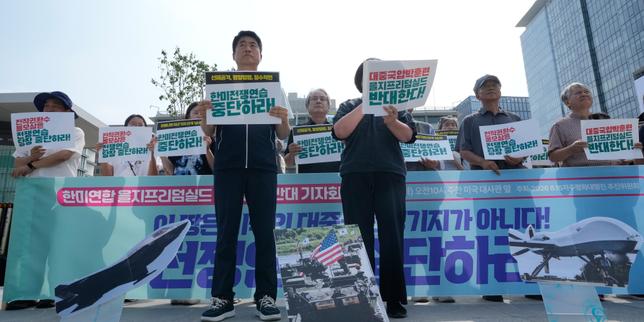
For decades, the Korean peninsula was drawn in stark, high-contrast ink. On one side, the Allied steel of Seoul and Washington locked shields in annual choreography—thousands of boots pounding frozen mud, armored columns rumbling through the valleys, and fighter jets tearing open the gray sky above the 38th parallel. On the other side, millions of eyes watched from fortified bunkers, reading every roar of a jet engine as an existential threat. It was a rhythm. A dangerous, expensive, highly predictable rhythm.
Then came the letters.
Shining, colorful sheets of paper carried across a heavily armed border inside leather briefcases. Written not in the sterile language of state department communiqués, but in the intimate, unvarnished tone of an unexpected pen pal.
Imagine standing on a ridge in Gangwon Province at dawn. The air tastes of pine and diesel. Down in the valley, the heavy machinery of the Ulchi Freedom Guardian drills sits cold and silent. The tanks are parked. The treads are caked in last night's frost. The engines are off. Silence, in a place built for noise, feels louder than artillery.
Donald Trump wanted quiet. Not because he misread the geography, but because he believed the map could be redrawn with a handshake.
History often pivots on strange, deeply personal moments. Behind the grand architecture of international summits lies something much more fragile: human ego, flattery, and the sudden, intoxicating belief that decades of institutional momentum can be undone by the force of a single relationship. When the American president looked across the negotiating table, he did not see an ideological adversary locked in a generational cold war. He saw a counterpart. Someone he could deal with. Someone who, in the strange theater of high-stakes diplomacy, sent him letters that reportedly left him captivated.
To protect that burgeoning chemistry, the calculus of global defense began to bend.
Think about what a military exercise actually is. To the public, they are acronyms read aloud on evening news broadcasts. To the generals who plan them, they are intricate, living nervous systems. Every battalion movement, every supply line simulated, every encrypted radio frequency tested is a muscle memory built over seventy years. When you scale them back, you are not just saving fuel or lowering the temperature of a diplomatic room. You are letting the muscles atrophy.
Critics called it a dangerous concession. They pointed to the empty runways and the silent artillery ranges with a quiet, mounting dread. Security, they argued, is not a gift you trade for warm words and photo opportunities.
Yet, the alternative was a spiral. We had lived through the fire and fury summer of 2017. We remember the visceral terror of children in Seoul practicing air-raid drills while leaders traded nuclear taunts like playground insults. The margin for error back then was razor-thin. A stray radar blip, a mistranslated phrase, and millions of lives could have evaporated in the span of a single afternoon.
So when the order came down to scale back the war games, it was born of a profound exhaustion with that precipice.
Let us be honest about the confusion of that era. It was dizzying. One day, the alliance was ironclad, unbreakable, forged in the blood of the Korean War. The next day, the leader of the free world was publicly questioning the cost of stationing tens of thousands of troops in Asia, referring to joint drills as provocative and exorbitantly expensive. Allies in Seoul swallowed hard. Generals in the Pentagon stared at their briefing decks in stunned disbelief.
Diplomacy is often messy, clumsy, and deeply uncomfortable to watch in real-time. It lacks the clean narrative arc of a Hollywood film.
Consider a hypothetical intelligence analyst sitting in a dim basement in Yongsan Garrison in those months. Coffee cups stacked three high. Monitors casting a pale blue glow over tired faces. They were not looking at grand geopolitical theories. They were looking at satellite imagery of North Korean test sites, trying to figure out if the pause in drills was buying genuine peace or merely giving Pyongyang the cover it needed to quietly refine its uranium enrichment programs while the world was distracted by the theater of summitry.
That is the hidden cost of personal diplomacy. It trades the institutional memory of alliances for the volatile chemistry of individuals.
When the Singapore summit concluded, the world held its breath. Trump stepped before the microphones and announced that the expensive, provocative war games would stop. The reaction was immediate. A collective gasp echoed through foreign policy circles from Washington to Tokyo. To the administration, it was a bold stroke of visionary courage. To the traditionalists, it was giving away leverage for nothing more than a photo op and a vague promise written on parchment.
We now know how that story played out. The letters stopped coming with the same frequency. The nuclear facilities continued to hum beneath the mountains. The big exercises eventually crept back, rebranded, restructured, but fundamentally anchored to the same old anxieties.
The ink on those diplomatic agreements faded quickly under the harsh light of reality.
Yet, something fundamental shifted. The illusion that these alliances were permanent, unchanging fixtures of the natural world was shattered forever. We learned that the architecture of global security is only as strong as the political will of the leaders inhabiting it at any given second.
The mountains along the DMZ do not care about letters. They do not care about the sudden warmth between two men who command the fates of millions. They stand there, cold and indifferent, watching the mists rise and fall.
We are left in the aftermath of that strange season, holding a map that no longer matches the terrain. The drills have resumed, but the innocence of the alliance is gone. We know now how close the machinery of war can come to stopping, and how easily a president can reach out a hand and quiet the thunder, if only for a moment, to see if the world sounds different without the noise.