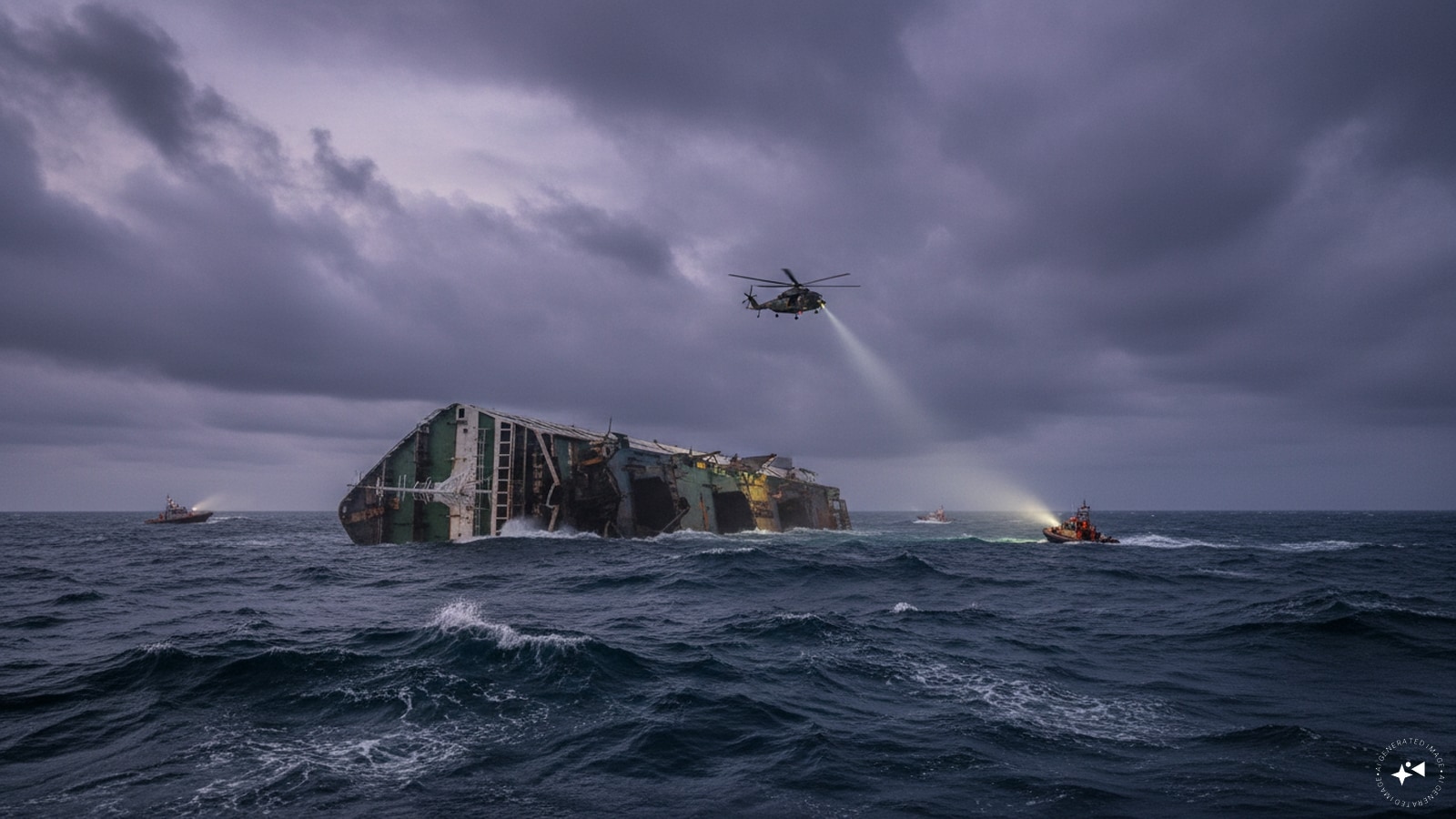
Archipelagic logistics systems rely heavily on inter-island ferry networks to sustain passenger mobility and supply chains. When a passenger vessel capsizes, such as the recent incident in the Java Sea leaving 129 people missing, the event is frequently mischaracterized as an unpredictable environmental anomaly. A rigorous examination of transit failures reveals a predictable sequence of structural vulnerabilities involving vessel stability limits, regulatory enforcement gaps, and the spatial dynamics of maritime search operations.
The Economics of Fleet Overload
The baseline economic model for regional ferry operators relies on high passenger and cargo volume per transit to offset fixed operational expenses, primarily fuel and maintenance. This financial pressure creates an structural incentive to exceed official load capacities.
When a vessel departs with passenger counts exceeding safety thresholds, two physical parameters change simultaneously:
- Center of gravity shifts upward due to passenger movement and unsecured cargo placement.
- Freeboard height decreases, reducing the reserve buoyancy needed to resist dynamic wave action.
In typical transit environments across the Java Sea, seasonal weather patterns generate irregular wave frequencies. A vessel operating near its maximum deadweight tonnage loses the margin of error required to recover from lateral wave impacts. The transition from stable navigation to sudden capsizing is governed by metacentric height calculations where external torque exceeds righting moments within seconds.
Regulatory Enforcement Gaps
Statutory frameworks governing maritime safety in Indonesia are comprehensive on paper, outlining strict mandates for life-saving appliances, manifests, and weather clearance certificates. The failure point lies entirely within enforcement architecture at departure ports.
Port authority checks often rely on visual inspections and self-reported manifest data rather than automated weight verification systems or strict passenger turnaround protocols. This creates an institutional blind spot. Operators face minimal financial disincentives for non-compliance compared to the immediate profit loss of leaving passengers behind or delaying departure for adverse weather verification.
When enforcement relies on discretion rather than mandatory electronic gating, safety protocols degrade into administrative checkboxes. The structural result is a persistent fleet-wide vulnerability profile where undocumented passengers and excess cargo routinely bypass oversight.
Search and Rescue Response Latency
The logistical complexity of locating a capsized vessel and survivors across open oceanic sectors depends on rapid initial positioning and environmental modeling. When 129 individuals are missing following a Java Sea incident, search and rescue teams face an exponential decay curve regarding survivor recovery probability.
Search operations are dictated by distinct operational variables:
- Surface drift vectors driven by prevailing wind friction and tidal currents.
- Thermal dissipation rates for human subjects in open water.
- Sensor coverage limits of aerial and surface assets across wide search grids.
Because maritime distress signals are often delayed or absent when a vessel sinks rapidly, the initial search datum is frequently inaccurate by several nautical miles. Search planners must compute probability maps that expand exponentially over time. Every hour of delay increases the search area multiplicatively, reducing the probability of intercepting drifting subjects before hypothermia or dehydration compromises survivability.
Systemic Interventions for Transit Safety
Mitigating future disasters requires a transition from reactive emergency response to predictive operational controls. Incremental safety campaigns fail because they target crew behavior rather than the economic and institutional drivers of overloading.
Mandatory digital ticketing integrated with automated turnstile tracking at all municipal ports would establish real-time passenger manifests, preventing unregistered boarding. Simultaneously, installing load-sensor telemetry linked directly to national maritime authority servers would strip local harbor masters of discretionary override powers regarding vessel departure clearances.
Without binding technical constraints enforced through automated systems, maritime transit networks will continue to absorb catastrophic losses whenever environmental conditions stress compromised hull stability.