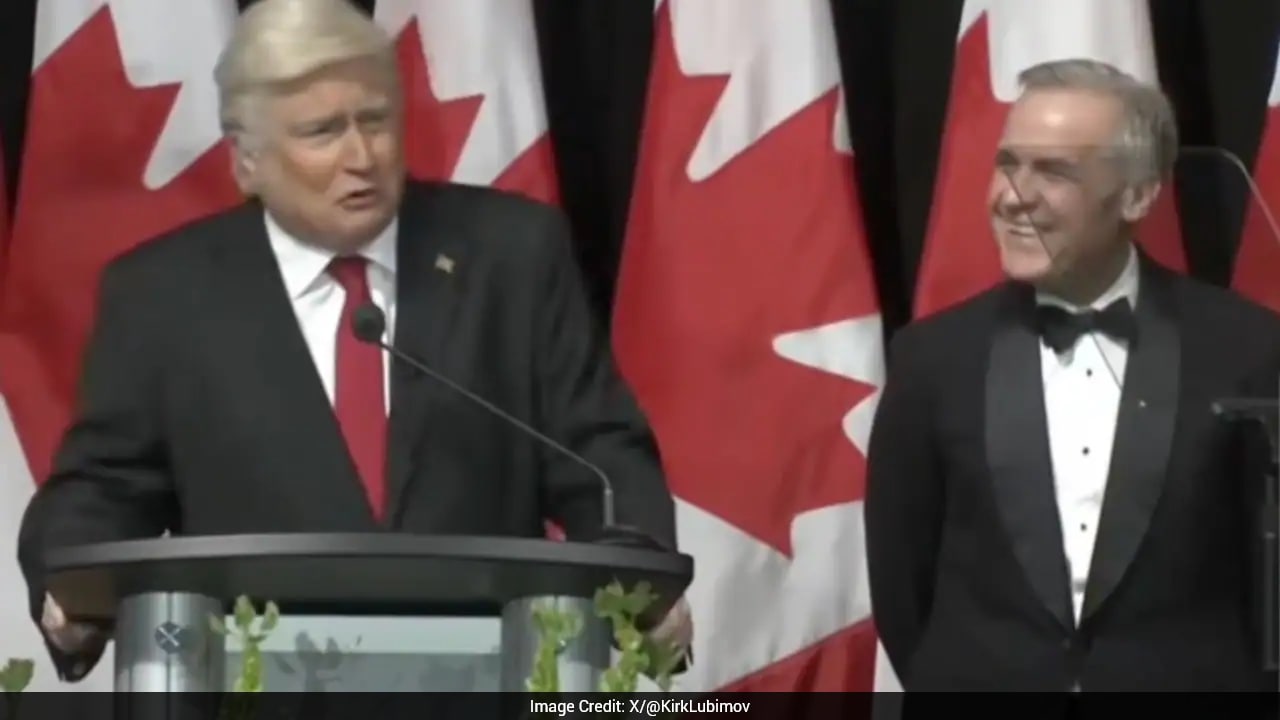
Political pundits love a punchline. Give the Ottawa press corps a room full of tuxedo-clad elites, an open bar, and a Prime Minister willing to make a self-deprecating joke about his own backside, and they will churn out thousands of words treating a high-stakes diplomatic warning like a weekend comedy special.
That is the lazy consensus surrounding Mark Carney’s appearance at the Parliamentary Press Gallery dinner. The mainstream media coverage focused entirely on the surface-level optics. They cataloged the vulgar jokes, giggled at the cheap shots aimed at the Oval Office, and framed the evening as a charming humanizing exercise for a famously technocratic central banker turned politician.
They missed the entire point.
When a man who spent years running both the Bank of Canada and the Bank of England steps up to a podium, nothing is accidental. Central bankers do not wing it. Every syllable is priced into the market before it leaves their mouths. Treating Carney’s roast as lighthearted banter is like watching a heavyweight boxer throw a stiff jab to measure distance and writing a review about how nice his gloves look.
The Myth of the Harmless Political Roast
To understand what actually happened in that ballroom, you have to abandon the romanticized delusion that political roasts are harmless pressure valves. In Washington, the White House Correspondents' Dinner has long served as a mutual admiration society where journalists and politicians pretend to hate each other before sharing cabs to the same after-parties.
Ottawa is different, and the current geopolitical climate is volatile.
When Carney took aim at US-Canada ties and dropped barbs directed at the Oval Office, he was not trying to win a Netflix special. He was executing a time-tested communications maneuver known in crisis management and high-level diplomacy as signaling through plausible deniability.
If the Prime Minister of Canada stands at an official podium in Parliament and attacks the sitting President of the United States, it triggers an immediate diplomatic incident. Ambassadors get summoned. Retaliatory tariffs get drafted before the evening news airs. Markets panic.
If the exact same message is delivered over dessert at a press dinner, wrapped in a joke about his own anatomy, the message lands in Washington with the exact same force, yet the State Department cannot formally complain without looking thin-skinned. It is asymmetrical diplomatic warfare disguised as stand-up comedy.
Why the Press Corps Fell for the Decoy
I have spent two decades advising executives and public figures on high-stakes media strategy. I have watched brilliant leaders destroy their own credibility because they let reporters dictate the framing of an event, and I have watched mediocre leaders survive massive scandals because they threw the press a shiny, vulgar object to chase.
Carney threw them a shiny object.
By leaning into crude humor—specifically jokes targeting his own physical attributes and perceived stiffness—Carney exploited a fundamental weakness in modern political journalism. Reporters are desperate for narrative simplicity. The prevailing narrative around Carney has always been that he is an aloof, Goldman Sachs-minted elitist who lacks the common touch required for retail politics.
When he tells a dirty joke, the press corps collectively gasps, writes down the quote, and congratulates themselves for capturing a "rare unscripted moment." Meanwhile, the actual policy signaling slips right past their editors untouched.
Let us look at the mechanics of the room that night:
- The Hook: Self-deprecating, slightly blue humor designed to lower the audience's analytical defenses and guarantee viral headlines.
- The Pivot: Once the room is laughing, the speaker introduces a sharp, uncomfortable truth about bilateral trade and American unpredictability.
- The Shield: Any criticism of the geopolitical jab is immediately deflected by critics being told they "cannot take a joke."
This is basic behavioral psychology. Daniel Kahneman spent his career documenting how human attention works, specifically how emotional arousal—like shock or laughter—temporarily suspends critical scrutiny. Carney used a room full of seasoned political journalists as unwitting distribution channels for a message aimed squarely at the White House and the global bond markets.
Dismantling the US-Canada Diplomatic Illusion
The conventional wisdom in North American business circles is that the US-Canada relationship is too big to fail. Analysts point to the trillions in bilateral trade, the integrated automotive supply chains, and the longest undefended border in the world as proof that friction between Ottawa and Washington is always temporary.
That assumption is dangerously outdated.
We are operating in an era of aggressive economic nationalism. The polite fiction that Washington will always treat Ottawa as a favored little brother died years ago, yet Canadian commentators still clutch to it like a security blanket. Every time a Canadian leader makes a sharp remark about American protectionism or Oval Office chaos, the pundit class clutches its pearls and worries about "poke-the-bear" diplomacy.
They are asking the wrong question. They keep asking whether Carney’s jokes risked offending the American administration. The real question is whether silence would have signaled weakness to domestic voters and international investors.
Canada is an export-dependent economy sitting next to an increasingly erratic superpower. If the Canadian Prime Minister acts like a nervous subordinate afraid to mention the elephant in the room, capital flees. Investors do not want a leader who begs for mercy from Washington; they want a leader who understands the leverage Canada actually holds—energy, critical minerals, fresh water, and geopolitical stability—and isn't afraid to remind the neighbors of it.
What Everyone Gets Wrong About Technocrats in Politics
There is a persistent, lazy trope that former central bankers make terrible politicians because they lack charisma. People point to the dry, agonizingly precise language of monetary policy statements and assume the person reading them has the personality of a spreadsheet.
That misunderstands the job of a central banker.
When you run a G7 central bank during a financial crisis, your primary weapon is not interest rates. Your primary weapon is forward guidance—the ability to manipulate human expectations using nothing but carefully chosen words. You learn quickly that tone, inflection, and strategic ambiguity move billions of dollars faster than actual policy changes.
Carney did not suddenly learn how to work a room when he entered politics. He spent years working rooms filled with the most cynical, ruthless bond traders on earth. Compared to trying to calm down a panicked trading floor in London during Brexit, making a room of Ottawa journalists laugh is child's play.
He knew the media would obsess over the vulgarity. He knew the clip of him roasting himself would dominate social media feeds for forty-eight hours. And he knew that tucked inside that viral clip was a clear, unmistakable signal to both his domestic base and his American counterparts: Canada is not going to sit quietly and absorb economic shocks without pushing back.
The Hidden Risks of Weaponized Humor
To be clear, this strategy is not bulletproof. Weaponizing humor in high-stakes diplomacy carries severe, asymmetric risks that can backfire spectacularly if the execution slips by even a millimeter.
First, there is the problem of audience fragmentation. A joke that lands brilliantly in a dimly lit ballroom in Ottawa can read like an arrogant insult when translated into a three-second soundbite on cable news in Ohio or Pennsylvania. In an era where algorithms strip away all context, relying on irony or sarcasm is playing with fire. If American voters—and by extension, American lawmakers—hear only the punchline without the self-deprecating setup, the plausible deniability evaporates instantly.
Second, self-deprecation has a shelf life. It works brilliantly the first time an aloof technocrat uses it because it violates expectations. Do it twice, and it looks like a rehearsed parlor trick. Do it three times, and you risk validating the exact caricature you are trying to destroy. If Carney leans too heavily on the "look how normal and funny I am" routine, voters will stop seeing a serious crisis manager and start seeing a politician trying too hard to be liked.
Third, the markets eventually demand substance over theater. You can buy time with clever rhetoric, and you can soothe nerves with a well-timed roast, but you cannot joke your way out of structural productivity deficits, housing crises, or punitive tariffs. If the diplomatic warning shot is not backed up by hard-nosed trade negotiations and actual economic reform, the punchlines quickly turn bitter.
How to Actually Read Political Theater
If you want to understand where North American policy and markets are heading, stop reading the recap articles that grade politicians on their comedic timing. Those pieces are written for people who treat politics like a reality television show.
Instead, apply a basic intelligence-gathering framework to every high-profile public appearance:
- Ignore the laughs, track the targets. Who was the butt of the joke? If a leader mocks themselves, they are trying to disarm a known vulnerability. If they mock an ally, they are testing the boundaries of a strained relationship without triggering a formal crisis.
- Look at the timing against economic calendars. Political speeches do not happen in a vacuum. Check what trade negotiations, central bank announcements, or legislative votes are scheduled within fourteen days of the event. You will almost always find a direct correlation between the "off-the-cuff" remark and an impending closed-door negotiation.
- Watch the reaction of the bureaucrats, not the pundits. Pundits react to tone; bureaucrats react to intent. If an embassy issues a stiff "no comment" or suddenly schedules a background briefing the next morning, the joke wasn't a joke. It was a shot across the bow.
Stop Confusing Entertainment With Strategy
The coverage of Mark Carney’s roast is a textbook case of media myopia. By reducing a calculated display of diplomatic signaling to a list of cheap laughs and anatomy jokes, commentators proved why they are consistently blindsided by major political and economic shifts.
They were looking at the clown shoes while missing the steel-toed boots underneath.
In modern statecraft, the podium at a comedy dinner is often more dangerous than the podium at the United Nations. Nobody expects a knife fight over dessert, which is precisely why smart leaders bring one. Next time a central banker steps up to a microphone and tells a dirty joke about the leader of the free world, stop laughing and check your portfolio.