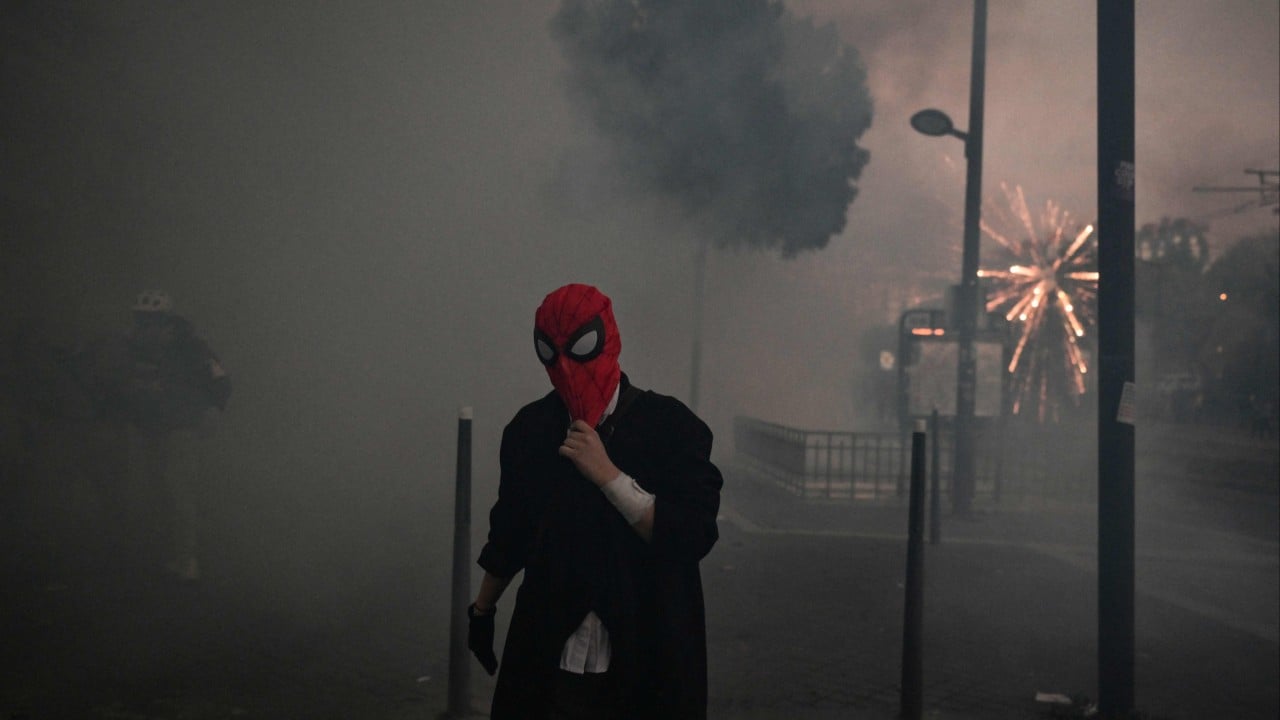
The smell of roasted chestnuts always hits you first on the Boulevard Voltaire, right before the tear gas does.
If you have ever stood in a Parisian crowd during an autumn mobilization, you know that particular alchemy of scents—wet wool, cheap tobacco, fried dough, and then, suddenly, that sharp, metallic sting at the back of your throat that makes your eyes water before your brain even registers a threat. On October 31, the last day of October, that familiar sensory cocktail returned to the streets of France, draped in the macabre irony of Halloween. Hundreds of thousands of people marched from Paris to Marseille, from Lyon to Nantes, turning an evening usually reserved for children begging for sugar into a roaring, smoke-choked referendum on the future of the French Republic.
To read the standard wire reports is to consume a sterile diet of numbers and property damage. You will read about smashed bank windows, overturned scooters, riot police deployed in armored columns, and interior ministry estimates pitted against union headcounts. Those reports tell you what happened. They entirely miss why a seventy-year-old retired nurse would put on a skeleton mask and walk five miles in the freezing rain alongside an eighteen-year-old university student wearing a plastic Guy Fawkes grin.
They miss the quiet desperation that turns a festive evening into a flashpoint.
The Architecture of a Boiling Point
To understand why France erupts with such clockwork regularity—and why this specific Halloween demonstration carried a sharper, darker edge than the protests of seasons past—you have to stop looking at the cobblestones and start looking at kitchen tables.
Consider a hypothetical family living in the outer ring of Lyon. Let us call them the Moreaus, though they are a composite of millions of households across the hexagon. Marc is forty-six, a logistics coordinator whose wages have remained stubbornly flat for four years. Claire is forty-four, a teaching assistant who spends her evenings grading papers under a single desk lamp because they agreed to keep the thermostat set at sixteen degrees Celsius until December. For the Moreaus, inflation is not an abstract metric debated by economists on evening television; it is the decision to put the olive oil back on the supermarket shelf and buy sunflower oil instead. It is the quiet dread that arrives every time the boiler makes a rattling noise in the basement.
When people like the Moreaus look at Paris, they do not see a gleaming capital of culture and high finance. They see an insulated fortress where technocrats pass budgets using constitutional loopholes, bypassing parliamentary votes to push through austerity measures, pension adjustments, and cuts to public services.
That is the invisible engine of French street politics. In countries where the legislature functions as a genuine release valve for public anger, frustration dissipates through speeches, amendments, and compromise. In France, the Fifth Republic was intentionally designed by Charles de Gaulle in 1958 to concentrate immense executive power in the hands of the president. Think of the French political system like a heavy cast-iron pressure cooker with a welded shut safety valve. You can turn up the heat—rising grocery bills, stagnant wages, unpopular decrees—and the pot will sit there silently, absorbing the energy, until the metal itself gives way.
The street is not a hobby for the French. It is their legislature.
Behind the Cardboard and Face Paint
By mid-afternoon on October 31, the Place de la République in Paris looked less like a political rally and more like a surrealist theater production gone off the rails.
Hundreds of thousands of citizens had answered the call of the major labor confederations—the CGT, Force Ouvrière, and student unions—to protest the latest wave of budget cuts and the relentless squeeze on purchasing power. Because it was Halloween, the visual language of the protest shifted. Protesters carried papier-mâché effigies of government ministers dressed as vampires draining blood from a giant cardboard paycheck. Others wore skull makeup, holding hand-painted signs reading Morts de faim—starving to death—or Notre retraite est un film d'horreur—our retirement is a horror movie.
Gallows humor has always been the armor of the French working class. When you feel powerless against a state apparatus that seems deaf to your existence, mockery is the only weapon left that does not require a permit.
I remember standing near a brass band playing a jaunty, off-key rendition of Bella Ciao just off the Place de la Bastille during a similar demonstration a few years back. A woman standing next to me, wearing a bright orange high-visibility vest over a tailored trench coat, turned to me and laughed as a group of masked youths sprinted past carrying a stolen construction barrier. "Look at them," she said, shaking her head, though there was no anger in her voice. "They think they are fighting a war. I am just here so my daughter can afford to go to university without taking out a loan she will pay off until she is fifty."
That distinction is crucial, and it is almost always erased when the headlines scream about clashes.
A massive French demonstration is never a monolith. It is an ecosystem. At the front and center march the families, the hospital workers, the teachers, the railway engineers, and the retirees. They walk slowly, pushing strollers, sharing thermoses of coffee, chanting slogans that have echoed down these exact Haussmannian boulevards since the days of the Paris Commune in 1871.
And then, clinging to the edges like storm clouds gathering around a mountain peak, is the Black Bloc.
The Anatomy of a Clash
Around 4:30 PM, as the early autumn dusk began to settle over the Seine and the streetlamps flickered on, the mood in Paris curdled.
It happened the way it always happens. Near the Boulevard Beaumarchais, a column of individuals dressed entirely in black—hoods up, goggles strapped tight, faces obscured beneath balaclavas—broke away from the main body of the march. Within minutes, the rhythmic chanting of the unions was drowned out by the percussive thud-thud-thud of heavy hammers striking reinforced glass. Bus shelters shattered into glittering piles of safety crystal. The facade of a luxury real estate agency was spray-painted with anarchist symbols and set alight.
From the side streets, the Compagnies Républicaines de Sécurité—the notorious CRS riot police—moved in with mechanical precision.
If you have never seen a CRS charge up close, it is a terrifying spectacle of modern state power. Dressed in full body armor that makes them resemble dark, faceless beetles, carrying clear polycarbonate shields and batons, they advance in a tight phalanx, drumming their shields in unison to create a psychological wall of sound.
Then come the canisters.
A tear gas grenade does not just release smoke; it explodes with a deafening concussive bang that rattles your ribcage and triggers an immediate, primal panic response in the human nervous system. Within seconds, thick white plumes blanketed the avenue. Ordinary protesters—people who had spent the afternoon peacefully holding cardboard signs—were suddenly blinded, choking, stumbling over curbs, clutching at strangers' coats to find their way toward clean air.
In the chaos, street medics wearing white helmets marked with red crosses rushed into the fog with saline bottles to flush out burning eyes. Meanwhile, at the front lines, young militants hurled paving stones, glass bottles, and commercial-grade fireworks back at the police lines, painting the smoke-filled sky in violent flashes of red and green.
By nightfall, the pattern had repeated itself across the country. In Nantes, a city with a long, fierce tradition of radical labor activism, fires burned in the middle of tram tracks while water cannons swept the squares. In Lyon, police deployed tear gas near the Rhône to disperse crowds attempting to block major intersections. Across France, dozens of arrests were made, dozens of officers and protesters were treated for injuries, and millions of euros in urban infrastructure lay in ruins.
Why the Violence Never Solves Anything—Yet Never Stops
It is easy, from the comfort of a quiet living room thousands of miles away, to condemn the broken glass and move on. Violence is ugly. Burning trash cans do not lower the price of bread, and smashing the window of a neighborhood bank branch does not rewrite a national budget.
Yet if we stop at moral condemnation, we blind ourselves to a profound political truth.
I will admit something that rarely makes it into tidy journalistic analyses: watching these scenes unfold year after year leaves me deeply conflicted. On one hand, you feel an visceral revulsion at the wanton destruction—knowing that the municipal workers sweeping up the shattered glass at four in the morning belong to the exact same working class the rioters claim to defend. On the other hand, you cannot ignore the uncomfortable historical reality that in France, peaceful politeness rarely moves the needle.
Consider the numbers. According to interior ministry figures—which are notoriously conservative—over 300,000 people took to the streets across France on Halloween. Union organizers placed the figure closer to 800,000. Regardless of which ledger you trust, that represents a massive civic mobilization on a working Thursday.
Why did it turn violent? Because when hundreds of thousands of citizens scream at a wall for months and the wall does not even vibrate, a fringe element inevitably decides to bring a sledgehammer. And once the sledgehammer comes out, the state responds with batons, and the cameras immediately pivot away from the 300,000 peaceful marchers to focus exclusively on the 300 people throwing rocks.
It is a tragic, mutually reinforcing choreography. The government uses the images of burning cars to delegitimize the entire protest movement as a threat to public order, avoiding any serious debate about wages, pensions, or taxation. Meanwhile, the radicals interpret the heavy-handed police response as proof that the state is an authoritarian enemy that can only be confronted with force.
Caught directly in the crossfire are the Moreaus—the teachers, the nurses, the delivery drivers—who simply wanted their government to hear that the math of their daily lives no longer works.
The Ghosts Walking Home
By 9:00 PM, the rain began to fall harder over Paris, washing the residue of tear gas down into the storm drains.
The sirens gradually faded into the distance, replaced by the low hum of street-sweeping trucks and the clatter of metal shutters being pulled down over storefronts. In the neighborhoods surrounding the Place de la Nation, actual Halloween trick-or-treaters—children dressed as tiny witches and superheroes, escorted by nervous parents—hurried down the wet sidewalks, stepping carefully around piles of wet ash and shards of broken glass.
It was a jarring, unforgettable collision of two worlds.
Think about what those children saw on their walk home. They saw a society at war with itself, where adults felt compelled to put on masks just to demand a dignified living, and where the state met their anger with armored shields and chemical smoke.
France has survived centuries of upheaval precisely because its citizens refuse to go quietly into economic decline. That fierce, stubborn refusal to accept indignity is one of the country's greatest civic virtues. Yet a democracy cannot survive indefinitely on street battles and emergency decrees. When the distance between the governed and those who govern grows so vast that the only remaining medium of communication is fire and tear gas, something fundamental in the social contract has snapped.
Near the entrance to the Oberkampf metro station, long after the crowds had dispersed, a discarded protest sign lay soaked in a puddle beneath a flickering streetlamp. The rain had blurred the black marker ink, turning the slogans into dark, weeping streaks across the wet cardboard, while a single plastic skeleton mask sat beside it in the gutter, staring up at the empty Parisian sky with hollow, unblinking eyes.