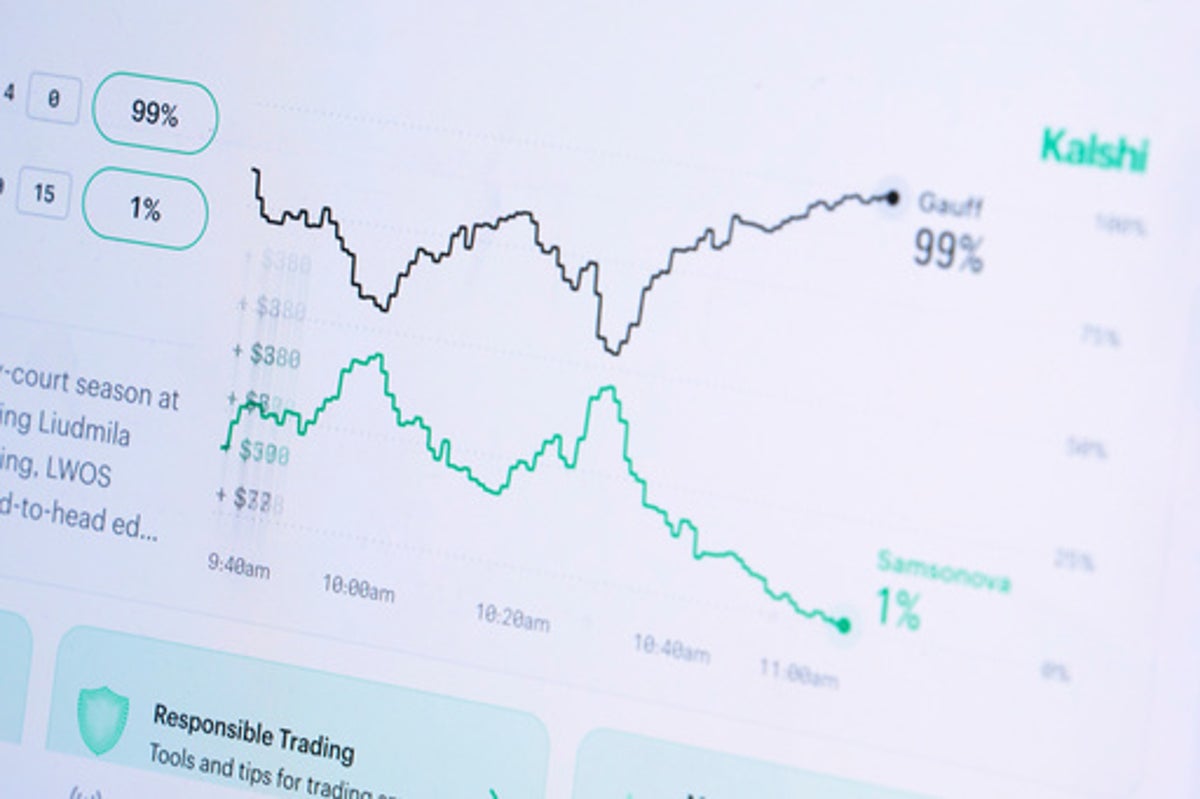
Prediction markets promised to be the ultimate truth machine, a way to aggregate the wisdom of the masses to forecast everything from election results to the price of eggs. Instead, they have morphed into a high-stakes hunting ground where retail speculators are systematically drained by a small cohort of professional algorithmic traders. While the surface narrative suggests these platforms democratize information, the underlying mechanics tell a different story. The average participant isn't just betting against the house; they are betting against specialized software and institutional-grade data feeds that move faster than any human can blink.
The Architecture of the Sucker Bet
The fundamental flaw in modern prediction markets lies in the illusion of a level playing field. On platforms like Polymarket or Kalshi, users buy "shares" in an outcome. If you think a specific event will happen, you buy the "Yes" side. If the event occurs, your share pays out a dollar. The price of that share represents the market’s perceived probability of the event. A price of $0.60 suggests a 60% chance of success. In other developments, read about: Why Rheinmetall Q1 Earnings Miss Is Just a Blip in the Defense Boom.
This seems straightforward. It isn't.
In a traditional stock market, value is often tied to long-term growth or earnings. In a prediction market, value is binary and temporary. This creates a zero-sum environment where every dollar won by a "whale" or a professional firm is a dollar directly extracted from a retail trader. Unlike sports betting, where a bookmaker sets a line and takes a margin (the vig), prediction markets are peer-to-peer. This sounds more fair, but it actually removes the buffer. You aren't fighting a sportsbook; you are fighting a quant who has spent $50,000 on a custom API integration to front-run news. Investopedia has also covered this fascinating subject in great detail.
The Information Gap
Consider how information travels. When a major political figure makes a surprise announcement, that news hits specialized terminals and high-speed data scrapers seconds before it reaches social media. On a prediction market, those seconds are an eternity.
Professional outfits use automated bots to scan news wires for keywords. If a "breaking" alert hits, the bot executes a trade on the relevant market before the average user has even unlocked their phone. By the time the retail trader sees the news and goes to buy "Yes" shares, the price has already adjusted. The "easy money" is gone. The retail trader ends up buying at the top of the move, essentially providing liquidity for the professional to exit their position with a guaranteed profit.
Why the Wisdom of the Crowd Often Fails
The "wisdom of the crowd" theory suggests that if you ask enough people a question, the average of their answers will be close to the truth. This holds up when people are making independent guesses about the number of jellybeans in a jar. It falls apart when the participants are influenced by the same biased information streams.
In prediction markets, we see a massive "echo chamber" effect. Because these platforms often attract a specific demographic—typically younger, tech-savvy, and politically active individuals—the prices reflect the biases of that group rather than an objective reality.
Sentiment Over Substance
Take, for instance, a hypothetical market on whether a specific tech CEO will resign by the end of the year. If the CEO is unpopular among the platform's user base, the "Yes" price will often stay irrationally high. People are betting on what they want to happen, or what they feel will happen, rather than the contractual realities of the CEO's employment.
Professional traders love this bias. They don't care about the CEO. They care about the mathematical delta between the "irrational" market price and the "rational" probability. They wait for the crowd to push a price to an extreme, then they take the other side. They aren't predicting the event; they are predicting the crowd's mistake.
The Liquidity Trap
One of the most significant hurdles for these platforms is "thin" liquidity. In a massive market like the S&P 500, you can buy or sell thousands of shares without moving the price more than a fraction of a cent. In most prediction markets, the volume is minuscule.
If a market has only $10,000 in total liquidity, a single $500 bet can swing the "probability" by five or ten points. This makes the markets incredibly easy to manipulate. "Wash trading"—where one person buys and sells to themselves to create the appearance of activity—is a constant shadow over the industry. By artificially moving the price, a manipulator can create a false sense of momentum, tricking others into jumping in. Once the price reaches a certain level, the manipulator dumps their position, leaving the latecomers holding worthless "shares."
The Regulatory Grey Zone
While some platforms have fought for and won approval from regulators like the CFTC, many operate in a legal netherworld. This lack of oversight means there are fewer protections against insider trading.
If a staffer at a major news network knows a poll result ten minutes before it goes live, there is nothing stopping them from placing a bet on a prediction market. In the regulated stock market, this would be a felony. In the wild west of crypto-based prediction markets, it’s just another Tuesday. The retail trader is effectively playing a game of poker where half the players at the table can see through the back of the cards.
Structural Disadvantages for the Common User
Even when the market isn't rigged, the math is stacked against the casual participant.
- Opportunity Cost: Your money is locked up until the event occurs. If you bet on an election a year away, that capital is sitting idle.
- Transaction Fees: Between exchange fees and the cost of moving money onto the platform, you might need to be right 55-60% of the time just to break even.
- Tax Complexity: Every trade is a taxable event. Calculating the gains and losses on hundreds of small bets is a nightmare that most retail users aren't prepared for.
The Professionalization of "Hunch"
The people winning consistently on these platforms aren't following their gut. They are building models. These models incorporate historical data, polling averages, and even weather patterns. They use Bayesian statistics to update their probabilities in real-time.
When you place a bet because you "have a feeling" about a football game or a court case, you are going up against a Monte Carlo simulation that has run 10,000 versions of that event. You are bringing a knife to a drone strike.
The professionalization of these markets has stripped away the "fun" and replaced it with cold, hard efficiency. This efficiency is good for "finding the truth," but it’s terrible for the casual user who just wants to back their favorite candidate or team. The spreads tighten, the "mispriced" bets vanish instantly, and the window for profit becomes a needle's eye.
The Ethics of Forecasting
There is a deeper, more unsettling question about what happens when we turn everything into a market. When we put a price on a tragedy, a natural disaster, or a war, we create incentives for people to want those things to happen.
Critics argue that prediction markets on sensitive topics can lead to "incentivized interference." If enough money is riding on a specific outcome, someone might be tempted to tip the scales in the real world. While we haven't seen a large-scale example of this yet, the financial motivation is baked into the system. As the pools of money grow from thousands to millions, the temptation only increases.
The Exit Strategy
If you are going to participate in these markets, you must stop treating them as a way to "earn" a living or "invest" your savings. They are a form of high-complexity gambling.
To survive, you have to look for the "dumb money." This means finding markets where emotions run high and the pros haven't arrived yet. Avoid the high-volume political or sports markets where the algorithms dominate. Look for niche, technical questions where specialized knowledge actually counts for more than a high-speed data feed.
Understand that the price you see on the screen isn't the "truth." It is simply the current equilibrium between people who are guessing and people who are calculating. Most of the time, the people calculating are the ones taking the money.
Don't be the liquidity for someone else's exit. If you can't identify the sucker in the market within five minutes, it's you. Stop looking for the "sure thing" and start looking at the order book. The depth of the market tells you more about the reality of the situation than any headline ever will. If the volume is low and the spread is wide, you aren't trading; you're donating.
The house doesn't always win in prediction markets, but the person with the fastest computer and the biggest bankroll usually does. Every time you click "buy," remember that on the other side of that trade, there isn't just another person—there's likely a server farm in a basement making sure your "hunch" pays for its electricity bill.