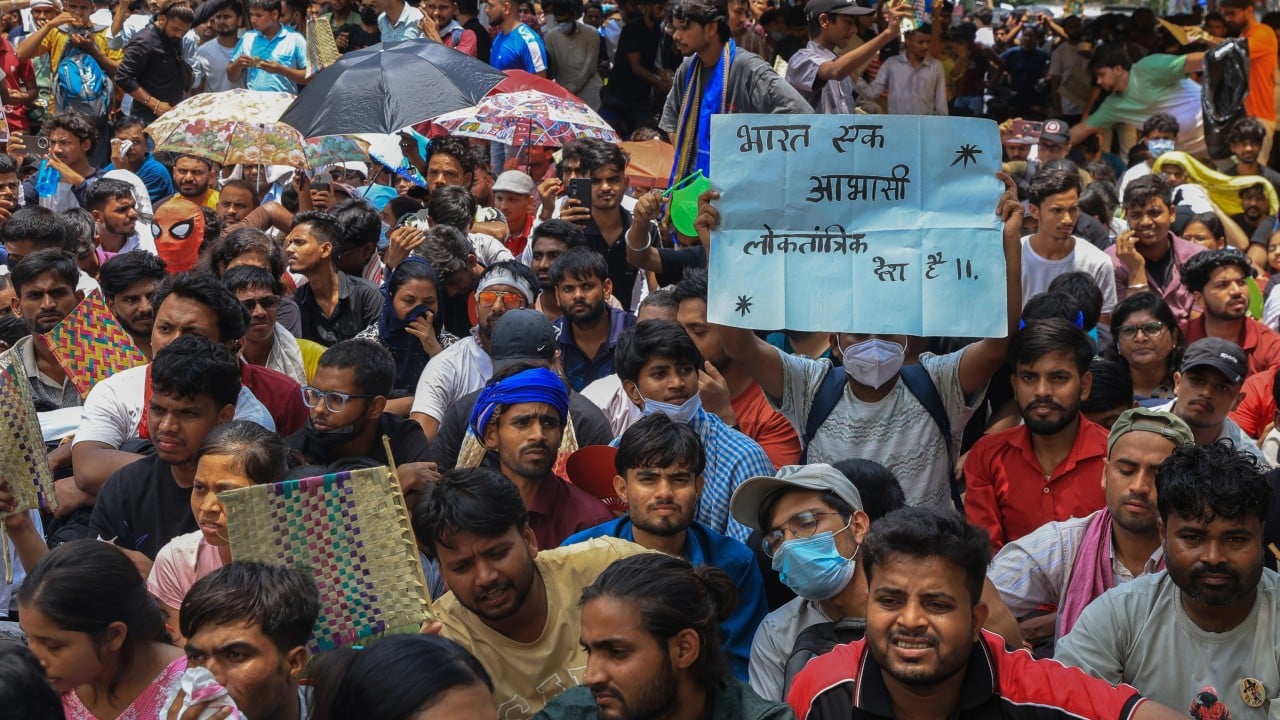
Political stability in modern electoral democracies rests on an unwritten social contract: educational credentialism must reliably convert into economic mobility. When this conversion mechanism fails, public dissent evolves from ideological opposition into structural friction. Recent friction points in India, manifest in large-scale mobilization around administrative failures like professional examination paper leaks, highlight a fundamental calibration error in governance models that once enjoyed uncritical youth support. Analysts who attribute this shift entirely to surface-level grievances or ephemeral internet memes misdiagnose a deeper structural realignment.
The friction is best understood through a three-tier analytical model: the Credentialism Bottleneck, the Accountability Deficit, and the Information Architecture Shift.
The Credentialism Bottleneck and Economic Friction
The baseline expectation of an aspirational demographic cohort is efficient labor market clearing. India possesses the world's largest youth demographic dividend, a structural advantage that transforms into an economic liability if absorptive capacity remains restricted. Official metrics often point to absolute employment growth or falling aggregate unemployment rates, but these macro figures mask a critical qualitative mismatch.
The core issue is underemployment and the high cost of credential acquisition. Millions of young citizens invest years and significant familial capital into preparing for highly competitive civil service examinations or professional entrance tests. When systemic administrative failures—such as repeated paper leaks affecting millions of applicants—invalidate these cycles, the financial and psychological loss is immediate.
This creates a negative cost function for participants:
- Direct financial loss spent on coaching and preparation infrastructure.
- Opportunity cost of delayed entry into productive economic activity.
- Psychological depreciation resulting from perceived institutional indifference.
When competitive pathways break down, the frustration is no longer confined to traditionally marginalized segments or opposition strongholds. It cuts across class and caste boundaries, drawing in middle-class and upper-caste youth who previously formed the core of the incumbent political base.
The Accountability Deficit
In centralized political structures, executive authority relies on a top-down signaling mechanism. Responsiveness is often mediated through administrative bureaucracy, which can insulate leadership from ground-level feedback loops. Over extended tenures, this institutional insulation breeds an accountability deficit.
When street-level protests emerge—such as those organized by youth collectives demanding systemic examination overhauls and leadership resignations—the state's initial reflex is frequently security-oriented rather than diagnostic. The deployment of physical deterrence against educated, aspirational youth alters the political psychology of entire households. When middle-class parents observe heavy-handed policing directed at peaceful demonstrators, the political calculus shifts from abstract loyalty to immediate familial protection and demand for institutional redress.
The political risk for an established administration lies in the transition of dissent from fragmented grievances into unified coalitions. Historically, Indian political movements derived strength from sectional interests, such as agrarian unions or identity-based groups. Youth-led movements driven by systemic institutional breakdown transcend these traditional fault lines, unifying disparate demographics under a shared banner of administrative competence and transparency.
Information Architecture and Mobilization Velocity
Traditional political communication relied on vertical channels controlled by party machinery or mainstream media. Today, the velocity of political alignment is governed by decentralized digital networks. Memes, satirical digital assets, and rapid-fire video documentation function as low-cost, high-impact coordination tools that bypass conventional state censorship or narrative management.
This digital infrastructure allows horizontal solidarity to form instantaneously. A localized grievance regarding a compromised civil service examination in one state converts into a national focal point within hours. The state's traditional capacity to shape the timeline of public discourse is neutralized by decentralized content generation. Consequently, political mobilization no longer requires years of grassroots party building; it requires only a catalytic administrative failure that validates existing latent anxieties.
Strategic Forecast and Systemic Adaptation
The realignment of youth sentiment away from uncritical alignment toward conditional support represents a permanent maturation of the electorate. The demographic dividend is finite. If the structural bottlenecks in credential verification, public examination integrity, and high-value job creation are not resolved through transparent administrative re-engineering, political volatility will remain a baseline feature of the landscape.
The strategic imperative for any governing apparatus under such pressure is a pivot from rhetorical reassurance to procedural transparency. Future electoral outcomes will be dictated less by ideological narrative control and more by verifiable mechanical efficiency in the delivery of public goods and institutional integrity.
How India Is Failing Its Educated Youth
This analysis provides economic context regarding the employment challenges and systemic hurdles facing India's young labor force.