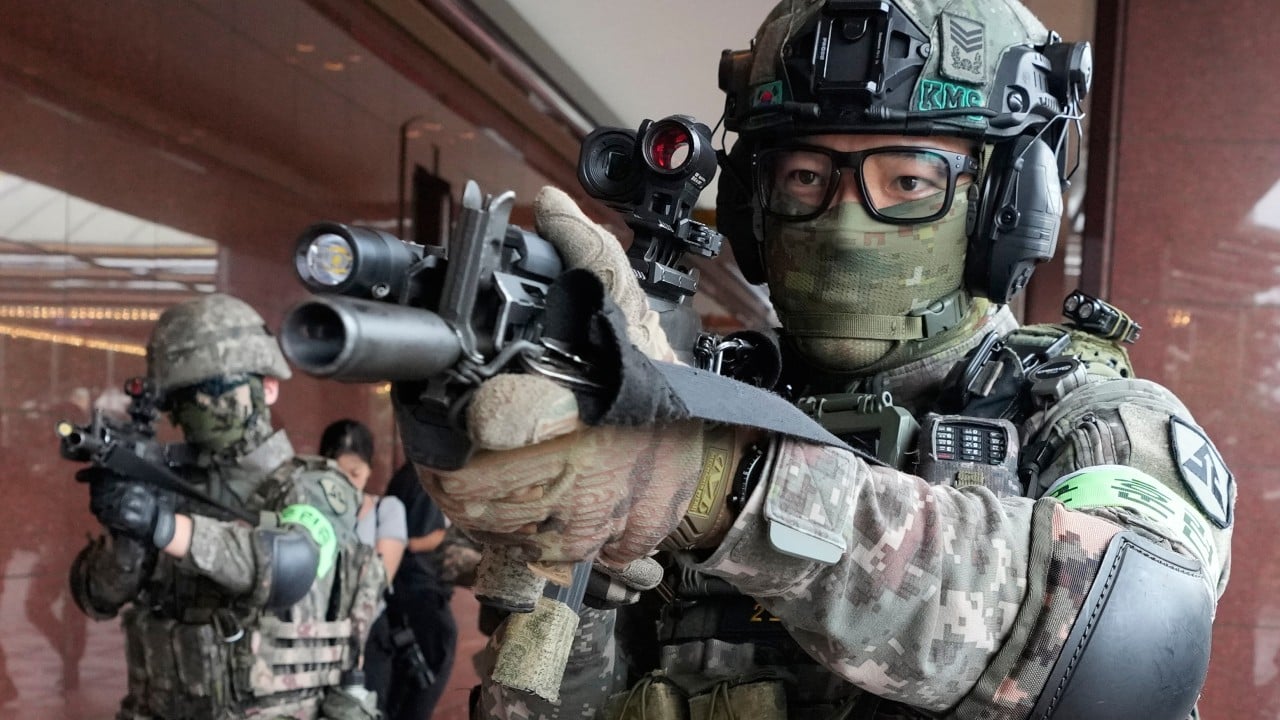
Strategic planning collapse occurs when political disruption overrides the mathematical reality of military readiness verifications. The sudden truncation of the Ulchi Freedom Shield exercise, shortened by six days following a directive from Washington, exposes structural vulnerabilities in the transition plan for wartime operational control. Seoul's target of an OPCON transfer around 2028 depends on sequential verification milestones. When field training exercises and command post simulations are arbitrarily truncated, the alliance breaks the verification feedback loop necessary to certify South Korean leadership of the Future Combined Forces Command.
The transition architecture is bound by three strict operational pillars. Each pillar acts as a functional dependency for the Security Consultative Meeting scheduled for October.
The Three Pillars of Wartime Command Verification
Initial Operational Capability
The first phase established baseline interoperability, ensuring that South Korean military headquarters could process allied intelligence and logistics data under simulated theater-wide stress. This phase primarily tested command infrastructure compatibility rather than tactical command execution.
Full Operational Capability
The second phase requires the Future Combined Forces Command to execute theater-level counteroffensive operations under a South Korean four-star general. This verification depends entirely on large-scale exercises like Ulchi Freedom Shield. Without uninterrupted execution of these scenarios, quantitative metrics for command-and-control stability cannot be gathered, leaving the evaluation incomplete.
Full Mission Capability
The final phase confirms the alliance's capacity to absorb total strategic shock, manage rapid escalation dynamics, and direct multi-domain fires across the peninsula. Truncating exercises short-circuits the data collection required to sign off on this capability.
The Cost Function of Truncated Exercises
Military readiness cannot be evaluated through theoretical doctrine alone; it functions as a product of repetition, friction, and stress-testing. When training days are cut by nearly a third, the reduction is non-linear in its impact on readiness.
$$\text{Readiness Index} = \int_{0}^{T} (\text{Simulation Fidelity} \times \text{Friction Coefficient}) , dt$$
When time parameter $T$ is compressed without warning, the integration of complex multi-domain synchronization drops exponentially. Counteroffensive rehearsals, which form the core of the second half of the exercise schedule, are precisely the components sacrificed during sudden political contractions. Lawmakers and military analysts note that setting a firm target year at the upcoming Security Consultative Meeting becomes mathematically unfeasible when the empirical data from full-scale exercises is missing.
The absence of a synchronized diplomatic heads-up compounds the structural risk. Foreign Minister Cho Hyun confirmed that both Seoul and local U.S. commands received no prior notice before the operational curtailment was announced publicly. Summoning the U.S. Ambassador addresses diplomatic friction, but it does not solve the underlying operational deficit.
Strategic Vulnerabilities in the 2028 Timeline
The ambition to transition wartime control around 2028 relies on the assumption of a stable testing environment. Political interruptions introduce systemic variance that invalidates historical planning assumptions.
- Verification Data Deficit: The evaluation committee lacks sufficient operational logs to prove that South Korean command structures can independently manage coalition logistics during a high-intensity conflict.
- Alliance Trust Asymmetry: Sudden shifts in exercise parameters force South Korean defense planners to build contingency frameworks for unilateral defense capabilities faster than domestic procurement cycles allow.
- Deterrence Signaling Decay: Adversaries calculate operational readiness based on exercise duration and complexity. Truncation signals a compromise in alliance cohesion.
To salvage the strategic roadmap, defense planners must decouple the verification process from short-term diplomatic messaging.
Execute a data-driven audit of remaining simulation logs from the shortened exercise window to isolate unverified command nodes. Reallocate upcoming bilateral staff talks toward tabletop exercises that isolate the specific counteroffensive modules dropped during the early termination of field drills, ensuring baseline verification data is captured before the October ministerial meetings.