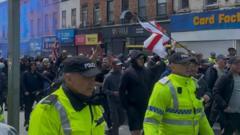
The containment failure of public demonstrations is rarely a product of spontaneous escalation. Instead, it is the predictable output of a friction dynamic between two distinct operational architectures: a decentralized, crowd-sourced mobilization network and a centralized, rule-bound state enforcement apparatus. When an anti-immigration march results in targeted arrests, public commentary typically defaults to ideological finger-pointing. A structural analysis, however, reveals that these outcomes are determined by quantifiable variables: spatial density, tactical asymmetry, and the thresholds of state intervention.
To understand why a demonstration crosses the threshold from a legally protected expression of dissent to a criminal justice intervention, we must map the underlying mechanisms that govern crowd dynamics and police operational doctrine.
The Tri-Particle Structure of Demonstration Friction
Every high-tension public demonstration operates within a structural framework defined by three distinct variables. When these variables intersect inadequately, containment protocols fail, leading directly to state intervention and tactical arrests.
[Crowd Catalyst] <---> [Spatial Bottlenecks] <---> [Enforcement Thresholds]
1. The Mobilization Catalyst and Composition Symmetry
Public demonstrations are not monolithic blocks; they are highly stratified aggregations of individuals with varying risk tolerances and objectives. In anti-immigration marches, the composition typically splits into three tiers:
- The Ideological Core: Highly motivated actors who view the physical occupation of space as a zero-sum confrontation with the state or counter-protesters.
- The Sympathetic Periphery: Passive participants adhering to the legal parameters of assembly, serving primarily as numerical volume.
- The Opportunistic Elements: Non-aligned actors drawn to the operational chaos, utilizing the crowd density as a shield for property destruction or acute Agitation.
Friction accelerates when the ideological core successfully manipulates the sympathetic periphery into acting as a human buffer against law enforcement. This tactical blending degrades the police department’s ability to execute targeted extractions, drastically increasing the probability of systemic, indiscriminate containment measures.
2. Spatial Bottlenecks and Kinetic Pressure
The physical environment dictates the velocity of crowd escalation. Urban topographies possess fixed carrying capacities. When mobilization networks funnel a high volume of participants into restricted arterial corridors, the kinetic pressure of the crowd increases exponentially.
This creates a structural bottleneck. As forward momentum halts due to police cordons or natural architectural barriers, the density at the front increases to critical levels. In fluid mechanics, compressing a fluid increases pressure; in crowd dynamics, compressing a human mass eliminates individual agency. Participants at the front are pushed into physical contact with enforcement lines not by intent, but by the unmanaged kinetic energy generated by the periphery at the rear.
3. State Enforcement Escalation Thresholds
Law enforcement agencies operate under strict operational directives designed to balance constitutional protections with public safety. The transition from monitoring to active arrest protocols is governed by an explicit escalation matrix.
| Enforcement Phase | Trigger Event | Tactical Objective | Primary Operational Tool |
|---|---|---|---|
| Phase 1: Passive Containment | Crowd formation within permitted boundaries | Route maintenance and traffic isolation | Bicycle barriers, static skirmish lines |
| Phase 2: Active Interdiction | Projectile deployment or boundary breaches | Isolation of high-risk agitators | Targeted snatch-and-grab extractions |
| Phase 3: Systemic Dispersal | Widespread property damage or physical assault | Complete clearing of the operational zone | Long-range acoustic devices, chemical agents |
The arrest of eight individuals during a march indicates a highly specific operational choice: Phase 2 Active Interdiction. Had the entire assembly degenerated into a riot, arrest figures would be orders of magnitude higher, or entirely suppressed in favor of mass dispersal. A single-digit arrest metric proves that law enforcement successfully isolated the ideological core from the sympathetic periphery, neutralizing specific points of friction without triggering a systemic crowd collapse.
The Asymmetry of Modern Information Networks
The structural instability of modern anti-immigration marches is exacerbated by the platform architecture used to organize them. Traditional civic movements relied on hierarchical command structures—unions, political parties, or formal advocacy groups—that could negotiate terms with municipalities and enforce internal discipline among participants.
Contemporary mobilizations are largely decentralized, driven by algorithmic amplification on digital platforms. This creates an operational vulnerability: high mobilization capacity paired with zero command capability. An organizer can leverage an algorithm to assemble five thousand people in a city center within forty-eight hours. However, that same organizer possesses no structural mechanism to communicate real-time tactical directives to the crowd once kinetic friction begins. Without a chain of command, the crowd defaults to emergent behavior, where the most radical actors dictate the movement's physical trajectory.
This digital-physical mismatch creates a profound information asymmetry for law enforcement. Police intelligence units track public data feeds to estimate crowd size, but they cannot interface with a centralized leadership structure to de-escalate tensions. Consequently, law enforcement must prepare for the worst-case scenario, deploying hard-tactical assets that the crowd frequently interprets as an unprovoked escalation, validating the narrative of the ideological core.
The Cost Function of State Intervention
Every arrest executed during a public demonstration carries an immense operational and political cost function for the state. Law enforcement command staff are acutely aware that physical intervention is a high-risk gamble.
The execution of a single arrest requires a minimum of three to four officers to safely isolate, control, zip-tie, and transport a resisting individual out of a dense crowd. This operational requirement temporarily degrades the structural integrity of the police skirmish line. Each extraction creates a localized vulnerability in the enforcement barrier—a physical gap that counter-protesters or radicalized elements of the march can exploit to breach the containment zone.
Furthermore, the legal threshold for a successful prosecution requires detailed documentation of the specific unlawful act. In the chaos of a moving march, capturing clear evidentiary data (such as body-worn camera footage of a specific individual launching a projectile) while maintaining a defensive posture is exceptionally difficult. If officers execute warrantless arrests without bulletproof evidentiary backings, the state faces significant civil liability and public delegitimization.
Therefore, when eight arrests occur, it implies that the targets were either highly visible agitators whose continued presence posed a systemic threat to the containment barrier, or individuals who directly breached the physical security perimeter of enforcement personnel. The state does not arrest to punish ideology; it arrests to preserve spatial control.
Strategic Matrix for Urban Space Management
To minimize municipal disruption and prevent the systemic escalation of decentralized demonstrations, public safety authorities must move away from reactive containment models toward predictive spatial management. The following three-tiered framework outlines the necessary operational adjustments required to govern modern high-density protests.
Phase-Shift Spatial Planning
Municipalities must abandon the practice of granting static assembly permits in high-density commercial corridors. The physical footprint of a march must be dynamically scaled based on real-time digital sentiment analysis and historic mobilization velocity. If predictive data indicates a high probability of counter-protest convergence, the state must enforce non-intersecting transit corridors separated by natural geographical barriers, such as rivers or multi-lane divided highways, eliminating the possibility of physical engagement between opposing factions.
Intelligence-Led Selective Extraction
Rather than relying on massed skirmish lines that present a confrontational facade, law enforcement agencies must maximize the use of plainclothes spotter teams and high-resolution aerial surveillance. By identifying and tracking high-risk instigators within the ideological core long before they initiate physical breaches, tactical units can execute precise extractions at peripheral transit points rather than within the dense center of the crowd. This starves the mobilization of its radical catalysts without triggering the defensive herd mechanics of the sympathetic periphery.
Decentralized Communication Nodes
Public safety frameworks must adapt to the platform-driven nature of modern protests. If the crowd lacks a central leadership structure, the state must establish direct communication channels with the participants themselves. This involves deploying localized cell-broadcast warnings and long-range acoustic announcements that clearly define the spatial boundaries of legal assembly and the explicit legal consequences of crossing specific physical thresholds. Removing the ambiguity of police intent strips the ideological core of its ability to frame state intervention as arbitrary violence, preserving the compliance of the sympathetic periphery.
The survival of stable civic spaces depends on the state's capacity to view demonstrations through the cold lens of organizational logistics and physical dynamics rather than political rhetoric. The arrest of eight citizens is not a political statement; it is the mathematical consequence of unmanaged friction within an urban space.