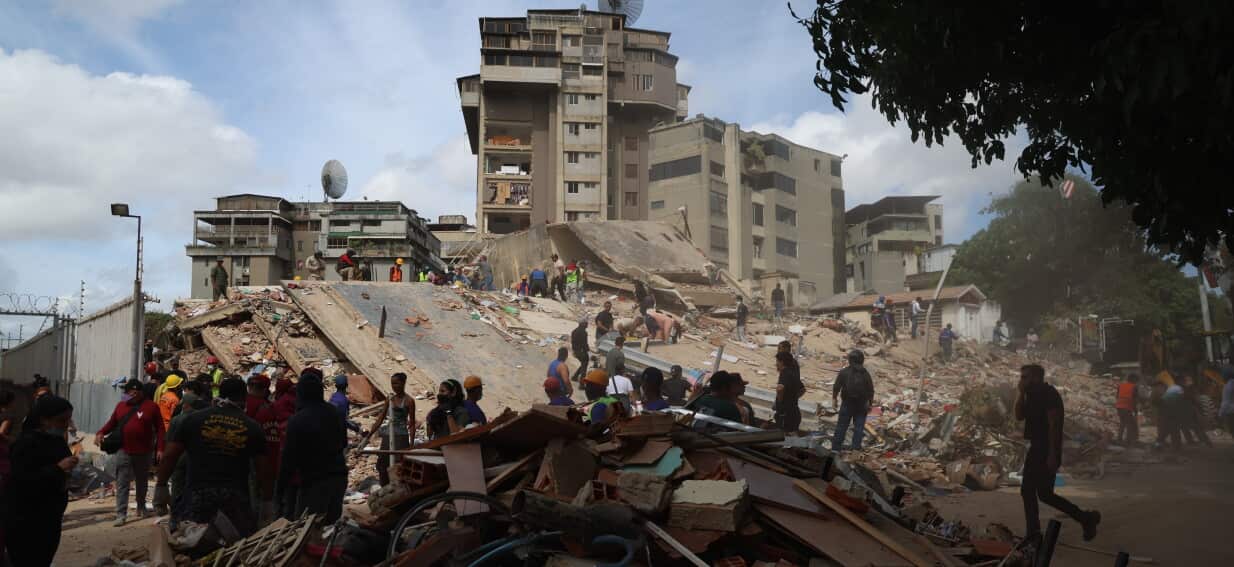
The immediate aftermath of a major seismic event in an economically isolated nation creates a predictable, compounding logistics failure. When an earthquake strikes an environment like Venezuela—characterized by degraded domestic infrastructure and complex international sanctions—the primary bottleneck shifts instantly from raw resource availability to information velocity. For the expatriate diaspora, specifically the large community of Venezuelans living across Australia, this manifests as a high-friction communication blackout. The inability to verify the safety of localized networks triggers an immediate, uncoordinated surge in capital transfer and parallel rescue planning, often counterproductive to centralized international aid channels.
Analyzing this crisis through the lens of supply chain resilience and network topology reveals that the standard humanitarian playbook is fundamentally misaligned with modern diaspora dynamics. To optimize relief velocity and mitigate the psychological and economic strain on external stakeholder communities, we must map the crisis into three distinct operational phases: Information Asymmetry, Capital Deployment Bottlenecks, and Last-Mile Delivery Failures. Meanwhile, you can explore other events here: The Brutal Truth About the New Border Reality.
The Friction Layer: Information Asymmetry and Network Degradation
The primary variable governing diaspora anxiety and subsequent misallocation of capital is the immediate degradation of localized telecommunications networks. In sudden-onset natural disasters, the failure of the cellular grid follows a predictable three-part decay function:
- Physical Infrastructure Destruction: Direct kinetic damage to cellular towers, fiber-optic trunk lines, and power stations.
- Grid Congestion: A geometric spike in simultaneous connection attempts paralyzes the remaining functional spectrum, creating an artificial blackout even in undamaged zones.
- Data Throttle Policies: State-managed networks often prioritize state or military communications, severely reducing civilian bandwidth.
This structural silence forces families in cities like Sydney, Melbourne, and Brisbane into a state of acute information starvation. The competitor narrative frames this purely as an emotional tragedy; however, from an analytical perspective, it represents a catastrophic failure of data flow. To explore the complete picture, we recommend the recent analysis by The Washington Post.
When nodes in a network cannot report their status, external actors assume the worst-case scenario. This systemic uncertainty drives irrational economic behavior. Diaspora members begin attempting to procure emergency supplies through informal, unverified local agents rather than waiting for validated institutional channels. The absence of a single, decentralized registry for survivor verification turns a localized geographic crisis into a global productivity drain across the expatriate network.
The Liquidity Trap: Sanctions and Asymmetric Financial Channels
Once a diaspora community shifts from information gathering to resource mobilization, they encounter the financial infrastructure chokepoint. In the case of Venezuela, this problem is severely exacerbated by international banking restrictions, specifically compliance mandates related to anti-money laundering (AML) and counter-terrorist financing (CFT), alongside country-specific sanctions.
The financial friction can be modeled through two opposing mechanisms:
Formal Remittance Channels
Traditional wire transfers and formal remittance networks operate under high compliance overhead. During an emergency, these channels suffer from severe latency. Compliance filters trigger automated holds on sudden, high-volume transactions moving toward high-risk jurisdictions. The result is a paradox: when capital velocity needs to be at its maximum, formal banking structures force it into a holding pattern, often delaying fund availability by 72 hours to five days.
Informal Peer-to-Peer (P2P) Networks
To bypass formal latencies, the diaspora inevitably routes liquidity through informal P2P mechanisms, digital asset transfers (cryptocurrencies), or parallel money-brokering systems. While these networks achieve near-zero latency, they introduce extreme counterparty risk and inflationary pressures.
[Diaspora Capital Input]
       │
       ├─► Formal Channels ──► High Compliance Filters ──► 72-120 Hour Latency
       │
       └─► Informal P2P ─────► Zero Compliance Filters ──► Immediate Liquidity ──► Local Price Gouging
A sudden influx of unregulated capital into a disaster zone where supply is fixed or diminishing causes immediate localized hyperinflation. The real purchasing power of the sent funds degrades rapidly as local bad actors price-gouge essential commodities like clean water, fuel, and medical supplies.
The Last-Mile Paradox in International Relief Mobilization
While the global community rallies to pledge institutional aid, the operational reality of deploying that aid into a logistically constrained environment reveals deep inefficiencies. International aid models assume a cooperative local gateway—typically a centralized government agency or a highly coordinated network of domestic NGOs. When these gateways are compromised by political instability or bureaucratic corruption, the efficiency of international pledges drops precipitously.
The bottleneck is not a lack of global goodwill or funding; it is a throughput limitation at the physical points of entry. Ports, runways, and border crossings dictate the maximum volume of aid that can enter the theater per 24-hour cycle.
- Airfield Saturation: Small regional airports near earthquake epicenters lack the apron space, material handling equipment (MHE), and fuel reserves required to sustain continuous cargo operations.
- Customs Weaponization: Bureaucratic protocols can be intentionally or unintentionally slowed, leaving temperature-sensitive medical supplies and perishable rations to degrade on tarmacs.
- Security Vacuum: The breakdown of local law enforcement opens transport corridors to hijacking, requiring aid agencies to divert resources from procurement to private security or risk losing entire supply lines.
Consequently, generic international donations often miss the critical 48-hour lifesaving window. The diaspora's frantic, hyper-localized interventions and the massive, slow-moving institutional relief efforts frequently collide, creating gridlock at the point of distribution.
Tactical Decentralization: Optimizing Future Disaster Responses
To bridge the gap between global desire to help and local execution reality, the operational framework of international aid must adapt. The reliance on centralized state apparatuses must be replaced with a model of tactical decentralization.
First, aid agencies must deploy temporary, low-orbit satellite communication nodes (such as Starlink arrays) directly into affected zones independently of local state permission. Establishing localized mesh networks allows survivors to register their status on decentralized ledgers, immediately breaking the information asymmetry that paralyzes diaspora communities globally.
Second, financial tracking must transition toward pre-vetted, non-custodial digital asset pipelines. By establishing pre-cleared cryptographic wallets assigned to verified local mutual-aid groups and non-governmental entities on the ground, global networks can inject liquidity directly to the point of need, completely bypassing both the 72-hour formal banking filters and the predatory informal brokers.
Finally, the concept of "aid" must be reframed from shipping physical mass to provisioning local capabilities. Transporting tons of standard rations across the globe to a country with closed ports is logistically bankrupt. Capital should instead be directed toward unlocking existing regional supply chains in neighboring territories, utilizing localized distribution networks that already understand the informal geography of the terrain. The future of crisis mitigation lies not in the volume of the global rally, but in the precision and velocity of the decentralized network.