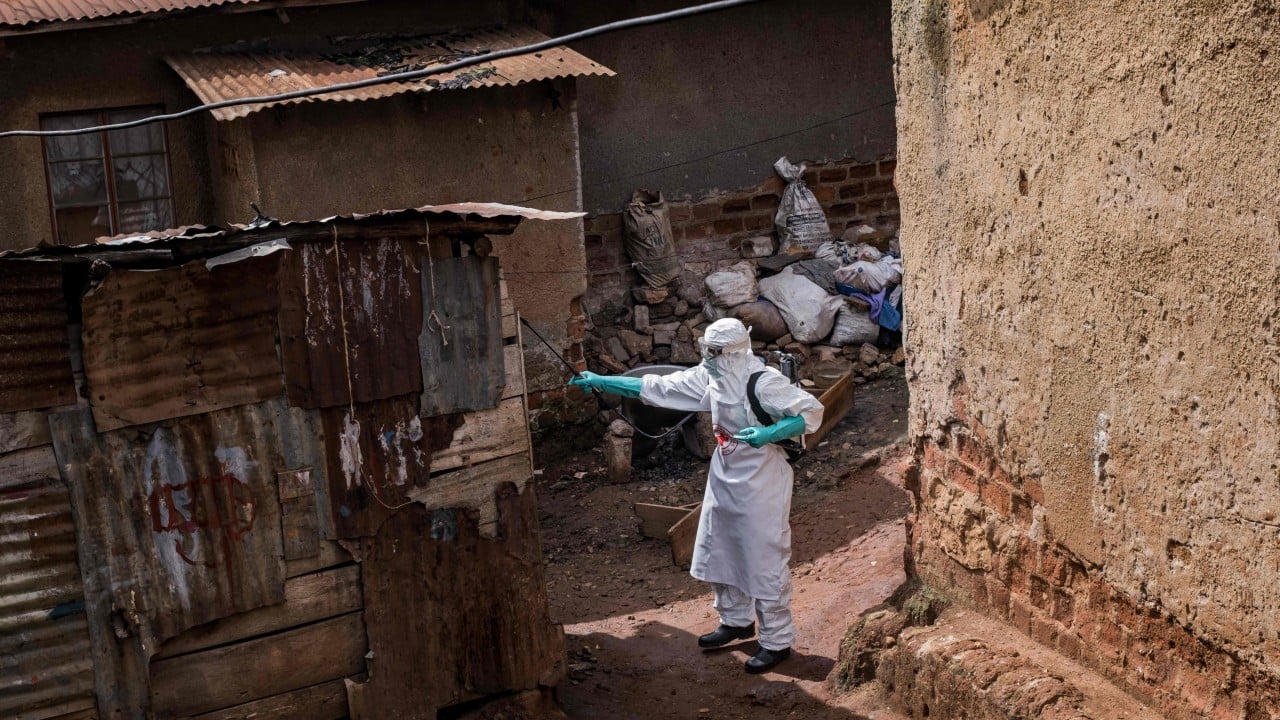
The closure of the Uganda-Democratic Republic of Congo (DRC) border in response to a surge in a rare Ebola variant represents a high-stakes deployment of geographic isolation to counter biological risk. While politically decisive, border closures are not absolute barriers; they are friction-inducing mechanisms that alter the transmission dynamics of a pathogen. Evaluating the efficacy of this intervention requires stripping away political rhetoric and examining the epidemiological, economic, and logistical friction points that dictate whether a quarantine stabilizes a crisis or inadvertently drives it underground.
The Pathogen Profile: Determinants of the Transmission Rate
To evaluate the necessity of geographic isolation, one must first isolate the variables of the specific pathogen. Ebola virus disease (EVD) outbreaks are non-homogeneous; virulence, transmissibility, and clinical presentation vary significantly by species—primarily the Zaire, Sudan, and Bundibugyo ebolaviruses.
The primary driver of urgency in the Uganda-DRC corridor is the specific biological profile of the circulating strain. When a "rare type" emerges, it typically implies a departure from the Zaire ebolavirus, which benefits from existing, highly effective countermeasures like the Ervebo vaccine. A surge in a rarer strain introduces two critical vulnerabilities into the healthcare architecture:
- Countermeasure Mismatch: Vaccines and monoclonal antibody treatments (such as Inmazeb and Ebanga) engineered for the Zaire strain show minimal to zero cross-reactivity with the Sudan or Bundibugyo variants. The therapeutic toolkit is effectively reset to supportive care.
- Diagnostic Lag: Surveillance systems optimized for dominant strains can experience false negatives or delayed confirmation times when processing atypical genetic profiles. Every hour of diagnostic lag multiplies the secondary attack rate ($R_0$) within community clusters.
The transmission dynamics of Ebola depend heavily on clinical presentation. Because the virus is not airborne and requires direct contact with bodily fluids, transmission peaks during the severe, symptomatic phases of the disease and post-mortem handling. This creates a distinct epidemiological profile: a low community $R_0$ in the early asymptomatic phase, but an exceptionally high institutional and familial attack rate once the disease pathology accelerates.
The Friction Model of Border Closures
A border closure does not function as a sterile, hermetic seal. Instead, it operates as a policy lever designed to increase the "cost of transit" for potentially infected vectors. The macro-level objective is to drive the reproductive number across borders ($R_{border}$) below 1.0.
The operational reality of the Uganda-DRC frontier complicates this model. The border spans hundreds of kilometers of porous terrain, characterized by informal trade routes, shared agricultural ecosystems, and deep-seated kinship networks that bypass official Points of Entry (POEs).
When a formal border closure is declared, it triggers three immediate structural shifts:
1. The Informalization Filter
By shutting down legal POEs, formal trade and transit are halted, but the human necessity for movement persists. Traffic diverts from monitored checkpoints—where infrared thermography, visual screening, and rapid isolation protocols exist—to unmonitored bypasses (panyas). The immediate consequence is a paradox: formal transmission metrics drop to zero, while unmonitored, high-risk transmission vectors increase.
2. Supply Chain Degradation for Medical Logistics
Border regions rely on shared market infrastructure for basic sustenance and medical supplies. A hard closure disrupts the supply chains of personal protective equipment (PPE), sanitation reagents, and diagnostic inputs moving into the epicenter. If the economic survival of border communities is compromised, compliance with public health directives decays symmetrically.
3. Altered Healthcare-Seeking Behavior
When military or paramilitary forces enforce isolation zones, the local population begins to view public health interventions as punitive measures rather than clinical assets. Symptomatic individuals actively evade surveillance, opting for hidden community management or traditional healers. This pushes the incubation and early transmission phases into the shadows, blinding epidemiological modeling teams.
Quantifying the Cost Function of Geographic Isolation
A rigorous strategy requires balancing the marginal reduction in viral transmission against the marginal increase in socioeconomic fragility. The economic cost function of a prolonged border closure along the Uganda-DRC axis can be broken down into three core dimensions.
Formal Trade Halts
The DRC is a primary export destination for Ugandan manufactured goods, agricultural products, and cement. A hard closure stops formal freight transit, causing immediate capital losses for logistics firms and inflating commodity prices within the DRC’s eastern provinces. This economic shock directly reduces the population's capacity to purchase hygiene infrastructure, worsening baseline vulnerability.
Informal Cross-Border Markets
A significant portion of the borderline population derives daily subsistence from micro-commerce (e.g., small-scale agricultural exchange, fish trade from Lake Albert, textiles). Disrupting this survivalist economy forces a choice between starvation and illegal border crossing. The data shows that economic necessity consistently overrides legal prohibitions, ensuring that the border remains porous despite state enforcement.
Resource Allocation Diversion
The personnel and capital required to patrol a militarized border zone are drawn directly from the broader state treasury. Every dollar spent on border interdiction is a dollar diverted from community-level contact tracing, diagnostic lab scaling, and localized treatment center deployment.
[Total Outbreak Budget]
   │
   ├──► Border Interdiction (High Visibility, Low Epidemiological Yield)
   │
   └──► Localized Containment (Low Visibility, High Epidemiological Yield)
           ├── Contact Tracing
           ├── Rapid Diagnostics
           └── Community Isolation Units
The Strategic Alternative: Managed Porosity
Instead of a binary open/closed framework, an advanced containment strategy relies on Managed Porosity. This framework treats the border not as a wall, but as a series of high-throughput epidemiological filters.
The implementation blueprint consists of three operational layers:
Layer 1: Incentivized Points of Entry
Keep key POEs open but mandate strict, non-punitive screening protocols. To ensure compliance, transit through these points must be structurally faster and safer than traversing informal routes. This can be achieved by offering free basic health check-ups, clean water distribution, and digital transit passes. By keeping the population flowing through designated channels, epidemiologists retain their data visibility.
Layer 2: Ring Surveillance and Community Isolation Hubs
Rather than positioning enforcement assets directly on the border line, deploy them in a concentric "ring" around known outbreak clusters, extending 20 to 50 kilometers deep into both territories. Establish community-led isolation hubs within this zone. These hubs must be managed by local leaders to de-escalate the fear of state coercion, allowing symptomatic individuals to self-isolate without facing criminalization or social stigma.
Layer 3: Cross-Border Data Synchronization
Pathogens do not recognize geopolitical sovereignty. A border closure often ruptures the flow of data between ministries of health. A managed approach establishes a unified, trans-national epidemiological dashboard. Contact tracing teams in Uganda and the DRC must operate on a shared digital ledger to ensure that when a contact crosses the border, the alert is handed off seamlessly to the corresponding field team without administrative delay.
Limits of the Analytical Model
The primary limitation of this managed containment model is its dependence on institutional trust. If a population has a baseline distrust of state authority due to historical conflict or corruption, health screenings at formal POEs will still be avoided, regardless of incentives. Furthermore, this framework assumes a level of bureaucratic agility and digital infrastructure that may not be fully realized in under-resourced provincial health departments. If the state lacks the capacity to run efficient screening lines, the resulting bottlenecks will naturally push travelers back toward informal, unmonitored channels.
Operational Execution Plan
To stabilize the current surge and prevent regional spillover without triggering an economic or humanitarian collapse, public health authorities must pivot from a policy of total exclusion to an architecture of risk-mitigated transit.
- Reopen designated major transit corridors within 72 hours, converting them into 24-hour Epidemiological Screening Zones equipped with rapid antigen assays and multiplex PCR capabilities optimized for rare variants.
- Establish a joint Uganda-DRC cross-border task force with unified command structure at the zonal level, erasing bureaucratic delays in contact-tracing data transmission.
- Deploy localized economic subsidies or food security assets to border communities to offset the loss of informal market access, neutralizing the financial incentive to bypass screening networks.
- Redirect military assets from frontline border blocking to logistics support—specifically, the rapid construction of decentralized isolation units and the secure transport of medical payloads to deep rural clinics.