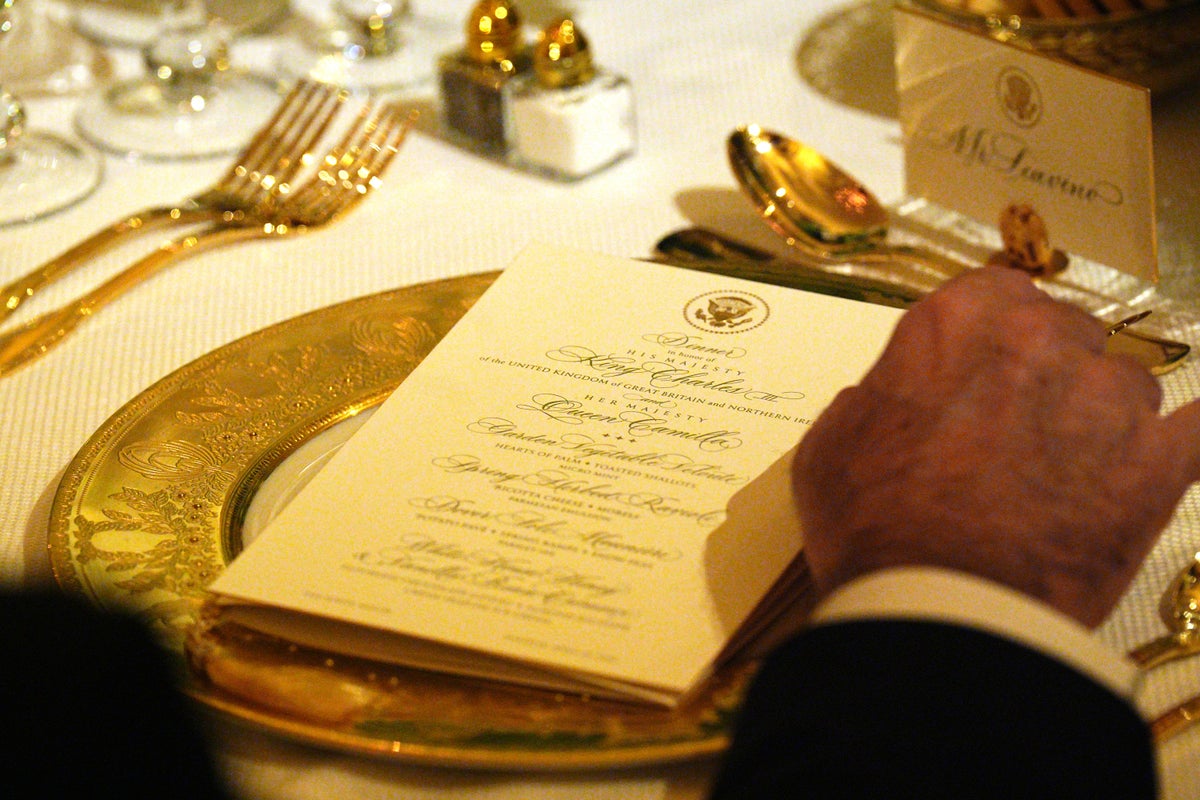
The state banquet at Versailles or Buckingham Palace is not a dinner; it is a high-density information exchange where every calorie serves a geopolitical function. While traditional commentary focuses on the aesthetic of the chinaware or the guest list, a structural analysis reveals the menu as a calculated risk-management tool designed to signal soft power, historical continuity, and economic alignment. This gastronomic architecture operates on three distinct planes: symbolic reconciliation, logistical perfection, and the projection of national resource dominance.
The Tri-Pillar Framework of State Dining
State banquets utilize a specific logic to achieve diplomatic objectives. To understand the menu presented to King Charles III, one must decompose it into its functional components. You might also find this connected story interesting: London Stabbings and the Failure of Reactive Security Theater.
1. Symbolic Reconciliation and Historical Anchoring
Menus serve as a non-verbal narrative of bilateral relations. When a British monarch dines in France, the menu must balance French culinary hegemony with British heritage. The selection of dishes acts as a "shared history" bridge. For example, the inclusion of ingredients or preparations that have historical precedent in both courts functions to minimize current political frictions by emphasizing centuries of shared elite culture.
2. The Logistical Constraint Variable
A state banquet for 160+ guests requires a menu optimized for "plate-consistency." The complexity of a dish is inversely proportional to the number of guests. A menu fails if the 160th guest receives a dish at a different temperature or texture than the 1st. Therefore, the choice of protein—typically a braised meat or a sturdy fish—is a decision based on thermal mass and moisture retention rather than purely on flavor profiles. As discussed in latest reports by USA Today, the effects are notable.
3. Resource Projection and Sustainability Signaling
In the modern era, "luxury" has shifted from rarity to provenance. The menu reflects a nation’s internal supply chain. Serving locally sourced, seasonal, and organic produce isn't merely a trend; it is a demonstration of agricultural sovereignty. For King Charles, a known advocate for organic farming, the menu serves as a mirror of his own values, creating an environment of psychological safety and alignment before formal discussions even begin.
Deconstructing the Menu Calculus
Every course in a state banquet represents a tactical decision designed to satisfy specific diplomatic requirements.
The Appetizer: The Neutral Ground
The opening course, often featuring high-value seafood like blue lobster or crab, establishes a baseline of prestige. From a psychological standpoint, this "Prestige Anchor" sets the perceived value of the evening. By utilizing French blue lobster, the hosts signal respect for the guest’s status while simultaneously asserting the superiority of French territorial waters. The complexity of the preparation—chilled and meticulously plated—demonstrates the sheer labor power of the kitchen, a proxy for the administrative competence of the host nation.
The Main Course: The Stability Anchor
The choice of Bresse chicken or a similar high-grade poultry for King Charles’s visit was a calculated move in risk mitigation. Beef carries religious and environmental baggage; lamb can be polarizing. Poultry, specifically the Poularde de Bresse, represents a "Protected Designation of Origin" (PDO) product. This choice is a technical exercise in French economic protectionism. It signals to the British delegation that despite trade barriers, French agricultural excellence remains the gold standard.
The cooking method—roasting or poaching—allows for a higher degree of control over the "service window." Unlike a steak, which has a narrow margin for error regarding doneness, a well-executed poultry dish provides a broader window for synchronized service across a massive dining hall.
The Cheese Course: The Sovereignty Statement
In French diplomacy, the cheese course is a non-negotiable assertion of cultural identity. For the banquet at Versailles, the selection of Comté and Stichelton (a British blue cheese) would have been a masterclass in "Reciprocal Sovereignty." By placing a British artisanal cheese on a French table, the host acknowledges the guest’s cultural parity. This is a deliberate departure from the traditional French stance of culinary isolationism, signaling a post-Brexit willingness to engage in "soft" integration.
The Economic Cost of Gastronomic Signaling
While the public sees a lavish meal, a strategy consultant sees a massive allocation of human capital and overhead. The cost-to-impact ratio of a state banquet is difficult to quantify but follows a specific power law.
- Labor-to-Plate Ratio: In a standard high-end restaurant, the ratio might be 1:4 (one chef for every four diners). In a state banquet at this level, the ratio nears 1:1 or higher when factoring in security-cleared service staff, sommeliers, and the "brigade de cuisine."
- Security Overhead: The hidden cost of the menu is the "Chain of Custody." Every ingredient must be vetted, every supplier screened, and the preparation monitored to prevent tampering. This adds a 30-40% premium to the raw ingredient cost.
- The Opportunity Cost of Failure: A single instance of food poisoning or an allergic reaction in a head of state is a catastrophic diplomatic failure. Consequently, menus are "sanitized" of high-risk allergens and extreme spices. The resulting flavor profile is often "conservative-prestige"—high quality but low risk.
The Sommelier’s Dilemma: Liquid Diplomacy
Wine selection at a state banquet is perhaps the most scrutinized element of the evening. The bottles chosen must satisfy three criteria:
- Vintages of Significance: Selecting a year that corresponds to a positive milestone in bilateral relations (e.g., the signing of an entente or a royal birth).
- Asset Liquidity: Serving a 1945 Mouton Rothschild is not just about taste; it is about pouring "liquid assets." It demonstrates that the host nation possesses a cellar—and by extension, a history—that money cannot simply buy on the open market today.
- The Champagne Protocol: Champagne is the universal lubricant of diplomacy. By starting with a prestigious Grand Cru, the host lowers the inhibition of the delegates, facilitating the informal "sideline" conversations where the real work of diplomacy occurs.
The Friction Between Modernity and Tradition
King Charles III presents a unique challenge to the traditional state banquet model due to his vocal stance on environmentalism and sustainable land management. This creates a "Diplomatic Dissonance" that the menu must resolve.
- The Foie Gras Factor: French tradition dictates the inclusion of foie gras. However, British sensibilities (and the King's personal ban on it in his households) create a friction point. The removal of foie gras from the menu is a significant concession of cultural tradition in favor of guest alignment. It represents a "Tactical Pivot" where the host prioritizes the psychological comfort of the guest over nationalistic pride.
- Vegetarian Integration: Historically, vegetarian options were an afterthought. In the current climate, the "Vegetarian Pivot" must be as prestigious as the meat-based primary. Using truffles, rare mushrooms, or heirloom vegetables allows the host to maintain the "Prestige Anchor" while adhering to modern ethical constraints.
The Strategic Recommendation for Future State Engagements
To maximize the ROI of gastrodiplomacy, host nations should move away from the "Grandeur for Grandeur's Sake" model and adopt a "Precision Alignment" strategy.
- Audit Guest Values Early: The menu should be a physical manifestation of the guest's policy priorities. If the guest is focused on climate change, the menu should be a 0-km, carbon-neutral showcase.
- Leverage Technological Provenance: Utilize blockchain or QR-coded menus that allow guests to see the exact farm and soil conditions of their meal. This elevates the dining experience into a demonstration of the host nation's technological integration into agriculture.
- Reduce the Guest Count, Increase the Density: The "Versailles Model" of hundreds of guests is becoming an atmospheric liability. Reducing the guest list allows for higher-complexity dishes (e.g., soufflés or delicate emulsions) that signal a higher level of artisanal mastery and intimacy.
The state banquet remains one of the few remaining "analog" tools in a digital diplomatic landscape. Its power lies in its physical necessity; leaders must eat, and the environment in which they do so dictates the tone of their subsequent negotiations. The menu is the script for that environment.
The final move in any state banquet strategy is the "Long-Tail Sentiment." The gifting of a specific ingredient used during the meal, or the publication of the menu with historical annotations, ensures that the diplomatic impact extends beyond the digestive cycle. In the case of King Charles, the menu was not just a meal; it was a calibrated effort to reaffirm the "Special Relationship" through a shared, high-prestige sensory experience that transcended the complexities of modern European politics.