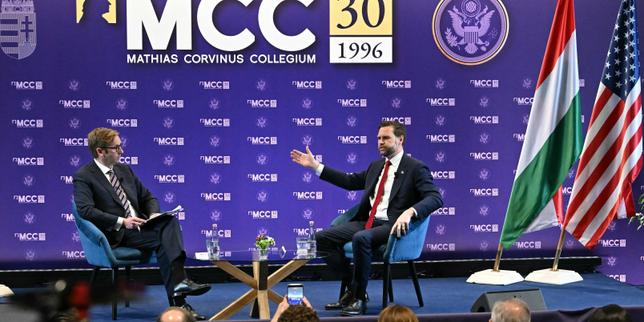
The restructuring of Hungary’s state-funded think tanks and educational foundations represents a cold optimization of capital allocation rather than an ideological retreat. For over a decade, the Hungarian state constructed a parallel intellectual infrastructure designed to produce counter-elite cadres and project soft power abroad. The current consolidation and partial dismantling of these entities reflect structural fiscal constraints, a shifting domestic political threat matrix, and the diminishing marginal returns of institutionalized cultural warfare.
To understand this transition, one must analyze the institutional network not as a collection of independent academic bodies, but as a centralized patronage ecosystem operating under specific financial and political constraints. When the macroeconomic environment tightens, the state treats these organizations as line items subject to efficiency audits and strategic downscaling.
The Fiscal Imperative The Cost Function of Ideological Subsidies
The primary driver of the organizational contraction is a structural fiscal deficit. The Hungarian state budget faces compounding pressures from high sovereign debt servicing costs, persistent inflation, and the ongoing withholding of specific European Union cohesion and recovery funds. In a constrained fiscal environment, the opportunity cost of maintaining redundant intellectual bureaucracies rises exponentially.
The financing mechanism of these institutions relies on two main channels: direct budgetary appropriations and asset transfers via public interest asset management foundations (KEKVAs). The KEKVA model initially insulated these organizations from annual budgetary debates by endowing them with state-owned shares in blue-chip corporations, such as MOL (oil and gas) and Gedeon Richter (pharmaceuticals). This structure creates a specific dependency matrix:
- Dividend Yield Volatility: When corporate profits fluctuate or state-directed windfall taxes suppress corporate distributions, the baseline revenue of the endowed foundations drops.
- Capital Lock-up: The illiquidity of the transferred real estate portfolios limits the ability of these foundations to fund operational deficits through asset liquidation without explicit state approval.
- Sovereign Borrowing Costs: As the state curtails general public spending to meet deficit targets, public tolerance for highly visible, well-funded political vanity projects diminishes, making direct budgetary top-ups politically expensive.
The reduction in funding forces an immediate rationalization of operations. Entities that grew rapidly during the capital-surplus years of 2018–2022 now face a structural retrenchment. The state is systematically identifying overlapping mandates and eliminating budgetary duplication across the network.
The Institutional Redundancy Bottleneck Mapping the Network
The Hungarian state-funded intellectual ecosystem expanded without strict architectural oversight, resulting in a fragmented network of institutions with competing jurisdictions. The primary actors include the Mathias Corvinus Collegium (MCC), the Századvég Foundation, the Danube Institute, and the Center for Fundamental Rights (Alapjogokért Központ).
An operational audit of these organizations reveals significant structural redundancy across three primary vectors:
[State Capital Allocation]
       │
       ├─► Domestic Policy Analysis ──► (Századvég vs. Center for Fundamental Rights)
       ├─► Elite Cadre Formation   ──► (MCC vs. National University of Public Service)
       └─► International Soft Power ──► (Danube Institute vs. MCC Brussels)
The first duplication occurs in domestic policy analysis and polling. Both Századvég and the Center for Fundamental Rights have historically received overlapping mandates to monitor public opinion and generate pro-government legal and social narratives. Maintaining two distinct executive suites, communication teams, and research staffs for identical target audiences creates a classic operational inefficiency.
The second duplication appears in elite cadre formation. The rapid capitalization of MCC, which received assets equivalent to a significant percentage of the state's annual education budget, created a structural conflict with traditional state universities, particularly the National University of Public Service (NKE). Both institutions compete for the same narrow pool of high-achieving student talent, driving up recruitment and faculty acquisition costs unnecessarily.
The third duplication resides in international influence operations. The establishment of satellite offices in Brussels, Vienna, and Washington by different arms of the same network led to bidding wars for foreign talent, contradictory public messaging strategies, and fragmented lobbying efforts. The state is resolving this bottleneck by centralizing international operations under a unified command structure, cutting the budgets of subordinate institutes that failed to achieve measurable policy influence in foreign capitals.
The Political ROI Shift From Cultural Warfare to Digital Mobilization
The rise of a viable domestic political challenger in 2024 transformed the strategic requirements of the ruling Fidesz party. The emergence of the Tisza Party, led by Péter Magyar, altered the electoral calculus, shifting the primary political threat from a fragmented ideological left to a centrist, populist mobilization model. This shift renders the long-term intellectual cultivation strategy of traditional think tanks obsolete for immediate political survival.
The return on investment (ROI) for state-funded think tanks is measured in long-cycle cultural shifts and the slow production of future bureaucrats. The current political environment demands short-cycle, high-velocity digital mobilization. A million-euro budget allocated to a conservative think tank for publishing academic journals or hosting international conferences yields negligible utility when a political crisis requires immediate counter-narratives on TikTok, Facebook, and local digital media networks.
The state is reallocating capital away from high-overhead institutional setups and toward agile, direct-to-consumer digital influence networks. The funding velocity is shifting toward centralized media holding companies (such as KESMA) and decentralized digital influencer pools (such as the Megafon Center). These entities operate with lower fixed costs, higher audience saturation rates, and immediate feedback loops, making them vastly more efficient political instruments during an active electoral cycle than traditional research institutes.
Operational Downsizing Mechanisms
The liquidation of these parallel structures does not occur through abrupt closures, which would signal political weakness. Instead, the state employs a three-part bureaucratic deconstruction methodology.
Budgetary Starvation and Attribute Stripping
The state reduces or freezes nominal funding while allowing inflation to erode the real purchasing power of the institution. Simultaneously, critical real estate assets or corporate equity held by the foundations are reassigned to other state priorities via subtle legislative amendments, crippling the institution's long-term balance sheet.
Forced Mergers and Shared Services
To cut administrative overhead, independent think tanks are stripped of their autonomous back-office infrastructure. Accounting, human resources, legal counsel, and public relations functions are centralized into a single state-controlled entity. This leaves the target think tank as a mere brand name with no independent operational capacity.
Leadership Purges and Metric-Based Attrition
The state replaces ideological purists with technocratic turn-around managers. These managers introduce strict Key Performance Indicators (KPIs) regarding media citations, publication volume, and event attendance. Staff members who cannot meet these corporate metrics are phased out, reducing headcount through natural and forced attrition without triggering mass layoffs.
The Reconfiguration of the Illiberal Patronage Model
The consolidation of the Hungarian think tank sector demonstrates the inherent vulnerability of state-capitalized intellectual movements. When an intellectual ecosystem is decoupled from market demand and relies entirely on state patronage, it remains permanently subordinate to the immediate fiscal and political needs of the sovereign.
The strategic forecast for the remaining entities involves a shift from content generation to pure narrative distribution. The institutions that survive this rationalization process will be those that can successfully retool their operations to serve as direct instruments of state communication, abandoning any lingering aspirations toward genuine academic or policy research. The era of the heavily endowed, semi-autonomous illiberal think tank has ended; the era of the lean, metrics-driven state communications utility has begun.