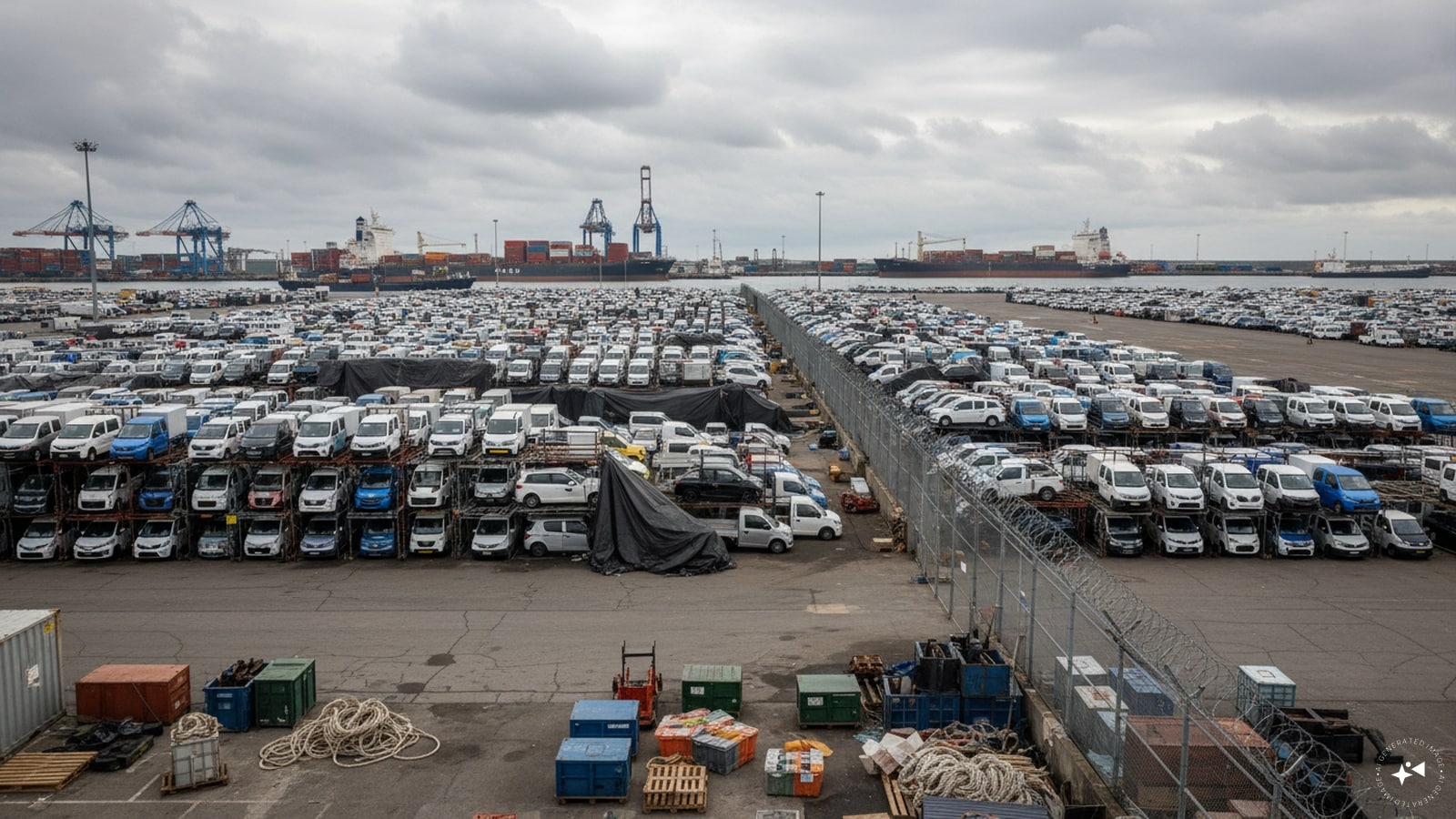
Oversubscription of the first-year Tariff Rate Quota (TRQ) under the India-UK trade pact proves that pent-up demand for British-manufactured vehicles in India far exceeds the initial regulatory ceiling. When import applications surpass the allocated low-duty volume immediately upon opening, the market signals a severe structural imbalance between India’s historically protectionist tariff walls and the commercial appetite of luxury and niche automotive importers. Understanding this bottleneck requires dissecting the economic mechanics of tariff rate quotas, the rent-seeking behaviors they trigger, and the operational realities of automotive supply chains navigating bilateral trade concessions.
The Architecture of Tariff Rate Quotas in Automotive Trade
A Tariff Rate Quota is a two-tiered trade policy instrument combining a quantitative restriction with a tariff differential. Unlike an absolute quota, which halts imports entirely once a ceiling is reached, a TRQ allows a predetermined volume of goods—the in-quota allocation—to enter the importing country at a reduced or zero-duty rate. Any volume imported beyond that threshold faces the standard, significantly higher Most-Favored-Nation (MFN) tariff rate.
In the context of the India-UK trade agreement, India has traditionally maintained some of the highest automotive import duties globally. Completely Built Units (CBUs) imported into India historically faced basic customs duties ranging from 60% to 100%, depending on engine displacement and Cost, Insurance, and Freight (CIF) value, before accounting for additional cesses and domestic taxes. By introducing a low-duty TRQ for UK-origin vehicles, negotiators created a narrow, high-value corridor designed to appease British automotive exporters without triggering immediate domestic market disruption for Indian Original Equipment Manufacturers (OEMs).
The immediate oversubscription of the Year 1 quota exposes the fundamental flaw in gradualist trade liberalization: when the gap between the in-quota tariff and the out-of-quota tariff is vast, the economic value of the quota allocation itself becomes an artificially scarce asset. Importers do not merely compete on consumer demand; they compete to capture the tariff differential.
Three Drivers of Immediate Quota Oversubscription
The rapid exhaustion of the first-year application window stems from three distinct commercial forces operating simultaneously within the Indian automotive sector.
Arbitrage on the Tariff Differential
When a duty drops from triple-digit territory to a concessional rate, the landed cost of a vehicle decreases dramatically. Importers face a strategic choice: pass the savings to the end consumer to expand market share, or retain a portion of the margin to subsidize marketing, dealership expansion, and homologation costs. Because luxury and performance vehicles exhibit lower price elasticity of demand than mass-market segments, importers can capture substantial economic rent on every unit cleared under the TRQ. Applying for the maximum permissible allocation is the only rational move for any eligible entity.Strategic Front-Loading Against Regulatory Friction
Trade pact implementation rarely runs without administrative delays. Customs valuation disputes, Rules of Origin (RoO) audits, and shifting homologation standards create high operational friction. Experienced trade compliance teams know that early-stage quotas often undergo administrative recalibration in subsequent years if utilization rates appear low or if domestic lobbying intensifies. Importers front-load applications in Year 1 to secure immediate inventory, lock in current customs interpretations, and insulate their balance sheets from future policy tightening.The Allocation Mechanism and Game Theory
How the Directorate General of Foreign Trade (DGFT) or the designated Indian customs authority allocates an oversubscribed quota dictates applicant behavior. If the authority uses a pro-rata distribution model—scaling down every applicant's request proportionally based on total demand—rational actors will systematically inflate their initial applications. If an importer requires 500 units and anticipates a 50% pro-rata cut due to market-wide oversubscription, they will apply for 1,000 units. This strategic inflation creates a feedback loop that exaggerates headline oversubscription figures while masking true baseline consumer demand.
Rules of Origin as the True Bottleneck
Securing a provisional TRQ allocation is only the first hurdle; clearing the vehicle at an Indian port requires surviving Rules of Origin verification. Under bilateral trade agreements, preferential tariffs apply exclusively to goods that genuinely originate from the partner country, preventing third-party nations from using the UK as a transshipment hub to bypass Indian tariffs.
Modern automotive supply chains are deeply globalized. A vehicle assembled in the UK frequently relies on powertrains from continental Europe, battery cells from East Asia, and electronics from North America. To qualify for the India-UK TRQ, manufacturers must meet strict Regional Value Content (RVC) thresholds or undergo specific Change in Tariff Classification (CTC) rules.
This creates a sharp operational divide among British exporters:
- Legacy Luxury and Heritage Brands: Manufacturers with deep UK-based engineering, chassis fabrication, and final assembly footprints can document sufficient domestic value addition more easily, though they remain vulnerable to sub-tier component origin audits.
- Electric Vehicle (EV) Platforms: Because the battery pack accounts for 30% to 40% of an EV's total value, UK-assembled electric vehicles utilizing imported cells struggle to meet high RVC thresholds unless the trade pact incorporates specific phase-in flexibilities or cumulation clauses.
If an importer wins a TRQ slice based on projected shipments, only to fail an RVC audit at the port of entry, the shipment is hit with the full MFN duty retroactively, destroying unit economics and tying up working capital in prolonged customs litigation.
The Homologation and Type-Approval Filter
Beyond tariff schedules and origin certificates lies India's regulatory compliance regime. Vehicles imported under a TRQ must still conform to the Central Motor Vehicles Rules (CMVR) unless they fall under specific low-volume exemptions.
India has historically permitted OEMs to import up to 2,500 CBU vehicles annually without undergoing full domestic homologation, provided the vehicles meet recognized international standards such as European Economic Commission (ECE) regulations. However, aligning the TRQ allocation with these non-tariff regulatory exemptions requires precise sequencing.
An importer cannot simply dump vehicles into the market upon receiving a quota license. Each model variant requires certification, right-hand-drive compliance verification, and localized after-sales service readiness. In practice, this means the companies best positioned to execute on Year 1 TRQ allocations are established entities with existing Indian subsidiaries, bonded warehousing infrastructure, and active homologation pipelines—not opportunistic third-party traders.
Domestic Market Insulation and the CBU vs. CKD Calculus
The Indian government's willingness to grant a low-duty TRQ for UK CBUs is calibrated to protect its domestic manufacturing base. India's automotive policy relies heavily on the Phased Manufacturing Programme (PMP), which incentivizes local assembly and component sourcing through lower duties on Completely Knocked Down (CKD) and Semi-Knocked Down (SKD) kits compared to fully built imports.
By capping the UK concession within a strict TRQ rather than executing an immediate, across-the-board tariff cut, Indian policymakers achieve two objectives:
- Protecting Mass-Market Volume: Domestic champions operating in the sub-$25,000 segment face zero direct threat from UK CBU imports, as British manufacturing cost structures preclude competition at Indian entry-level price points.
- Forcing Localization at Scale: A TRQ acts as a market-testing mechanism. It allows British brands to build brand equity and establish a customer base in India at viable price points. Once annual demand for a specific model consistently exceeds the narrow TRQ ceiling, the economic logic shifts. To scale volume without paying prohibitive out-of-quota MFN tariffs, the manufacturer must transition from CBU imports to local CKD assembly in India.
In this light, Year 1 oversubscription is not a policy failure; it is the exact commercial pressure point designed to pull foreign capital into domestic Indian assembly operations over a five-to-seven-year horizon.
Operational Vulnerabilities in Quota Execution
For trade compliance directors and automotive supply chain leads managing these allocations, several execution risks threaten to erode the theoretical margin gains of the TRQ.
1. Port Congestion and Demurrage Accumulation
When multiple importers rush to clear vehicles within the same fiscal window to beat quota expiration deadlines, specialized Roll-on/Roll-off (RoRo) port terminals in Mumbai or Chennai experience acute bottlenecks. Customs officers scrutinizing first-time FTA documentation inevitably slow down clearance times. High-value luxury vehicles sitting in port storage accumulate rapid demurrage charges and insurance liabilities, eating directly into the tariff savings.
2. Currency Volatility Between Application and Landing
TRQ applications and CIF duty calculations are exposed to fluctuations between the British Pound (GBP) and the Indian Rupee (INR). Because customs duties are assessed on the CIF value at the time of import, an appreciation of the GBP against the INR pushes the rupee-denominated assessable value upward. This can inadvertently bump a vehicle into a higher tax bracket under India's complex structure of Integrated Goods and Services Tax (IGST) and compensation cesses, which apply on top of the basic customs duty.
3. Under-Utilization Penalties and "Use-It-or-Lose-It" Clauses
To prevent incumbents from hoarding quota allocations purely to block competitors, trade authorities routinely attach strict utilization timelines and bank guarantee requirements to TRQ licenses. If a manufacturer faces a global semiconductor shortage, a shipping lane disruption, or a sudden factory halt in the UK, failing to utilize the allocated quota before the fiscal cutoff results in the forfeiture of performance securities and potential blacklisting from Year 2 allocations.
Strategic Playbook for Importers and Domestic Competitors
The immediate oversubscription of the Year 1 quota establishes a clear competitive baseline for the remainder of the trade pact's phase-in period. Market participants must adjust their operational strategies accordingly.
For UK Automotive Exporters and Indian Subsidiaries:
Stop treating the TRQ as a volume-growth mechanism; deploy it strictly as a high-margin flagship seeding tool. Allocate scarce in-quota slots exclusively to highest-margin halo models, performance trims, and flagship electric vehicles where absolute tariff dollar savings per unit are maximized. Simultaneously, initiate feasibility studies for local CKD assembly of high-volume core models immediately. Relying on annual TRQ lotteries for core revenue exposes the business plan to unacceptable regulatory variance. Audit every tier-one and tier-two supplier bill of materials now to build a defensible, audit-proof Rules of Origin dossier before the first vessel docks.
For Indian Domestic OEMs:
Do not waste lobbying capital attempting to reverse Year 1 TRQ allocations; the diplomatic and bilateral commitments are locked. Instead, focus competitive pressure on the non-tariff regulatory perimeter. Monitor incoming UK models for strict adherence to Indian safety, emissions, and localized testing standards, and prepare domestic product launches in the premium SUV and luxury EV segments to intercept British brands before they achieve the scale required to justify local CKD localization.
For Trade and Customs Authorities:
Publish transparent, formulaic allocation criteria immediately to eliminate speculative application inflation in Year 2. Implement a strict mid-year utilization review that automatically revokes unused quota slices at the six-month mark and redistributes them to secondary applicants with ready-to-ship inventory. Without an active mid-year clawback mechanism, strategic hoarding will artificially depress actual bilateral trade volumes despite record headline application numbers.