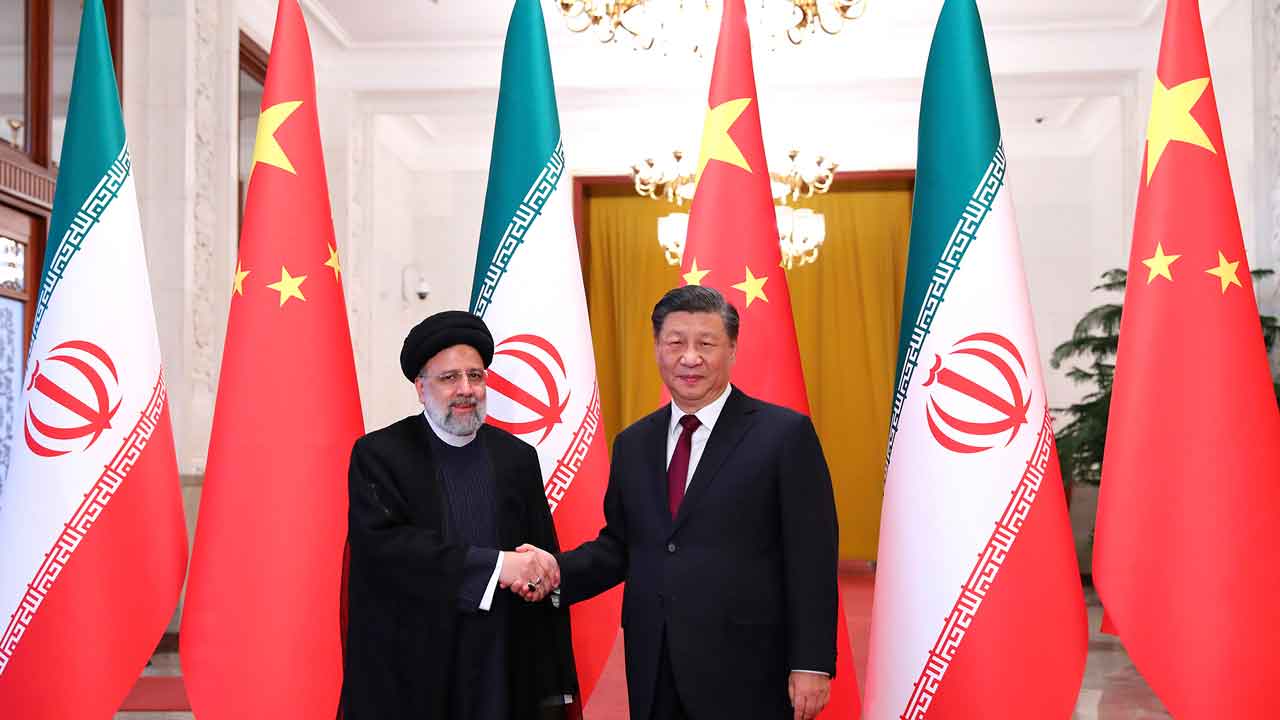
The convergence of Chinese commercial remote sensing capabilities and Iranian kinetic strike systems represents a fundamental shift in the regional power projection equation. While traditional intelligence focuses on the diplomatic fallout of such cooperation, the technical reality is defined by a data-transfer bottleneck that has recently been bridged. Iran’s ability to target U.S. and allied assets no longer relies on indigenous satellite constellations—which remain rudimentary—but rather on the procurement of high-revisit, sub-meter resolution imagery from Chinese commercial entities. This creates a proxy-intelligence loop where the "sensor-to-shooter" timeline is compressed through third-party infrastructure, allowing for precision guidance without the necessity of a sovereign space program of equivalent scale.
The Architecture of Orbital Subcontracting
The dependency on external orbital assets is not a matter of convenience; it is a structural requirement for Iran's missile doctrine. To understand the effectiveness of recent strikes, one must analyze the three specific layers of the intelligence-kinetic interface.
1. The Temporal Resolution Gap
Traditional military satellites often prioritize high-resolution "snapshot" imagery. However, targeting mobile or recently reinforced military bases requires temporal resolution—the frequency with which a satellite passes over the same spot. By utilizing the Chinese commercial fleet (such as the Jilin-1 constellation), Iran gains access to a revisit rate that exceeds that of many dedicated military systems.
- Static Intelligence: Baseline mapping of a base (hangars, fuel depots).
- Dynamic Intelligence: Real-time monitoring of troop movements, aircraft rotations, or the positioning of air defense batteries like the MIM-104 Patriot.
2. Spectral Diversification
Visual imagery (Electro-Optical or EO) is limited by cloud cover and night cycles. The integration of Synthetic Aperture Radar (SAR) data from Chinese partners allows Iran to "see" through weather and darkness. SAR sensors measure the backscatter of microwave pulses, creating a map based on physical texture and material density rather than light. This capability is critical for identifying the metallic signatures of mobile launchers or command centers hidden under camouflage netting.
3. The Geolocation Accuracy Function
Precision-guided munitions (PGMs) require more than just a picture; they require highly accurate coordinates. The error margin in targeting is a function of the satellite’s orbital ephemeris—the exact knowledge of where the satellite is in space at the moment of capture. Chinese commercial data provides the high-fidelity metadata necessary to translate a pixel into a coordinate with a Circular Error Probable (CEP) low enough to enable "building-specific" targeting.
Quantifying the Kill Chain Compression
The effectiveness of a strike is measured by the speed at which data moves from the sensor to the weapon system. In previous decades, this cycle (the OODA loop) took hours or days. The Sino-Iranian data pipeline leverages "Commercial-Off-The-Shelf" (COTS) cloud processing to automate the identification of targets.
The Latency Bottleneck
The primary constraint in satellite intelligence is data downlink. A satellite must pass over a ground station to dump its collected data. China’s global network of ground stations, combined with high-speed data relay satellites in geostationary orbit, allows for a near-instantaneous transfer of imagery to Iranian analysts. This reduces the latency from "image capture" to "target package" to under 30 minutes in optimized scenarios.
Targeting Parameters for Iranian Ballistic Systems
Iranian systems like the Fateh-110 or the Kheibar Shekan utilize inertial navigation systems (INS) corrected by GPS or GLONASS. However, the terminal phase—the final seconds before impact—often relies on optical or radar scene matching.
- Phase A: High-altitude satellite imagery defines the target's GPS coordinates.
- Phase B: The missile’s onboard computer compares the "live" view from its seeker head against the pre-loaded satellite "template" provided by Chinese data.
- Phase C: Discrepancies are corrected mid-flight via control vanes, ensuring the warhead strikes the specific designated coordinate.
The Doctrine of Plausible Deniability via Commercial Channels
The use of commercial Chinese satellites provides Beijing with a layer of strategic ambiguity. Because these satellites are operated by companies that are nominally private (despite being integrated into the Chinese Military-Civil Fusion strategy), the Chinese state can claim that data sales are merely commercial transactions. This complicates the U.S. response framework. Intercepting or jamming a Chinese military satellite is an act of war; disrupting a "commercial" data stream is a legal and diplomatic grey area.
The Cost-Benefit Asymmetry
The cost to launch and maintain a modern imagery constellation is measured in billions of dollars. By "renting" this capability, Iran bypasses the massive capital expenditure and technical risk of space-based R&D. The cost function for Iran becomes an operational expense (OPEX) rather than a capital expenditure (CAPEX). This allows Iran to divert its limited budget toward mass-producing low-cost, high-precision loitering munitions and ballistic missiles, effectively out-spending the U.S. in terms of "cost-per-kill" ratios.
Strategic Vulnerabilities in the Data Pipeline
Despite the advantages of this orbital partnership, the reliance on third-party data creates specific failure points that Western defense planners can exploit.
Data Integrity Attacks
The most potent counter-measure is not physical destruction, but the corruption of the data stream. If the satellite imagery provided to Iran can be subtly altered—shifted by a few meters or modified to hide specific assets—the Iranian missiles will follow those errors to their conclusion. This "spoofing" of the target template represents a cyber-kinetic hybrid defense that avoids the escalatory risks of kinetic anti-satellite (ASAT) warfare.
The Signal-to-Noise Ratio in Rapid Targeting
The sheer volume of data produced by a constellation like Jilin-1 creates a "noise" problem. Iranian intelligence must filter through terabytes of data to find actionable targets. This creates a reliance on automated AI object-recognition software. By utilizing deceptive physical decoys (inflatable launchers, thermal emitters that mimic engine heat), the U.S. can overwhelm these algorithms, forcing the Iranian kill chain to slow down as human analysts are brought back into the loop to verify targets.
Assessing the Displacement of Hegemony
The utilization of Chinese orbital assets by Iran is a symptom of a broader trend: the democratization of high-end military intelligence. The US once held a monopoly on "God’s-eye-view" situational awareness. Today, that monopoly is replaced by a competitive market where any state with sufficient capital can purchase the intelligence once reserved for superpowers.
This shift necessitates a change in US base defense posture. Hardened shelters and point-defense systems (C-RAM, Iron Dome) are insufficient when the enemy possesses sub-meter accuracy. The only viable defense is Active Dispersal.
Military assets must be moved frequently, exceeding the revisit rate of the satellite constellations. If a base's configuration changes every four hours, a satellite pass from six hours ago becomes a liability rather than an asset. The US must transition from a "Fortress" posture to a "Fluid" posture, treating every static coordinate as a compromised location.
The strategic priority is the development of "Counter-Space Electronic Warfare" (CSEW) capabilities. Rather than shooting down satellites, the goal must be the localized "blinding" of sensors over specific geographic windows. By creating "dark zones" where Chinese commercial sensors cannot reliably collect data, the US breaks the first link in the Iranian kill chain. This is not a technological luxury; it is the prerequisite for maintaining a presence in the Middle East as the Sino-Iranian technical axis matures.