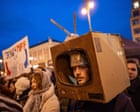
Institutional autonomy in public broadcasting depends on a single structural firewall: direct, decentralized revenue collection. When Prime Minister Andrej Babiš’s governing coalition moved to abolish Czechia’s mandatory household television and radio licence fees—currently totaling 205 koruna per month—and replace them with direct allocations from the central state budget, it triggered a predictable institutional crisis. The resulting mobilization of roughly 350,000 demonstrators on Prague’s Letná Plain, preceded by on-air strikes at Czech Television and Czech Radio across 21 municipalities, is not merely a partisan dispute over household taxation. It is a textbook stress test of institutional capture, resource dependence theory, and European regulatory enforcement.
Standard news coverage frames the Prague demonstrations as an emotional clash between populist governance and civil society groups like Million Moments for Democracy. That framing obscures the underlying operational mechanics. To evaluate the actual risk to media independence in Czechia, analysts must examine three distinct variables: the fiscal substitution mechanism, the procedural velocity of the legislation, and the supranational regulatory tripwires embedded in European Union law.
The Fiscal Substitution Mechanism and Resource Dependence
In organizational theory, Pfeffer and Salancik’s resource dependence model establishes that an institution’s behavior is inevitably shaped by the entities controlling its critical inputs. Public service broadcasters across Europe rely on ring-fenced statutory fees specifically to sever the principal-agent relationship between sitting cabinet ministers and newsroom editors.
Under the existing Czech framework, Czech Television and Czech Radio draw revenue directly from households via the 205-koruna monthly levy. This structure creates three operational safeguards:
- Revenue Predictability: Multi-year capital expenditures—such as investigative journalism units, regional bureaus, and technical infrastructure—can be planned without annual political negotiation.
- Dispersed Principal Risk: Because millions of individual households remit the fee, no single political actor can threaten the broadcaster’s solvency in retaliation for unfavorable coverage.
- Automatic Inflation Insulation: While statutory adjustments require parliamentary approval, the baseline cash flow remains insulated from discretionary mid-year budget freezes.
The Babiš coalition’s draft legislation, authored by the Ministry of Culture, dismantles this architecture by routing broadcaster funding through the annual state budget while simultaneously cutting overall allocations to state television and radio by approximately 15 percent.
Prime Minister Babiš has publicly rejected characterizations of this policy as nationalization, asserting in an op-ed that the government will not interfere in editorial operations and floating alternative concepts such as voluntary payments. From an operational standpoint, explicit editorial directives from a minister are unnecessary once budget control is centralized. When a newsroom’s annual operating capital becomes a line item negotiated every twelve months by the Ministry of Finance and approved by a parliamentary majority, self-censorship becomes a rational survival strategy. Editors and board members face an implicit penalty function: aggressive investigative reporting on government procurement, agricultural subsidies, or coalition conflicts of interest carries a direct fiscal risk during the next budget cycle.
The Three Pillars of Institutional Capture in Central Europe
Demonstrators on Letná Plain—the same physical staging ground where 750,000 citizens assembled in November 1989 during the Velvet Revolution—explicitly referenced the "Slovak scenario" alongside precedents in Hungary, Poland, and Serbia. Across Central and Eastern Europe, the neutralization of public service media has followed a standardized three-stage operational sequence rather than overt state takeover.
Stage One: Financial Starvation and Deficit Induction
The incoming governing coalition frames mandatory user fees as a regressive tax burden on households during periods of inflation. By abolishing the fee and imposing an immediate haircut—in Czechia’s case, the projected 15 percent budget reduction—the state forces the broadcaster into immediate operational contraction. Bureaus close, investigative desks are consolidated, and veteran journalists exit due to wage freezes.
Stage Two: Discretionary Budgetary Leverage
Once the broadcaster relies on parliamentary appropriations, the executive branch gains granular control over capital allocation. Supplemental grants for digital transformation, archive preservation, or emergency broadcasting are released selectively. This creates an asymmetric incentive structure where compliant management is rewarded with solvency while recalcitrant leadership faces administrative paralysis.
Stage Three: Governance Realignment
With the institution weakened financially and demoralized internally, the ruling coalition alters the appointment rules for oversight councils. Statutory hurdles requiring broad parliamentary consensus are lowered to simple majorities, allowing the governing bloc to install loyalists who subsequently replace senior newsroom executives.
During the November 3 broadcaster strike in Czechia, Czech TV’s rolling news channel replaced its standard morning broadcast with archival footage of communist-era president Gustáv Husák touring the Prague metro. While a government minister dismissed the broadcast by claiming the archival footage was an improvement over regular programming, the stunt illustrated the exact institutional memory driving public resistance. In post-communist democracies, audiences recognize that state-budgeted media historically functions as a state communication apparatus rather than an independent public utility.
Procedural Velocity as a Political Diagnostic
When evaluating legislative intent, institutional analysts look beyond statutory text to procedural execution. Democratic reforms designed to optimize public service efficiency typically involve green papers, economic impact assessments, and multi-stakeholder consultations with media unions, legal scholars, and international broadcasting bodies.
The Czech coalition’s handling of the media funding bill bypassed every standard deliberative friction point:
- Nocturnal Scheduling: The first reading of the bill to scrap licence fees was scheduled and pushed through the lower house at 4:36 AM on a Saturday.
- Consultation Omission: The Ministry of Culture drafted the legislation without meaningful stakeholder input and declined interview requests regarding the mechanics of the transition.
- Asymmetric Framing: Following night-time protests outside parliament—where police detained a single individual for throwing a cobblestone with zero injuries—the Prime Minister equated the demonstration to the January 6 assault on the United States Capitol.
In legislative strategy, scheduling controversial readings in the pre-dawn hours serves a specific tactical function: it compresses opposition floor time, minimizes live broadcast visibility, and signals to coalition backbenchers that the leadership prioritizes speed over consensus. Simultaneously, equating a largely peaceful perimeter protest with an armed insurrection functions to delegitimize institutional pushback before the bill reaches upper chamber review or constitutional challenge.
The European Regulatory Collision Course
Unlike Hungary in 2010 or Poland in 2015, Czechia’s governing coalition is executing this restructuring inside a fundamentally altered European legal environment. The European Union no longer relies solely on broad treaty principles to police media pluralism; it now possesses binding secondary legislation designed specifically to block state-budget capture.
The primary legal obstacle is the European Media Freedom Act (EMFA), alongside rule-of-law conditionality mechanisms tied to EU structural and cohesion funds. Under EMFA provisions, member states are legally obligated to ensure that public service media providers have adequate, sustainable, and predictable financial resources corresponding to the fulfillment of their public service remit, explicitly insulated from arbitrary political interference.
The European Parliament’s resolution—adopted by a decisive margin of 442 votes in favor to 158 against, with 47 abstentions—activates a formal escalation sequence:
- Regulatory Audit: The European Commission and the European Board for Media Services are formally tasked with assessing whether transitioning Czech Television and Czech Radio to annual state budget allocations violates EU statutory requirements for funding predictability.
- Infringement Proceedings: If the Commission determines that the 15 percent budget cut and annual appropriation model compromise editorial independence, Brussels can initiate infringement procedures leading to daily financial penalties at the Court of Justice of the European Union.
- Fiscal Conditionality: Members of the European Parliament explicitly linked the media bill to broader rule-of-law evaluations, raising the threat of freezing EU budgetary disbursements to Prague if the legislation advances unaltered.
This creates an acute macroeconomic trade-off for Prime Minister Babiš. Eliminating a 205-koruna monthly household fee delivers a visible, immediate populist dividend to domestic voters. However, triggering EU rule-of-law conditionality mechanisms puts billions of euros in European structural funds at risk—capital that directly supports Czech infrastructure, municipal budgets, and domestic enterprise.
Limitations of Street Mobilization and Institutional Defense
Civil society organizers, led by Mikuláš Minář of Million Moments for Democracy, framed the 350,000-strong Letná Plain gathering as a decisive turning point that forces authorities to recognize the scale of public opposition. Operational realism requires acknowledging the severe limitations of mass street protest against a disciplined parliamentary coalition.
First, protest size does not alter parliamentary arithmetic. Unless street demonstrations fracture the internal cohesion of the governing coalition—forcing junior partners to defect out of fear of electoral wipeout—a prime minister with a working majority can absorb reputational damage and pass the legislation regardless of crowd size.
Second, public trust in legacy public broadcasters is asymmetrical across demographics. While urban populations in Prague and regional centers view Czech Television as a foundational democratic guarantee, segments of the rural and older electorate perceive public media as aligned with urban political elites. Babiš’s framing of the licence fee as an unfair financial burden exploits this exact demographic cleavage.
Third, alternative funding models floated by the government, such as voluntary household subscriptions, suffer from the classic free-rider problem in public economics. Because public broadcasting is a non-excludable good, transitioning from a mandatory levy to voluntary contributions guarantees a catastrophic collapse in revenue—achieving the same financial starvation as a direct budget cut while allowing the government to claim it respected consumer choice.
Tactical Playbook for Institutional Preservation
For Czech civil society, opposition lawmakers, and media executives, relying solely on recurring mass rallies is a depreciating strategy. Sustaining the operational independence of Czech Television and Czech Radio requires shifting from reactive street mobilization to multi-front institutional friction:
- Deploy Constitutional and Supranational Injunctions Immediately: Opposition parties in the Senate and Chamber of Deputies must prepare immediate referrals to the Czech Constitutional Court upon final passage, anchoring their challenge in the constitutional right to information and the EU supremacy of the European Media Freedom Act. Simultaneously, media unions must submit formal evidentiary dossiers to the European Board for Media Services documenting the 4:36 AM procedural bypass and the projected 15 percent operational deficit.
- Reframe the Fiscal Narrative Around EU Fund Exposure: Opposition messaging must abandon abstract defenses of "journalistic freedom," which fail to move inflation-sensitive voters. Communications must focus entirely on the fiscal net loss: saving households 205 koruna per month while forfeiting billions of euros in frozen EU cohesion funds represents a catastrophic macroeconomic deficit for Czech taxpayers.
- Enforce Multi-Year Statutory Indexing as a Compromise Floor: If the parliamentary majority proves unbreakable and abolishes the direct household levy, institutional defenders must pivot to demanding an automatic, multi-year statutory funding formula pegged strictly to a fixed percentage of GDP or consumer price inflation, legally ring-fenced from annual Ministry of Finance discretion. Without an automatic mathematical indexing mechanism, annual state budget funding will inevitably degrade Czech public broadcasting into a compliant state organ within two electoral cycles.