The human response to catastrophic oncological trauma is typically evaluated through qualitative psychological lenses, yet the process of post-surgical rehabilitation operates on a quantifiable framework of biological adaptability, structural compensation, and neurocognitive re-mapping. When an individual survives a radical maxillofacial resection—such as the loss of a partial jaw and unilateral vision due to advanced carcinoma—the subsequent recovery trajectory is not a linear emotional journey. It is a complex optimization problem. Survival and functional restoration depend on the victim's ability to reallocate neurological resources, manage severe physiological deficits, and construct alternative behavioral feedback loops.
Human resilience in the wake of disfiguring surgical interventions can be systematically deconstructed into three distinct operational pillars: structural biophysical adaptation, sensory-motor compensation, and the deployment of deliberate psychological signaling mechanisms. For a different perspective, check out: this related article.
The Biophysical Cost Function of Maxillofacial Resection
Radical maxillofacial surgery completely alters the structural integrity of the craniomaxillofacial complex. The removal of a partial jawbone (mandibular or maxillary resection) destroys the mechanical equilibrium required for basic mastication, deglutition, and articulation.
When a significant portion of the jaw is excised, the remaining bone segments are subjected to altered muscular vectors. The lateral pterygoid, masseter, and medial pterygoid muscles on the contralateral side pull the remaining jaw segment toward the surgical defect. This structural deviation creates a permanent mechanical imbalance. Further coverage on this matter has been published by Healthline.
- Vector Deviation: The unilateral loss of muscle attachments causes the mandible to deviate toward the scar tissue, disrupting dental occlusion and reducing bite force by up to 70-80%.
- Soft Tissue Contracture: As surgical wounds heal, scar tissue contracture restricts the range of motion of the remaining temporomandibular joint (TMJ), inducing progressive trismus.
- Airway and Salivary Alterations: The loss of structural support for the floor of the mouth alters tongue position, which compromises airway patency during sleep and degrades swallowing efficiency, increasing aspiration risks.
Simultaneously, unilateral orbital exenteration or the loss of vision in one eye eliminates stereopsis—the brain's ability to perceive depth through binocular disparity. The visual field is instantly restricted by approximately 25-30% horizontally. The individual must transition from automatic visual processing to conscious, compensatory head movements to scan the blind hemisphere. This constant cervical rotation increases the metabolic cost of basic locomotion and accelerates musculoskeletal fatigue in the upper trapezial and splenius capitis muscles.
Sensory-Motor Re-Mapping Through Rhythmic Kinesiology
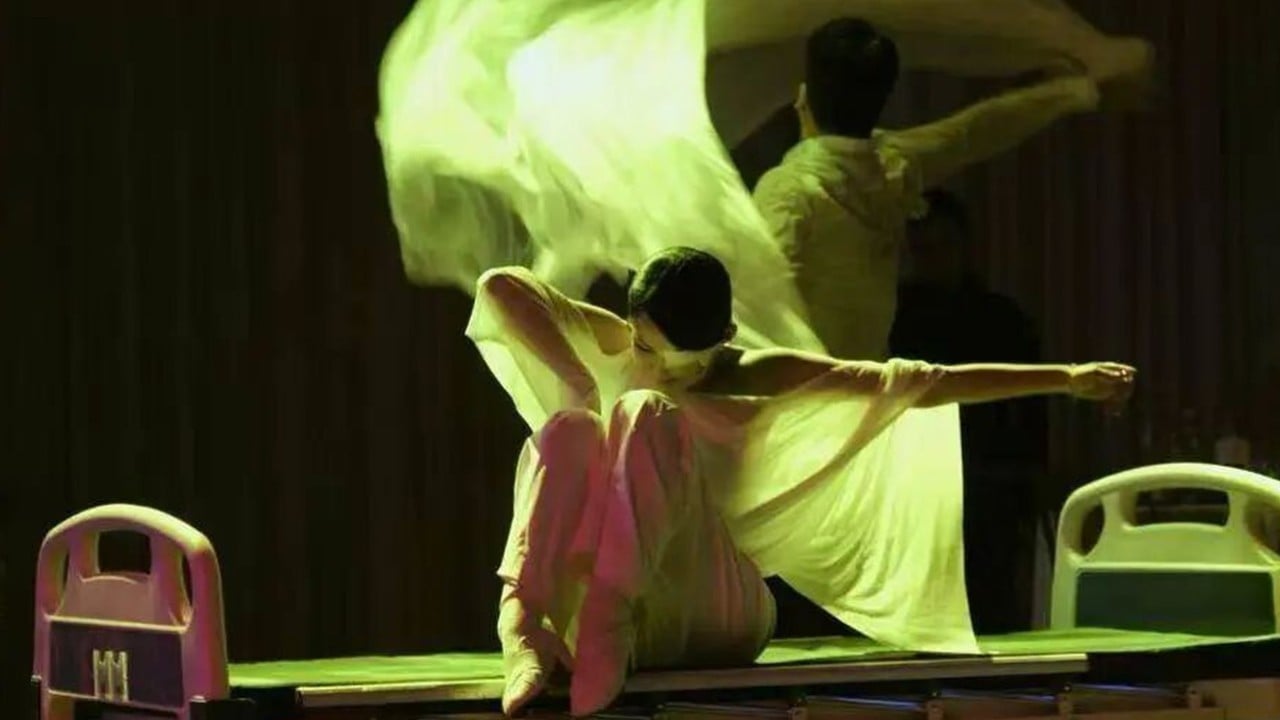
The utilization of rhythmic movement, such as dance, following catastrophic physical trauma serves a precise neurological function. It is not merely a recreational outlet; it is a highly effective mechanism for vestibular and proprioceptive recalibration.
When an individual loses unilateral vision and structural facial symmetry, the central nervous system experiences a profound disruption in its internal spatial map. The vestibular system, which relies on symmetrical inputs from both inner ears and visual confirmation from both eyes to maintain equilibrium, must be entirely recalibrated. Rhythmic kinesiology forces the brain to utilize alternative sensory inputs to calculate spatial orientation.
Proprioceptive Substitution
With binocular vision gone, the brain increases its reliance on mechanoreceptors located in the joints, muscles, and soles of the feet. Rhythmic, structured movement accelerates this proprioceptive feedback loops. By executing coordinated motor patterns, the individual forces the cerebellum to build a new computational model of the body’s center of gravity relative to its altered physical mass.
Vestibulo-Ocular Reflex Adaptation
The loss of one eye requires the remaining eye to perform wider saccadic movements to track objects. Engaging in complex physical routines trains the vestibulo-ocular reflex (VOR) to function under asymmetric conditions, reducing the dizziness and spatial disorientation commonly experienced by unilateral vision patients during rapid head turns.
Neuroplastic Cortical Reorganization
The cortical representation of the face and jaw in the somatosensory cortex undergoes massive reorganization following tissue loss. Engaging in complex, multi-limb motor tasks prevents the maladaptive plastic changes often associated with chronic pain and phantom sensations, directing cortical resources toward functional motor control instead.
The Strategic Function of Prosthetic Masking and Visual Signalling
The deliberate deployment of external artifacts—specifically eye patches and face masks—extends beyond clinical utility or simple concealment. In a social ecosystem optimized for facial symmetry, these items function as vital tools for managing social friction and conserving cognitive energy.
Facial symmetry is hardwired into human evolutionary biology as a primary indicator of health and genetic fitness. Radical surgical deviations from this symmetry elicit involuntary, subconscious negative feedback loops from observers, ranging from prolonged staring to micro-expressions of aversion. For the individual, navigating these interactions requires a continuous, exhausting expenditure of emotional and cognitive regulation.
The introduction of an eye patch and a mask strategically alters this dynamic by interrupting the observer's facial processing framework.
The mask and patch obscure the specific zones of structural asymmetry (the resected jawline and the empty orbit). By concealing the irregular geometry of the defect, the individual shifts the observer's focus away from a broken symmetry model and toward a structured, culturally understood aesthetic configuration. The eye patch signals a clear, legible narrative of medical trauma or intervention, converting an ambiguous, potentially jarring visual stimulus into a socially defined archetype.
This reduction in visual ambiguity directly lowers the social friction coefficient. The individual no longer needs to constantly brace for unpredictable public reactions, transforming the public space from a hostile environment of continuous scrutiny into a predictable, manageable domain. This conservation of cognitive bandwidth allows neurological resources to be redirected toward physical rehabilitation and complex motor tasks.
Limitations of Kinesiological Adaptation
While rhythmic physical activity provides clear neurological and vestibular benefits, it cannot fully circumvent the absolute physical constraints imposed by radical surgery. Proprioceptive substitution has a functional ceiling. It cannot replace the precision of true stereoscopic depth perception, meaning the individual will always operate at a disadvantage in high-velocity or unpredictable spatial environments.
Furthermore, prolonged muscular compensation for a missing jaw segment inevitably accelerates degeneration of the remaining temporomandibular joint. Without surgical reconstruction using vascularized free flaps (such as a fibula free flap) to restore bone continuity, the mechanical efficiency of the craniomaxillofacial apparatus remains permanently degraded. Kinesiological optimization is an adjunctive strategy; it maximizes the utility of the remaining biological assets but does not restore the original baseline.
Strategic Blueprint for Managing Catastrophic Structural Deficits
To optimize functional outcomes following severe craniomaxillofacial trauma, rehabilitation protocols must move beyond passive recovery models and adopt an aggressive, multi-tiered framework focused on objective physical metrics.
- Deploy Targeted Vestibular Habituation Protocols: Rather than relying on generalized physical activity, implement structured vestibular rehabilitation therapy (VRT) within 30 days post-surgery. Use repetitive habituation exercises specifically designed to force the remaining eye and inner ear to coordinate, rapidly reducing the timeline for spatial orientation recovery.
- Implement Early Asymmetric Myofascial Therapy: To counteract the unilateral muscular pull that forces the remaining jaw segment toward the surgical defect, initiate targeted physical therapy on the contralateral masseter and pterygoid muscles. Utilize customized intraoral appliances to maintain alignment and mitigate the progression of trismus.
- Optimize the External Cognitive Environment: Treat prosthetics, patches, and masks as functional tools for social bandwidth management. Utilize these artifacts strategically during high-density social interactions to minimize cognitive fatigue, then gradually phase them out in controlled, low-friction environments to promote direct facial desensitization and psychological adaptation.
- Establish Quantitative Biomarkers of Re-mapping: Measure the progress of neurological adaptation through objective metrics, including tracking changes in gait symmetry, saccadic velocity in the remaining eye, and maximum interincisal opening (MIO) distance over time. This shifts the evaluation of recovery from subjective emotional states to verifiable physiological milestones.