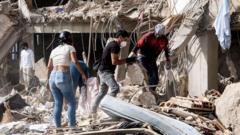
Urban search and rescue operations in the wake of major seismic events are governed by a brutal, non-linear decay function: the survival probability of trapped individuals drops exponentially every hour, while the structural instability of compromised concrete expands. When these dynamics occur within a structurally degraded economic environment—such as recent Venezuelan seismic disruptions—the crisis escalates from a localized engineering challenge into a systemic logistics failure. Emotional media narratives focus on individual miracles, but a rigorous operational audit reveals that rescue efficacy is determined entirely by three structural variables: collapse topology, supply-chain throughput, and localized acoustic communication networks.
Optimizing life preservation under these constraints requires moving past superficial reporting to map the exact physical and organizational bottlenecks that dictate who lives and who dies beneath the rubble.
Structural Collapse Topology and the Void Space Calculation
The immediate determinant of survival probability is the specific failure mode of the affected architecture. In regions characterized by informal construction or unreinforced masonry, seismic waves trigger predictable structural failures. Understanding these mechanical profiles allows engineering teams to predict where void spaces—pockets where human life can be sustained—are likely to form.
- Pancake Collapses: Occur when vertical support columns fail completely, causing upper floors to settle directly onto lower floors. This structure offers the lowest probability of void space creation. Survival relies on the presence of high-mass furniture or internal load-bearing partitions that resist total compression.
- V-Shape Collapses: Occur when an interior vertical support fails while the outer walls remain intact. The floor slabs crack and slope downward toward the center, creating two distinct triangular void spaces along the perimeter walls.
- Lean-to Collapses: Occur when a single outer wall or support column fails, causing one side of the floor slab to drop while the opposite side remains supported. This yields a highly predictable, singular triangular void space beneath the elevated side.
The primary impediment to extraction in these environments is the lack of heavy lifting machinery or precision concrete-cutting tools. When standard mechanical excavators are unavailable, rescue operations revert to manual debris removal. This shifts the operational timeline from hours to days.
Manual removal introduces a high risk of secondary collapse. Moving a single structural element without calculating the load redistribution can destabilize the entire pile, crushing remaining void spaces.
The Logistic Decay Function of the Golden Hour
In disaster medicine, the "Golden Hour" defines the window during which rapid medical intervention can prevent traumatic shock and systemic organ failure. In structural collapse scenarios, this timeline is elongated but significantly more hazardous due to the mechanics of crush syndrome.
When a limb is compressed by structural debris for more than four to six hours, skeletal muscle tissue begins to necrose, releasing high concentrations of myoglobin, potassium, and phosphorus into the isolated circulatory pocket. The moment the debris is lifted without proper medical preprocessing, these toxins flood the systemic circulation. This induces acute kidney injury and cardiac arrest—a phenomenon known as reperfusion injury.
The logistical bottleneck in underfunded regions is the lack of advanced life support field kits at the immediate extraction point. If a rescue team lacks intravenous hydration protocols (specifically isotonic sodium bicarbonate) to stabilize the patient before lifting the compressing load, the act of extraction itself becomes lethal.
The operational reality demands that triage occurs prior to structural movement, transforming a physical extraction problem into a complex medical sequencing challenge.
Communication Infrastructure Asymmetry and Civilian Acoustic Networks
When centralized telecommunications networks fail due to severed fiber-optic lines or power grid collapse, an information asymmetry develops between the rescue coordinators and the families on the ground. In the absence of specialized seismic acoustic sensors or thermal imaging arrays, civilian search methods become the primary tool for locating survivors.
Families shouting into structural voids establish primitive acoustic telemetry. While highly inefficient, this decentralized communication performs a crude form of triage mapping. This method introduces significant systemic errors:
- Acoustic Dispersions: Sound waves traveling through fractured concrete and hollow pipes warp significantly. A voice that sounds adjacent may originate from three floors below, leading to misallocated excavation efforts.
- Emotional Noise Contamination: High ambient noise levels from civilian crowds disrupt the periods of silence required for professional acoustic listening devices, stalling systematic search protocols.
- High-Density Reporting Bias: Areas with more vocal or active civilian populations receive disproportionate rescue resources, leaving isolated or completely collapsed structures uninspected.
To correct this distortion, incident commanders must enforce strict acoustic isolation zones, implementing alternating ten-minute windows of total site silence to calibrate directional microphones and verify structural feedback.
Resource Constraints and Closed Supply Logistics
Deploying specialized international Urban Search and Rescue teams requires frictionless logistical corridors. In restricted or economically isolated regions, the incoming supply chain suffers from severe friction points.
The absence of functional heavy transport aviation infrastructure near the epicenter forces reliance on ground transport over degraded or landslide-blocked roadways. This creates a severe staging bottleneck. Specialized shoring equipment, hydraulic jacks, and medical supplies sit in staging areas miles away from the collapse sites while manual labor teams attempt to clear thousands of tons of reinforced concrete with basic hand tools.
The strategic response to this bottleneck is the rapid deployment of a localized "hub-and-spoke" distribution model. Rather than attempting to deliver heavy machinery directly to every affected structure, assets must be centralized at high-density nodes. From these nodes, fast-moving scout teams equipped with basic search cameras and pneumatic lifting bags can be dispatched to verify viable void spaces before heavy equipment is committed.
Deployed Strategy for Asymmetric Search Environments
To maximize survival rates when facing severe equipment and structural deficits, incident commanders must bypass conventional multi-phase search doctrines in favor of an accelerated, targeted deployment matrix.
Resources should be distributed based on a strict triage hierarchy derived from the structural age and building material of the target zones, rather than the volume of civilian appeals. The immediate operational priority must focus on identifying lean-to and V-shape collapses in medium-density structures, where the ratio of void space creation per unit of collapsed material is mathematically highest.
Directing manual labor away from high-mass pancake collapses—where survival without heavy machinery is statistically negligible—and toward structures with predictable, accessible voids optimizes the deployment of constrained human capital. This cold calculus represents the only reliable mechanism for maximizing extraction volume when the logistical environment prevents a comprehensive technological response.