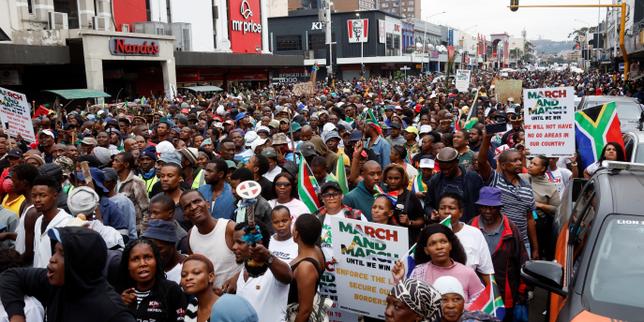
Mainstream reporting loves a predictable narrative. When anti-migrant protests flare up in Johannesburg or Pretoria, international correspondents dust off their standard playbook. They blame "irrational hatred," decry the rise of populist vigilante groups like Operation Dudula, and paint a picture of a nation gripped by simple bigotry.
They are looking at the smoke and missing the arsonist.
The lazy consensus states that South Africa’s xenophobic surges are merely a social or cultural pathology—a sudden, tragic lapse in the "Rainbow Nation" ideal. This diagnosis is not just wrong; it protects the actual culprits. Having spent years analyzing emerging market labor dynamics and watching policy blunders eat away at sub-Saharan Africa’s largest economy, I can tell you that South Africa’s xenophobia is not a cultural defect. It is a highly rational, predictable, and manufactured consequence of structural economic strangulation.
If you want to understand why communities turn on foreign shopkeepers and informal workers, stop reading sociology papers. Start looking at the mechanics of state-enforced economic exclusion.
The Scapegoat Economy: How Policy Failures Mimic Bigotry
The prevailing media narrative treats anti-immigrant sentiment as an isolated phenomenon driven by rogue agitators. This completely misunderstands how capital and labor collide when a government systemically fails its people.
South Africa's official unemployment rate hovers around 32%, with youth unemployment sitting at a catastrophic 60%. In any economy where more than half of the young population is legally locked out of productivity, friction is inevitable. But the catalyst isn't the presence of Zimbabweans, Mozambicans, or Nigerians. The catalyst is a rigid, hyper-regulated formal labor market that punishes domestic job creation.
When bargaining councils set minimum wages that ignore the realities of low-skilled labor, and when strict labor laws make hiring a permanent employee an immense financial risk, businesses adapt. They either automate, scale down, or pivot to the informal sector.
This is where the collision happens. The informal sector—spaza shops, street vending, domestic work, and micro-construction—becomes the only functional free market left in the country. Because foreign migrants are often excluded from formal state support, they operate with extreme efficiency within this informal ecosystem. They establish hyper-optimized supply chains, pool capital within migrant networks, and work hours that formal labor regulations prohibit for domestic citizens.
The domestic population, trapped by a lack of skills and conditioned by a state that promises welfare but delivers rolling blackouts (loadshedding), finds itself locked out of even the survivalist economy. The resulting rage is real, but its target is a misdirection. The media focuses on the fistfights in the streets, ignoring the bureaucratic red tape that created the arena in the first place.
Dismantling the "Stolen Jobs" Myth
Let’s address the most common question that dominates public debate and talk radio: Are foreigners taking jobs from South Africans?
The short, brutally honest answer is no, because those jobs did not exist in the formal structure to begin with.
The premise of the question is flawed. It assumes a fixed pie—the lump of labor fallacy—where every job held by an immigrant is a job subtracted from a citizen. In reality, migrant entrepreneurs in townships like Alexandra or Soweto often create micro-economies where none existed. They rent space from South African landlords, buy goods from local wholesalers, and stimulate cash velocity in overlooked neighborhoods.
Data from institutions like the Sustainable Livelihoods Foundation has repeatedly shown that informal foreign traders often outperform local operators not because of underhanded tactics, but because of superior retail logistics. They buy in bulk as collectives, lowering their unit costs and passing the savings onto impoverished consumers.
When populist movements forcibly shut down these shops, they don't open up vacancies for South Africans. They create food deserts. They drive up prices for the poorest citizens. They destroy local rental income for South African property owners who depend on migrant tenants to pay their mortgages.
The elite commentators sitting in the wealthy suburbs of Sandton look down and see tribalism. What is actually happening is a desperate, violent competition for liquidity in an economy where the state has choked off formal growth.
The Failure of the Corporate and Political Elite
I have watched corporate boards and political strategists navigate this crisis for a decade, and their cowardice is uniform.
Politicians across the spectrum—from the ruling African National Congress (ANC) to populist opposition parties—know exactly what they are doing when they play the migrant card. It is the ultimate political diversion tactic. If the public is busy hunting down undocumented workers, they aren't looking at the billions stolen from state-owned enterprises like Eskom and Transnet. They aren't asking why the public education system ranks among the worst globally despite massive budget allocations.
By transforming a systemic governance failure into an immigration crisis, the political class buys itself another election cycle.
[State Governance Failures] -> [Formal Economic Collapse] -> [Hyper-Competition for Informal Cash] -> [Xenophobic Flashpoints]
Meanwhile, the corporate sector hides behind superficial corporate social responsibility (CSR) initiatives and diversity statements. They refuse to publicly call out the labor rigidities and disastrous economic policies that cause this tribalism. They protect their own concessions while the township economy burns.
The downside of acknowledging this truth is uncomfortable. It means admitting that stopping xenophobia requires more than just "tolerance campaigns" or increased policing. It requires a complete dismantling of South Africa’s economic status quo. It requires deregulating the labor market, stripping away the monopolies of state-aligned enterprises, and allowing both domestic and foreign entrepreneurs to build businesses without state interference.
Stop Trying to "Fix" Xenophobia With Morality
The current approach to curing this societal rift is entirely performative. Human rights organizations launch awareness campaigns. Celebrities tweet hashtags. The government deploys tactical police units to clear out informal markets after a riot.
None of it works. None of it will ever work.
You cannot preach morality to a man who hasn't eaten in two days and watches his neighbor succeed where he has been set up to fail. Xenophobia will not be solved by lecturing impoverished communities on Pan-African solidarity. It will only be solved by making it easier to start a business, hire a worker, and build capital in South Africa than it is to break the law.
Until the underlying economic structures are deregulated to allow for mass, low-skilled employment, the informal sector will remain a pressure cooker. The media will continue to cover the explosions, blame the culture, and miss the point entirely.
The problem isn't that there are too many outsiders. The problem is that the state has made it a crime for insiders to build anything of value.