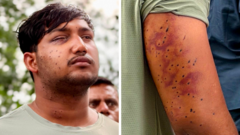
We love our simple villains. We love our clean narratives of good versus absolute evil. When unrest hits the streets, the media machine cranks out the same tired script: a monolithic state unleashing indiscriminate terror against peaceful, defenseless citizens.
The latest iteration of this lazy consensus focuses on the medical reports of protestors bearing injuries consistent with pellet-gun fire. Human rights organizations, compliant journalists, and armchair activists line up to decry the brutality. They look at the X-rays, point to the embedded metal spheres, and declare an open-and-shut case of state-sponsored mutilation.
They are missing the entire point because they refuse to look at the mechanics of urban chaos.
I have spent years studying crowd control dynamics, non-lethal munitions deployment, and the physics of civil unrest. I have watched commentators who have never stepped foot inside a riot zone pontificate about proportional response from the comfort of air-conditioned studios. The conversation around pellet-gun injuries is built on a foundational lie: that civil disobedience happens in a vacuum where security forces operate as stationary executioners firing into crowds of passive bystanders.
The reality is messier, uglier, and entirely counter-intuitive to the talking heads on television.
The Physics Of The Riot Zone
Let us clear away the emotional fog and look at the ballistics. Pellet guns, typically firing multi-pellet 12-gauge rounds or compressed-air projectile spreads, are designed as less-lethal deterrents. They are meant to inflict localized, non-fatal pain to disperse aggressive crowds without using live rounds that would turn a street corner into a morgue.
When you read reports claiming protestors have wounds "consistent with pellet-gun fire," the media wants you to picture a squad of armed personnel standing fifty yards away, systematically sniping peaceful marchers holding placards.
That is not how a riot works.
Imagine a scenario where a mob is actively firebombing a transit station, hurling concrete blocks at police lines, and advancing with steel rods. Security forces do not fire into the air as a polite warning. They deploy dispersal munitions at the pavement, relying on ricochet and spread to break the momentum of the charging front line.
When a lead pellet ricochets off asphalt before striking a shin or a calf, it tumbles. It loses velocity. It causes jagged, superficial tissue damage that looks horrific on a hospital chart but successfully stops a violent charge.
The injury is real. The medical diagnosis is accurate. The context being sold to the public is an absolute fabrication.
The Manufactured Martyrdom Industry
There is a lucrative economy in outrage. Every pellet wound treated in a trauma ward is immediately weaponized by political entrepreneurs who need a steady supply of victims to keep their fundraising engines running.
Let us be brutally honest about how casualty statistics are gathered during periods of civil unrest. Local clinics are flooded. Triage nurses are overwhelmed. In the chaos, distinguishing between a frontline rioter who spent three hours throwing petrol bombs and an innocent bystander caught in the crossfire becomes secondary to stopping the bleeding.
Yet, the moment those medical records hit the desk of an advocacy group, every single patient is retroactively christened an innocent, peaceful protestor.
This is intellectually dishonest.
In any volatile urban uprising, there is a distinct spectrum of participation. You have professional agitators, opportunistic looters, frontline combatants who actively engage security forces, and genuine bystanders trapped by geography. The current narrative erases this spectrum entirely. It paints every single person carrying lead fragments under their skin as a passive saint.
If you charge a barricade, you are no longer participating in a peaceful assembly. You are a combatant in a localized skirmish. Treating the resulting defensive injuries as proof of unprovoked state aggression requires a willful suspension of common sense.
What The Experts Won't Tell You About Non-Lethal Alternatives
Whenever critics demand the total ban of pellet guns, they conveniently ignore the alternative.
What happens when security forces lose their primary less-lethal dispersal tool? Do they magically sing songs and hold hands with the mob?
Of course not.
When you take away pellet guns, beanbag rounds, and rubber batons, you force security forces to choose between two catastrophic extremes: complete paralysis or live ammunition. There is no middle ground in physical security. If a crowd of five thousand people rushes a government perimeter with intent to breach, and the defenders have no intermediate force options, they will escalate immediately to lethal firearms to protect their positions.
Think about that the next time you nod along to a headline demanding the immediate outlawing of crowd-control shotguns. You are not advocating for peace. You are advocating for a higher body count.
Pellet guns are brutal. They leave ugly scars. They cause agonizing pain. They are meant to. They are instruments of state coercion designed to make continuing a riot physically unbearable. They are the ugly compromise we use to avoid massacres.
Until the critics proposing these naive bans can invent a magical forcefield that safely halts a charging mob of angry humans without bruising tissue or breaking skin, stop pretending that trading less-lethal force for live rounds is a humanitarian victory.
The wounds are real. The outrage is weaponized. And the people selling you the narrative are hoping you never ask what comes next when the guns go silent for good.