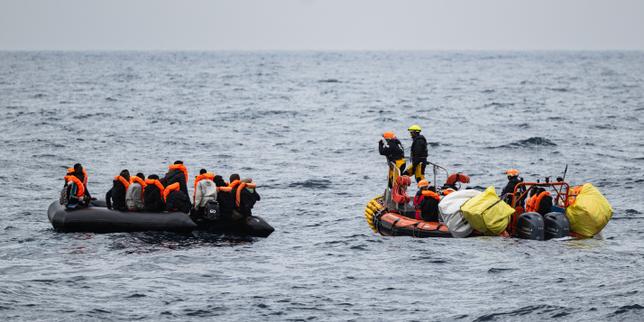
The crossing of the Central Mediterranean has reached a point of systemic equilibrium where the mortality rate functions not as a deterrent, but as a fixed cost of an inelastic migration market. Surpassing the threshold of 1,000 recorded deaths before the mid-year point indicates a breakdown in the European Union’s Integrated Border Management (IBM) strategy. This failure stems from a fundamental miscalculation: the assumption that increasing the physical and legal risks of transit would decrease the volume of attempts. Instead, the data suggests that risk intensification merely shifts the profit margins of smuggling networks and increases the lethality of the transit without suppressing the underlying demand.
The Triad of Migration Persistence
To analyze why fatalities continue to climb despite increased surveillance, we must evaluate the three structural pillars that sustain this corridor:
- Asymmetric Information and the Smuggling Monopoly: Migrants rarely possess real-time data on sea conditions or the structural integrity of the vessels provided. Smuggling networks operate as a predatory monopoly, where the "product" (passage) is sold based on perceived rather than actual safety.
- The Deterrence Paradox: As formal search and rescue (SAR) operations are decentralized or criminalized, the "pull factor" theory—which posits that rescue ships encourage crossings—has been statistically discredited. The removal of dedicated SAR assets creates a "security vacuum" that is filled by less seaworthy vessels attempting longer, more dangerous routes to avoid detection.
- The Geopolitical Pressure Valve: Transit countries like Libya and Tunisia utilize migration flows as a form of "non-linear leverage" in diplomatic negotiations with the EU. The oscillation in enforcement intensity is often a reflection of funding cycles and political concessions rather than operational capacity.
The Mechanics of Attrition in the Central Mediterranean
The figure of 1,000 deaths is a conservative baseline, limited by "invisible shipwrecks"—incidents where vessels disappear without distress calls or recovered remains. The mortality rate is driven by specific mechanical and logistical variables that define the modern crossing.
Vessel Structural Integrity and Overloading
Smuggling operations have transitioned from rubber boats to poorly welded "iron boats," particularly on the Tunisian route. These vessels are cheaper to manufacture but possess catastrophic stability profiles. Unlike inflatable crafts, which may remain buoyant even when punctured, iron boats sink rapidly upon capsizing, leaving zero window for surface rescue. The mass-casualty events are a direct function of the Stability Index of these vessels, which is compromised the moment they are loaded at 300% to 500% of their theoretical capacity.
The Search and Rescue (SAR) Gap
The geographical distribution of deaths correlates with the retraction of the SAR zone. Current maritime policy emphasizes "pull-back" operations by the Libyan Coast Guard (LCG). However, the LCG’s operational radius and response times are dictated by political stability and equipment maintenance cycles. When a distress signal is issued outside of an active NGO or commercial shipping lane, the probability of a fatal outcome increases exponentially with every hour of delay. We can express the risk as a function of:
- Distance from the nearest SAR asset
- Sea state (Beaufort scale)
- Vessel freeboard height
Environmental and Temporal Volatility
The "seasonality" of migration is becoming less predictable. While summer months traditionally see higher volumes, the push factors in countries of origin (conflict, hyperinflation, agricultural failure) are now so acute that they override seasonal weather risks. Attempting a crossing during the "shoulder seasons" (late winter/early spring) involves navigating unpredictable thermal fronts and higher sea states, which directly contributes to the early-year surge in fatalities.
Economic Incentives vs. Kinetic Enforcement
The European response has focused on kinetic enforcement—intercepting boats and destroying smuggling assets. This strategy ignores the economic reality that the migration industry is highly adaptive. When one route is closed or becomes too lethal, the market does not disappear; it diversifies.
The cost of a crossing ranges from $1,500 to $5,000 depending on the point of origin and the perceived "safety" of the vessel. In a high-risk environment, smugglers minimize their capital expenditure by using the lowest quality materials possible. If a boat is likely to be seized or sunk, there is zero incentive to invest in its seaworthiness. Consequently, the intensification of border "hardness" directly correlates with the decrease in vessel quality, thereby increasing the death toll.
The Externalization of Border Control and Its Limitations
The strategy of externalization—moving border checks to third countries—has created a dependency on volatile partners.
- Libya’s Fragmented Authority: The lack of a unified central government makes the "pull-back" mechanism unreliable and often leads to human rights cycles that fuel re-migration attempts.
- Tunisia’s Economic Precarity: As Tunisia faces internal economic pressures, its role as a "buffer zone" becomes a bargaining chip. Sudden shifts in domestic policy toward sub-Saharan migrants can trigger "panic departures," where thousands attempt to leave simultaneously to avoid local crackdowns, overwhelming any existing maritime safety nets.
Operational Realities of the Mediterranean Corridor
For maritime analysts, the Mediterranean is no longer a traditional border but a "managed zone of attrition." The current policy framework accepts a specific "clearance rate"—the percentage of migrants who successfully reach Europe versus those intercepted or lost—as a necessary byproduct of maintaining sovereign integrity. However, this model is reaching a point of diminishing returns. The administrative and political cost of managing 1,000+ deaths in six months creates a reputational deficit and legal liabilities under the International Convention for the Safety of Life at Sea (SOLAS).
Structural Recommendations for Migration Management
The current trajectory is unsustainable. To shift from a reactive, high-mortality model to a controlled, low-attrition framework, the following structural adjustments are required:
- Transition to "Smart" Surveillance and Immediate Intervention: Rather than using aerial surveillance (Frontex) solely for interception and pull-back coordination, the data must be integrated into a mandatory "Life-First" protocol that triggers the nearest vessel—commercial or governmental—regardless of political sensitivity.
- Regional Disembarkation Platforms: To break the smuggling cycle, legal processing must occur outside of the maritime zone. This requires the establishment of secure, third-party processing centers that meet international legal standards, removing the incentive to risk the sea crossing for the sole purpose of claiming asylum on European soil.
- Incentivizing Seaworthiness through Regulation: While counterintuitive, recognizing the transit as a market allows for the potential of "de-risking." If legal pathways are restricted, the secondary market will always exist. Strategic intervention could involve targeting the supply chain of boat engines and materials in transit countries, focusing on the "means of lethality" rather than the migrants themselves.
- Recalibrating the "Pull Factor" Metric: Policymakers must move beyond the binary debate of whether rescue ships encourage migration. The data demonstrates that migration volume is driven by "push factors" (GNP per capita in origin countries, conflict intensity) while mortality is driven by "SAR density." Decoupling these two variables allows for a more humane maritime policy that does not sacrifice border security.
The Mediterranean mortality rate is not an accident of nature; it is the predictable output of a system designed to prioritize deterrence over stability. Until the economic and geopolitical incentives of the smuggling trade are addressed through legal regional integration and standardized SAR protocols, the 1,000-death milestone will remain a recurring feature of the annual calendar. The strategic imperative is to move from a posture of reactive containment to one of proactive, legal-channel management that devalues the smuggling product at its source.