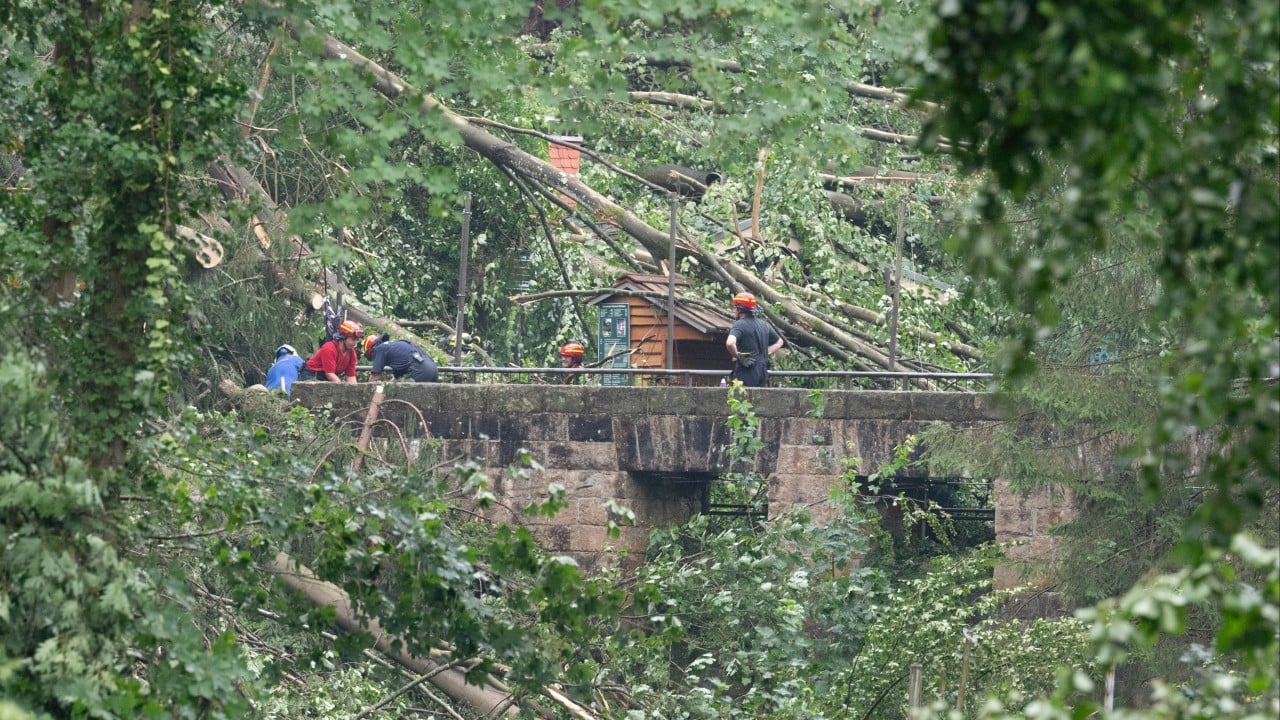
Severe weather events are rarely isolated atmospheric accidents; rather, they function as stress tests for regional infrastructure, public safety protocols, and emergency response logistics. When a severe storm system recently swept across Germany, resulting in one fatality and three critical injuries, public discourse typically focused on the meteorological anomaly itself. This approach misdiagnoses the risk vector. The primary variable is not the wind speed or the precipitation volume in isolation, but the friction coefficient between high-intensity weather phenomena and static physical assets. Analyzing this event requires a systemic breakdown of meteorological tracking precision, urban density exposure indices, and the operational bottlenecks inherent in civil protection frameworks.
The Mechanics of Atmospheric Force Amplification
Modern meteorological systems moving across Central Europe frequently encounter shifting thermal gradients driven by broader climatic changes. In the context of the recent German storm, the primary driver was a rapid-pressure-drop phenomenon that generated localized wind shears capable of exerting extreme force on vulnerable surface structures.
The kinetic energy of wind scales with the square of its velocity. A modest increase in wind speed translates to a non-linear spike in structural pressure. When gusts exceed structural tolerance thresholds—often engineered around historical baselines rather than high-variance modern extremes—failures manifest as unpredicted projectile generation and structural collapse.
- Dynamic Pressure Differential: High-velocity air displacement creates immediate pressure imbalances across building facades and canopy structures.
- Localized Wind Tunneling: Urban morphology frequently exacerbates wind speeds through narrow corridors, multiplying localized impact metrics far beyond regional averages.
- Soil Saturation Metrics: Prior precipitation levels dictate root system stability. Saturated ground eliminates the anchorage friction required for mature urban trees, turning them into high-momentum hazards.
Structural Vulnerability and the Human Cost Function
The human toll of the recent storm—characterized by localized fatalities and severe trauma cases—points directly to exposure timing and public notification latency. Casualties during high-wind events are predominantly tied to two vectors: vehicular operation during peak gust intervals and pedestrian exposure in unmanaged arboreal zones.
Urban planners and municipal risk managers operate under risk mitigation models that balance the economic cost of proactive closures against the statistical probability of injury. This trade-off creates systemic exposure. When meteorological warning lead times drop below critical operational thresholds, individuals remain mobile within high-risk corridors.
- Mobility Corridors: Arterial roadways flanked by mature landscaping represent high-risk zones during sudden convective wind events.
- Notification Latency: The temporal gap between radar detection of localized wind shears and the dissemination of consumer-level alerts dictates injury rates.
- Asset Decay: Aging municipal infrastructure, including older masonry and deferred maintenance on public trees, lowers the failure threshold of urban environments.
Emergency Response Logistics and Operational Bottlenecks
Emergency services deployment during widespread storm events faces immediate resource allocation constraints. Unlike localized structural fires or acute medical emergencies, meteorological events produce a high volume of concurrent calls across dispersed geographic sectors.
First responders utilize triage algorithms that prioritize life-safety incidents over property damage or minor blockages. However, clearing blocked transit arteries is a prerequisite for reaching critical trauma cases. This creates a circular dependency that stresses municipal dispatch centers.
- Concurrent Demand Spikes: Dispatch centers experience call volumes that frequently exceed automated queue capacities, necessitating manual triage under high cognitive load.
- Access Impediments: Downed power lines and obstructed roadways delay medical intervention units, increasing the morbidity risk for severely injured individuals.
- Inter-Agency Coordination: Municipal fire brigades, police forces, and technical relief organizations must synchronize operations to clear debris safely without inducing secondary structural collapses.
Mitigation Failures and Systemic Blind Spots
The recurring nature of severe weather impacts in developed economies highlights a persistent strategic flaw: reactive investment over predictive hardening. Municipalities routinely fund emergency response and post-event cleanup while underinvesting in the preventative reinforcement of the built environment.
Standardizing risk models against historical norms is an obsolete methodology. Climate variance has shifted the frequency distribution curve of extreme weather events, rendering legacy building codes and municipal forestry management protocols inadequate.
- Undergrounding Utilities: Overhead power distribution networks remain the primary catalyst for secondary hazards, including fires and prolonged service interruptions.
- Arboreal Management Deficits: Reactive trimming schedules driven by citizen complaints rather than systematic arboricultural risk assessments leave high-density pedestrian zones exposed.
- Public Behavioral Inelasticity: Warning fatigue diminishes compliance with stay-indoor advisories, necessitating automated physical access controls for vulnerable public parks and open-air infrastructure during high-risk windows.
Strategic Resource Allocation for Future Meteorological Shocks
To alter the loss function of future severe weather events, regional authorities must pivot from disaster response optimization to systemic asset hardening. This transition requires capital expenditure reallocation from post-event recovery budgets into continuous infrastructure auditing.
- Deploy High-Resolution Sensor Arrays: Implement localized micro-weather station networks to capture hyper-local wind shear data, reducing warning latency from hours to minutes.
- Enforce Dynamic Urban Forestry Protocols: Transition from static pruning schedules to predictive risk modeling based on root health, wind exposure vectors, and canopy weight distribution.
- Automate Public Space Closure Mechanisms: Integrate automated warning systems with physical access restrictions in high-density parks and pedestrian zones to eliminate the human compliance variable during extreme events.