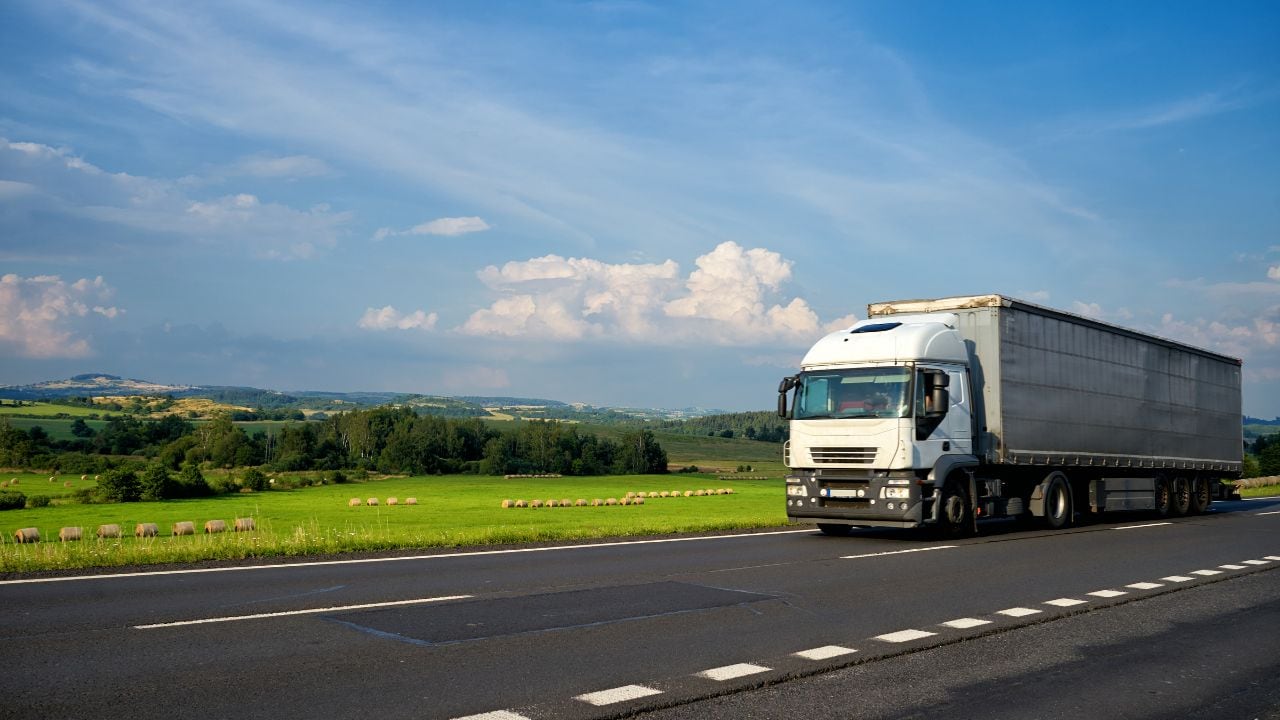
The steering wheel of a Freightliner Cascadia vibrates with a relentless, numbing frequency. For hours, the only world that exists is the twenty feet of asphalt illuminated by the high beams, cutting through the dense, early-morning fog of the American Midwest.
To the average motorist passing by, the man behind the wheel is just another anonymous cog in the machine of global supply chains. He is the reason fresh produce arrives at the grocery store by dawn. But look closer. Look at the white-knuckled grip on the wheel. Notice how his eyes dart to the rearview mirror every time a state trooper idles on the median.
This isn't just a grueling shift. It is a tightrope walk over an abyss.
Recently, thirty men who lived exactly like this found out just how fragile that tightrope is. They were Indian nationals, living and working illegally in the United States, operating commercial semi-trucks across state lines. Their journey did not end at a loading dock in Chicago or a warehouse in California. It ended in handcuffs, federal custody, and the sudden, cold reality of impending deportation.
To view this simply as a blip in law enforcement statistics misses the point entirely. It ignores the intricate, invisible network of desperation, human smuggling, and economic demand that keeps wheels turning in the dark.
The Mirage of the Open Road
Consider a hypothetical young man. Let’s call him Rajat.
Rajat grew up in a farming village in Punjab, watching the soil yield less profit each year while the debt of his family swelled. He heard stories. In the tea stalls and WhatsApp groups, men talked about America. They spoke of the interstate highway system, an endless ribbon of concrete where a man could climb into a silver truck, drive for days, and earn more in a week than his father made in a year.
The price of admission to this dream is staggering. Human smuggling networks, often stretching across multiple continents from India to South America and up through Mexico, charge upwards of $50,000 for passage. Families sell ancestral land, borrow from loan sharks, and risk everything on a single roll of the dice.
When Rajat finally crosses the border, the debt follows him like a shadow. It breathes down his neck. The pressure to earn money immediately is not a desire for luxury; it is a matter of survival for his parents back home.
The trucking industry presents a unique, irresistible backdoor. The United States faces a perennial shortage of commercial drivers. Freight needs to move. Supply chains are strained. In the underbelly of the logistics industry, certain sub-contractors and predatory fleet operators are willing to look the other way. They do not look for valid commercial driver’s licenses (CDLs) or legal work authorization. They look for bodies to fill seats.
Rajat is handed the keys to an eighty-thousand-pound vehicle. He is given a fake identity or a bypassed logging device. He has had minimal training, possesses no legal status, and carries the weight of a village on his shoulders. He is told to drive.
The Economics of Exclusion
The arrest of the thirty drivers exposes a massive structural vulnerability within American infrastructure. Operating a commercial motor vehicle requires rigorous training, medical certifications, and strict adherence to Department of Transportation (DOT) hours-of-service regulations designed to prevent fatal accidents caused by fatigue.
When undocumented workers are funneled into this sector, the safety guardrails vanish.
- Wage Suppression: Undocumented drivers are paid a fraction of the standard industry rate. They cannot complain about stolen wages or dangerous working conditions because a single phone call can trigger their deportation.
- Forced Overtime: Deprived of legal protections, these drivers are frequently coerced into driving far beyond the legal eleven-hour limit, turning exhausted men into liabilities on public highways.
- Regulatory Blind Spots: Small, fly-by-night trucking companies register under shell names, lease trucks to undocumented operators, and dissolve the business the moment federal investigators start asking questions.
The enforcement action that swept up these thirty men was not a random traffic stop. It was the result of coordinated intelligence tracking these exact gray-market logistics operations. Federal agents found a network of individuals who had bypassed every security screening, background check, and licensing requirement meant to keep the public safe.
But the real problem lies elsewhere. The demand for cheap freight transportation is a powerful vacuum. As long as retail giants and manufacturing hubs demand lower shipping costs, the system will create a space for exploiters to fill. The thirty arrested drivers were not the masterminds of this scheme. They were the fuel.
The Cost of the Breakdown
The human mind adapts to terror. For the first few months, a driver in Rajat's position panics every time a weigh station approaches. He memorizes back roads. He learns the exact times of day when enforcement checkpoints are likely to be unmanned.
Eventually, the adrenaline fades into a dull, constant ache. The cab of the truck becomes both a sanctuary and a prison. It is a self-contained world of Punjabi music tapes, lukewarm thermoses of chai, and the relentless hum of the highway. The driver becomes a ghost moving through the American landscape, vital to its economy but entirely detached from its society.
Then comes the breakdown.
A tail light goes out. A routine inspection is ordered at a state line. A trooper asks for logbooks that do not match, or a license that crumbles under scrutiny.
In an instant, the illusion shatters. The handcuffs are cold. The holding cell is loud. The phone call back to Punjab is the hardest part of the entire journey. How do you tell a mother who mortgaged her life that the investment has vanished? How do you explain that the American dream ends in a fluorescent-lit detention center, waiting for a charter flight back to the starting line?
The legal system moves with a bureaucratic indifference. The drivers face swift deportation proceedings. The trucking companies that hired them will likely pay a fine, rebrand under a new DOT number, and find thirty more desperate men to take their place. The cargo will still be delivered. The grocery store shelves will still be full.
The diesel engine idles in the impound lot, its cabin still smelling of cardamom and old upholstery, waiting for the next driver who thinks the road can save him.