The floorboards of an old wooden house in rural Japan do not just creak. They groan with a heavy, familiar history. For decades, those sounds meant nothing more than the house settling into the mountain clay, or perhaps a spouse slipping away to the kitchen for a glass of water.
But lately, the night sounds have changed. They carry weight.
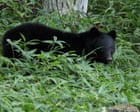
In the mountainous corridors of Hida, within Gifu Prefecture, an elderly couple woke in the pitch-black hours of a Tuesday morning to a sound that violated the sacred sanctuary of their home. It was not the gentle padding of slippers. It was the wet, heavy breathing of a beast that belonged to the canopy of the Japanese Alps, now standing on their linoleum.
When they gathered the courage to peer into their kitchen, they did not find a burglar looking for jewelry. They found an Asian black bear, its snout buried deep in the cold, humming light of their open refrigerator.
It was helping itself to their leftovers.
This is no longer a rare, freak occurrence. Across rural Japan, a silent invasion is underway, redrawing the boundaries between the civilized world and the wild. It is a story of demographic collapse, changing landscapes, and a desperate search for food that has turned wild animals into suburban burglars.
The Boundary Crumbles
For centuries, Japanese rural life was dictated by the concept of satoyama—the border zone where arable flatlands meet the steep, forested mountains. It was a buffer. Humans managed the foothills, thinning the bamboo, harvesting timber, and farming the slopes. The bears stayed in the deep woods, wary of the smoke, the noise, and the active presence of people.
Now, the satoyama is dying.
Japan is aging faster than almost any nation on earth. As the youth migrate to Tokyo and Osaka, the mountain villages are emptying out. The fields are left fallow. The brush grows thick and untended right up to the back doors of houses where octogenarians live alone.
To a bear, the boundary has simply vanished.
Consider the perspective of an animal waking from hibernation, or desperately trying to fat up for the coming winter. The forest offers acorns and beech nuts, but forestry monocultures—vast swathes of cedar planted during the post-war construction boom—offer very little nutrition. Meanwhile, just down the hill, there is an abandoned orchard of sweet persimmons. There are compost heaps filled with vegetable scraps. And inside those quiet, single-occupancy homes, there are white plastic boxes that stay cold and smell of salted fish and sweet melons.
It is a simple equation of caloric math. Why forage for hours in a barren forest when a sliding glass door is all that stands between you and a feast?
The Siege of Hida
The hunt for the kitchen-raiding bear of Gifu was not an isolated policing action. It was part of a frantic, nationwide scramble.
Local hunters and police officers formed patrols, armed with sirens, firecrackers, and shotguns. They searched the perimeter of the couple's home, looking for broken glass, muddy paw prints, and the distinctive scent of wild musk. But the bear had already melted back into the cedar groves, leaving behind a ruined kitchen and a couple who will likely never sleep soundly through a creaking floorboard again.
To live in these regions now is to live under a soft siege.
Residents are told to lock their windows—a strange and claustrophobic demand in hot summer months for a generation accustomed to leaving doors wide open to catch the mountain breeze. They are warned not to leave pet food outside, to harvest their fruit trees the moment they ripen, and to carry brass bells that jingle with every step.
The bells are meant to warn the bears of human presence, assuming the bears still care.
But that assumption is failing. The bears of modern Japan are losing their fear. They are learning that humans are loud, slow, and soft. They are learning that the sound of a bell does not mean danger; sometimes, it just means a food source is nearby.
The Human Cost of Conservation
There is a profound sadness to this conflict. Nobody wants to hunt these animals to extinction. The Asian black bear is a cultural symbol, a creature of myth and folklore that has shared these islands with humans for millennia.
Yet, when a bear crosses the threshold of a home, the equation changes instantly. It becomes a matter of survival.
Last year, bear attacks in Japan reached record highs. People were mauled in their driveways, attacked while walking to their cars, and cornered in their own kitchens. The victims are almost always the elderly, those least capable of running or fighting back.
The local hunting associations, known as the Ryuyukai, are also aging. The average hunter in Japan is now over sixty-five years old. These retired farmers and blue-collar workers are tasked with tracking a three-hundred-pound predator through dense, vertical terrain. It is a grueling, dangerous job, done mostly out of a sense of civic duty to protect their neighbors.
But they are fighting a losing battle against geography and time.
As the forests reclaim the empty villages, the bears are not just visiting; they are moving in. Abandoned houses become perfect dens. Overgrown gardens become private foraging grounds. The wilderness is reclaiming its lost territory, foot by agonizing foot.
The sun sets behind the jagged peaks of Gifu, casting long, bruised shadows over the quiet valleys. In the kitchens of a hundred shrinking villages, elderly hands reach out to lock the back doors. They check the window latches twice. They look out into the darkening tree line, where the forest presses close, waiting for the quiet scuffle of claws on the porch.
The fridge hums in the corner. It is no longer just an appliance.
It is bait.