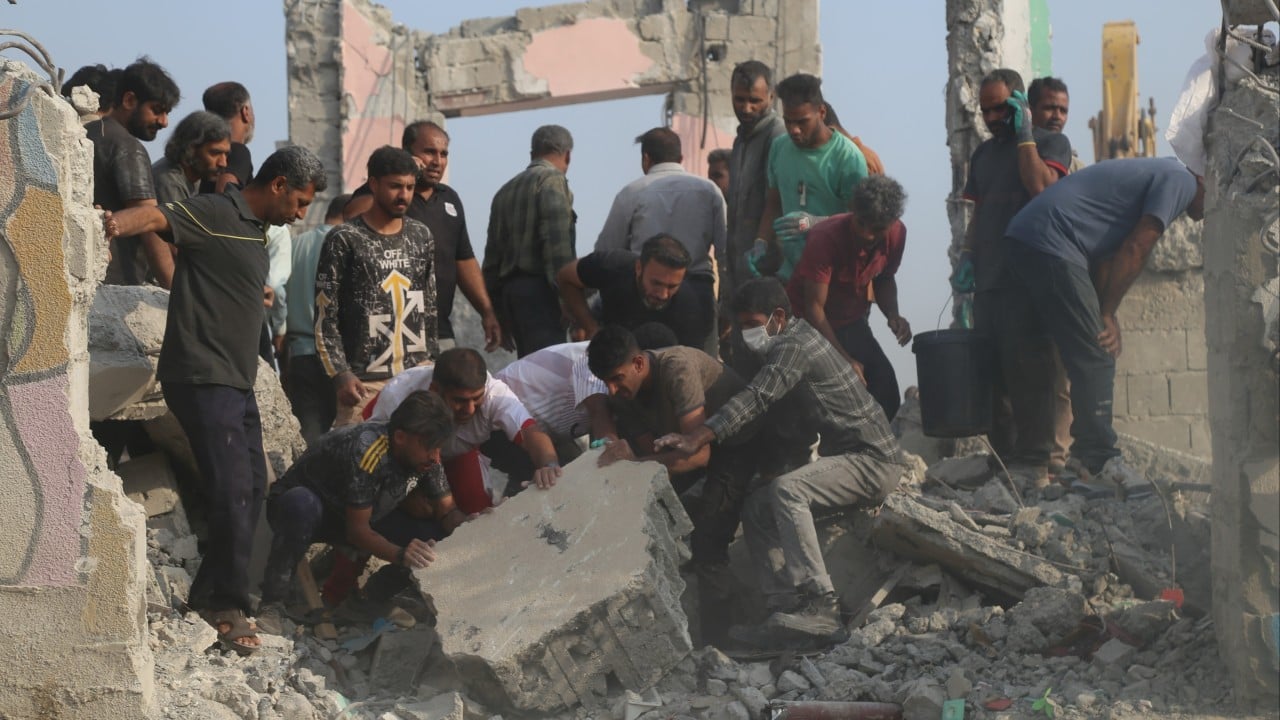
On February 28, 2026, the skies over Minab were completely clear. It was a normal Saturday morning in southern Iran. Children were at their desks. Teachers were mid-lesson. Then, a series of missile strikes tore through the Shajareh Tayyebeh Elementary School, flattening the building and burying hundreds under concrete.
The math of the aftermath is devastating. Out of 156 confirmed dead, 120 were schoolchildren. Another 26 were teachers.
Four months have passed. The dust has settled, but the finger-pointing hasn't. The Trump administration refuses to take explicit blame, even as the Pentagon’s internal findings point directly to a American Tomahawk missile. If you want to understand how modern warfare treats civilian collateral, you don't look at the press releases. You look at the bureaucracy that broke down before the first missile ever left its tube.
The Cost of Outdated Intelligence
The official line drifting out of Washington is that nobody hit a school on purpose. That's probably true. But it doesn't absolve the planners.
The Shajareh Tayyebeh school sat adjacent to the Sayyid al-Shuhada military complex, an active hub for the Islamic Revolutionary Guard Corps (IRGC) Navy. Decades ago, the school grounds belonged to that very base. But satellite imagery checked by independent groups like Amnesty International shows a clear physical separation happened between 2013 and 2016. Boundary walls went up. Three distinct civilian gates were built. Bright murals of crayons, apples, and playing children covered the exterior.
The U.S. military targeted 12 structures inside the neighboring IRGC compound. They managed to hit the civilian school because their target lists were hopelessly out of date.
The Pentagon knew the area changed. They just used old data anyway. When speed replaces verification in the opening hours of a massive air campaign, a decade of civilian infrastructure shifts gets erased in seconds.
Dismantling the Guardrails
This failure didn't happen in a vacuum. It was the direct result of deliberate policy choices made months before the war started.
The U.S. used to have robust internal checks. Congress specifically mandated a specialized Pentagon office dedicated entirely to civilian casualty mitigation. Their job was simple. They coordinated with commanders, verified "no-strike" lists, and double-checked target packages to ensure schools, hospitals, and mosques weren't on them.
When Secretary of War Pete Hegseth took office, he aggressively scaled those teams back. The civilian mitigation workforce was gutted by 90%. By the time operations against Iran kicked off, U.S. Central Command had exactly one staffer assigned to monitor civilian casualty risks for the entire theater.
Hegseth openly defended this shift. He complained about restrictive rules of engagement, arguing they stood in the way of winning wars. When you cut the staff responsible for keeping missiles away from classrooms, you don't get a more efficient military. You just get dead kids.
The Architecture of Denial
The political response to Minab has been a masterclass in dodging accountability.
At the G7 summit in France, President Trump initially admitted the strike was a mistake, calling war "nasty" and noting that "mistakes are made." But within days, the rhetoric shifted to complete denial. By late June, Trump openly questioned American involvement during media appearances, suggesting "missiles were flying all over the place" and blaming Iran's own lack of munition accuracy.
"Somebody said it was our missile, maybe it wasn't our missile... There were plenty of missiles being flown by other people."
- President Donald Trump, June 2026
This narrative falls apart under basic technical scrutiny. Iranian state media quickly published footage of the strike site alongside physical remnants of the weapon. Weapons experts identified the debris as components of a U.S. Tomahawk land-attack missile. Iran doesn't possess anything resembling that hardware. Neither does anyone else operating in that airspace except the U.S. Navy.
Weaponizing the Dead
While Washington dodges the blame, Tehran has spent the last four months using the tragedy for political leverage.
The Iranian government immediately labeled the incident a deliberate war crime. Foreign Minister Abbas Araghchi took to the UN Human Rights Council to blast the attack as a crime against humanity. Yet, local activists note that the Iranian state has been highly selective with the truth.
Minab is heavily populated by the Sunni Baluch ethnic minority, a group that has faced systemic discrimination and harsh repression from Iran's Shia central government for years. Many of the children killed were from families the regime routinely marginalized. After the blast, state-controlled media quickly took over the narrative, staging mass funerals and burying the children in identical, unmarked plots. They painted the victims as state martyrs to fuel the war effort, while refusing to publish an official, transparent list of the dead to the families.
Where Accountability Goes Next
The Pentagon investigation is still technically open, but don't hold your breath for a grand public confession. The pattern here is old and predictable.
True accountability requires more than an anonymous official admitting a mistake to a reporter. If you want to ensure Minab doesn't happen again, pressure has to look inward at the systems that allowed it.
- Demand congressional oversight: Congress must force the Department of Defense to release the full, unredacted findings of the Pentagon probe into the Minab strike.
- Restore targeting guardrails: The civilian casualty mitigation teams gutted under current leadership need immediate, mandatory funding and staffing restoration.
- Audit AI and automated targeting tools: Lawmakers need to probe exactly how much automated data sorting contributed to the reliance on outdated target profiles.
The families in Hormozgan province aren't getting their children back. But letting the administration pretend the missile belonged to someone else ensures the next targeting error is already being programmed.