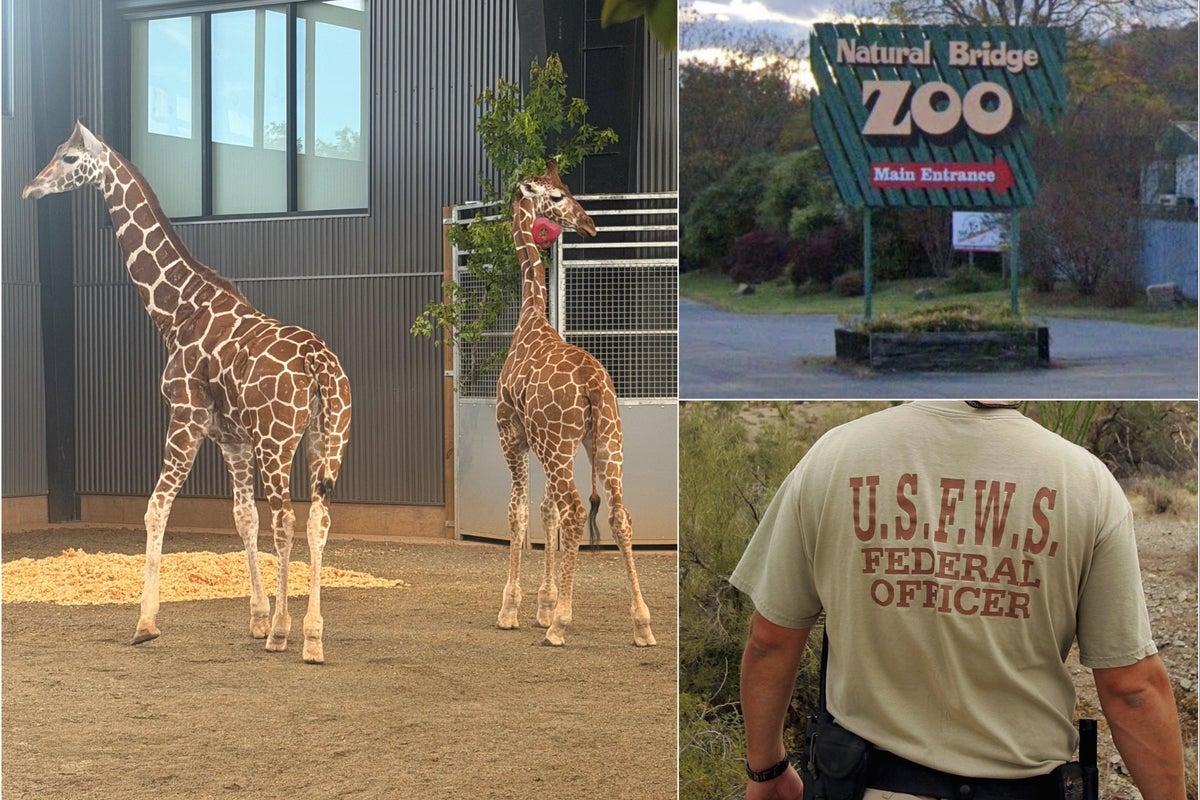
Two baby giraffes vanish from a Virginia facility, and the public loses its mind over a cinematic narrative of double-crossing informants and federal stings. The media loves a circus. They frame the caper like a high-end heist movie, complete with shadowy underworld figures and federal badges. It makes for fantastic headlines.
It also misses the entire point. Building on this idea, you can also read: The Seven Second Mistake That Cost a Man Seven Million Pounds.
The story is not about an informant or the dramatic recovery of endangered wildlife. The story is about an industry-wide security theater that collapses the moment a truck backs up to a poorly lit perimeter fence. I have spent years consulting on high-value asset protection and high-stakes facility logistics. When I look at the Virginia giraffe disappearance, I do not see a criminal mastermind. I see an embarrassing baseline vulnerability that every regulatory body refuses to fix.
Let us dismantle the lazy consensus. Experts at The Washington Post have provided expertise on this matter.
The Myth of the Perimeter
The prevailing public narrative assumes that accredited animal facilities possess fortress-like security setups. People imagine motion-activated lasers, biometric locks, and 24-hour armed patrols guarding every hoof and horn.
That is pure fantasy.
Most regional zoos, roadside sanctuaries, and private breeding facilities operate on shoestring budgets with legacy physical security. Perimeter fences are often standard agricultural chain-link meant to keep animals in, not to keep professional thieves out. CCTV cameras are frequently positioned as deterrents rather than active monitoring systems, feeding into local DVRs that nobody watches at three in the morning.
When two juvenile giraffes can be sedated, loaded, and driven off a property without immediate detection, the failure is structural. Relying on an informant to recover the assets months later is not a triumph of investigative policing. It is an admission that law enforcement had zero proactive capability to intercept the shipment once it cleared the gate.
Security is not a badge on a uniform or a sign on a gate. Security is the friction you create for an adversary. If an adversary can move a massive animal with minimal equipment and zero resistance, you have no security. You have an invitation.
The Economics of Exotic Contraband
Why target giraffes? To understand the crime, you have to look at the market mechanics. Exotic animal trafficking is driven by a simple economic equation: high demand, lax traceability, and porous international or interstate borders.
The lazy consensus suggests that these animals are stolen for private eccentric billionaires or underground menageries. While private collector vanity plays a role, the supply chain is far more bureaucratic. Unscrupulous dealers exploit the gaps between state wildlife agencies and federal oversight. Once an animal crosses a state line into a jurisdiction with weaker permitting laws, its paper trail goes dark.
Imagine a scenario where a corrupt broker acquires un-microchipped livestock, falsifies veterinary transport health certificates, and slides them into a legitimate commercial auction. It happens more often than federal prosecutors care to admit. The paperwork is often easier to fake than a fake ID at a college bar.
We treat wildlife trafficking as a conservation issue. It is actually a supply chain vulnerability problem. Until we treat live animal transport with the same cryptographic and physical chain-of-custody tracking we apply to pharmaceutical drugs or high-end firearms, animals will keep vanishing.
The Regulatory Illusion
Federal agencies like the USDA enforce the Animal Welfare Act. Critics demand stricter laws, heavier fines, and more red tape for facility operators.
More regulation is not the answer. Better operational execution is.
Adding another layer of federal paperwork does nothing to stop a guy with a flatbed trailer and a bribe. In fact, over-regulation often starves smaller, well-meaning facilities of the capital they need to upgrade actual physical infrastructure. They spend every dollar on compliance checklists instead of concrete bollards, modern thermal cameras, and redundant access control systems.
I have watched facilities blow millions on PR campaigns touting their conservation ethics while leaving their back loading docks wide open to anyone with bolt cutters. Priorities are completely inverted.
If you want to protect exotic animals, stop focusing on the paperwork and start focusing on the threat model.
How to Fix an Industry in Denial
If you run an animal facility, stop pretending your current posture works. You need to audit your vulnerabilities today.
- Red Team Your Grounds: Hire an independent security firm to break into your own facility at night. If they can touch your high-value stock without triggering an immediate, armed response, your security is a mirage.
- Mandate Biometric Traceability: Visual tags and standard ear tags are useless. Every high-value animal must have redundant, tamper-proof internal microchipping paired with GPS-enabled tracking collars where feasible.
- Harden the Loading Zones: The perimeter fence is rarely the weakest link. The loading dock is. Treat every loading bay like a high-security cargo terminal with strict dual-custody verification protocols.
The Virginia giraffe case is closed, the animals are back, and the media has moved on to the next shiny object. But the structural rot remains entirely untouched.
Until the industry stops treating security as an afterthought and starts treating it as an engineering discipline, the next heist is already in planning.