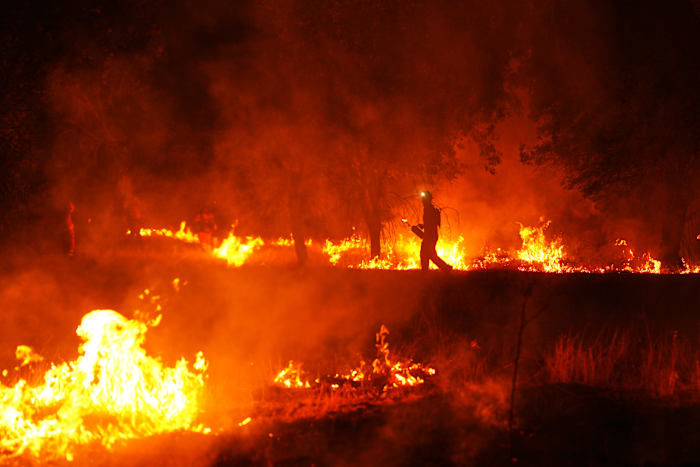
The air didn't just smell like smoke. It smelled like the end of something.
When you stand at the edge of a wildfire that has outgrown its own name, the wind stops feeling like weather and starts feeling like an adversary. It has weight. It carries the dry, crackling snap of millions of needles turning to ash in a fraction of a second. Down in the valleys of Spain, where the sun beats down with a heavy, unyielding persistence, the local fire crews knew the signs long before the sirens started wailing. They knew the soil. They knew the drought. Most of all, they knew the sound of a forest holding its breath.
Heat.
It is a simple word for a complex catastrophe.
To understand what happened during the record-breaking blazes that overwhelmed Spain’s emergency responders, you have to throw away everything you think you know about how fires behave. Movies teach us that fires move. They chase heroes across dry brush; they leap from tree to tree in neat, cinematic arcs.
Real fire doesn't chase. It occupies.
Mateo, a veteran firefighter with twenty-two summers of scorched boots behind him, put it simply over a lukewarm cup of coffee that tasted mostly of ash: "You aren't fighting a flame. You're fighting the atmosphere."
When temperatures shatter historical ceilings and relative humidity drops into the single digits, the very air turns hostile. Vegetation stops being wood and leaves; it becomes a compressed tank of high-octane fuel, waiting for a spark. On the days when the record blazes tore through the Spanish countryside, the atmosphere was so starved of moisture that wooden fences spontaneously splintered and dry brush ignited simply from the radiant heat of nearby air pockets.
No matter what you do, you can't put it out.
That phrase, uttered by a weary squad leader to a local radio reporter, became the grim mantra of the season. How do you extinguish a force of nature that treats water like lighter fluid? When temperatures cross certain thresholds, water dropped from airplanes evaporates before it ever kisses the canopy. It turns to steam mid-air, robbing the exhausted crews on the ground of their most basic tool.
Consider what happens next in the calculus of disaster.
When water fails, strategy shifts from defense to survival. Firelines—cleared swaths of earth meant to starve a blaze of fuel—become irrelevant when winds gust at sixty miles per hour, carrying burning embers a mile ahead of the front line. These embers cross roads, rivers, and highways, spawning dozens of new fires behind the backs of the people trying to contain the original monster.
It is a geometric nightmare. One fire becomes three. Three become ten.
Behind the statistics reported on the evening news—the thousands of hectares burned, the mandatory evacuations, the displaced families sleeping in school gymnasiums—are the human stories of quiet desperation. Take Maria, an olive farmer whose family has worked the same terraced hillsides for four generations. She didn't pack jewelry when the evacuation order came. She packed old photo albums and a small bag of soil from her grandfather's favorite grove.
"The trees are older than memory," she told me, her hands trembling as she watched the distant orange glow paint the night sky the color of a bruised peach. "You don't just leave them. You feel like you're abandoning an ancestor."
That is the invisible stake of these mega-fires. They are not merely ecological events; they are cultural erasures. When centuries-old pine forests and ancestral farming communities turn to carbon, a piece of the region's identity vanishes with the smoke.
Why are these fires so radically different from anything our parents or grandparents faced?
The answer lies in a dangerous convergence of climate trends and historical land management. For decades, wildfire suppression policies meant that every little spark was aggressively snuffed out. While well-intentioned, this policy inadvertently turned forests into powder kegs. Nature clears out dead brush through low-intensity, frequent fires. By stopping them entirely, we allowed decades of dead timber, dry undergrowth, and invasive scrub to pile up like kindling on a bonfire.
Add consecutive years of record-breaking heatwaves—fueled by a warming planet—and you create a recipe for disaster that defies human intervention. The system is overloaded. The math no longer works.
Yet, in the middle of this chaos, human endurance emerges in startling ways.
Watch the ground crews. They work forty-eight-hour shifts with eyes red-rimmed from soot and faces caked in gray dust. They sleep in 15-minute bursts against the tires of fire engines, waking up to the roar of a shifting wind. They operate heavy machinery with precision while surrounded by walls of fire that reach fifty feet into the air.
During one particularly harrowing shift near the crest of a ridge, a rookie named Carlos found himself cut off from his unit when a sudden wind shift crowned the trees around him in fire. The heat was immense, blistering the paint off their truck. In those terrifying seconds, training takes over, but so does something deeper—an instinctual refusal to surrender. His squad leader, veteran Mateo, didn't panic. He guided Carlos over the radio with a voice as calm as a Sunday morning, directing him to a safe zone they had scouted hours earlier.
They survived that night. Many others did too, saved not by luck, but by the stubborn, unyielding competence of people who refuse to let the forest take everything.
But bravery has a limit.
Heroism cannot replace systemic change. As the climate continues to shift and summers grow longer and harsher, the strategy of waiting for disaster to strike and then throwing water at it is doomed to fail. Experts agree that the future of wildfire management requires a fundamental shift: returning to controlled burns during safe windows, clearing defensible spaces around rural communities, and respecting the raw power of the landscape instead of trying to conquer it.
We have spent centuries treating nature as a resource to be managed rather than a partner to be understood. The bill has finally arrived, written in smoke and ash across the Spanish hills.
Night falls again over the blackened ridges. The roar of the front has quieted to a low, sinister rumble, like a sleeping beast digesting its meal. Down in the valley, a single porch light flickers on in a house that was spared by a sudden shift in the wind. A dog barks in the distance.
The smoke still hangs low, a bitter reminder of what was lost, and a warning of what is yet to come.
The embers glow faintly in the dark, waiting for the morning breeze.


