You smell pine needles and woodsmoke first. Then the sound hits you—a low, visceral rumble that feels less like a noise entering your ears and more like the ground itself clearing its throat.
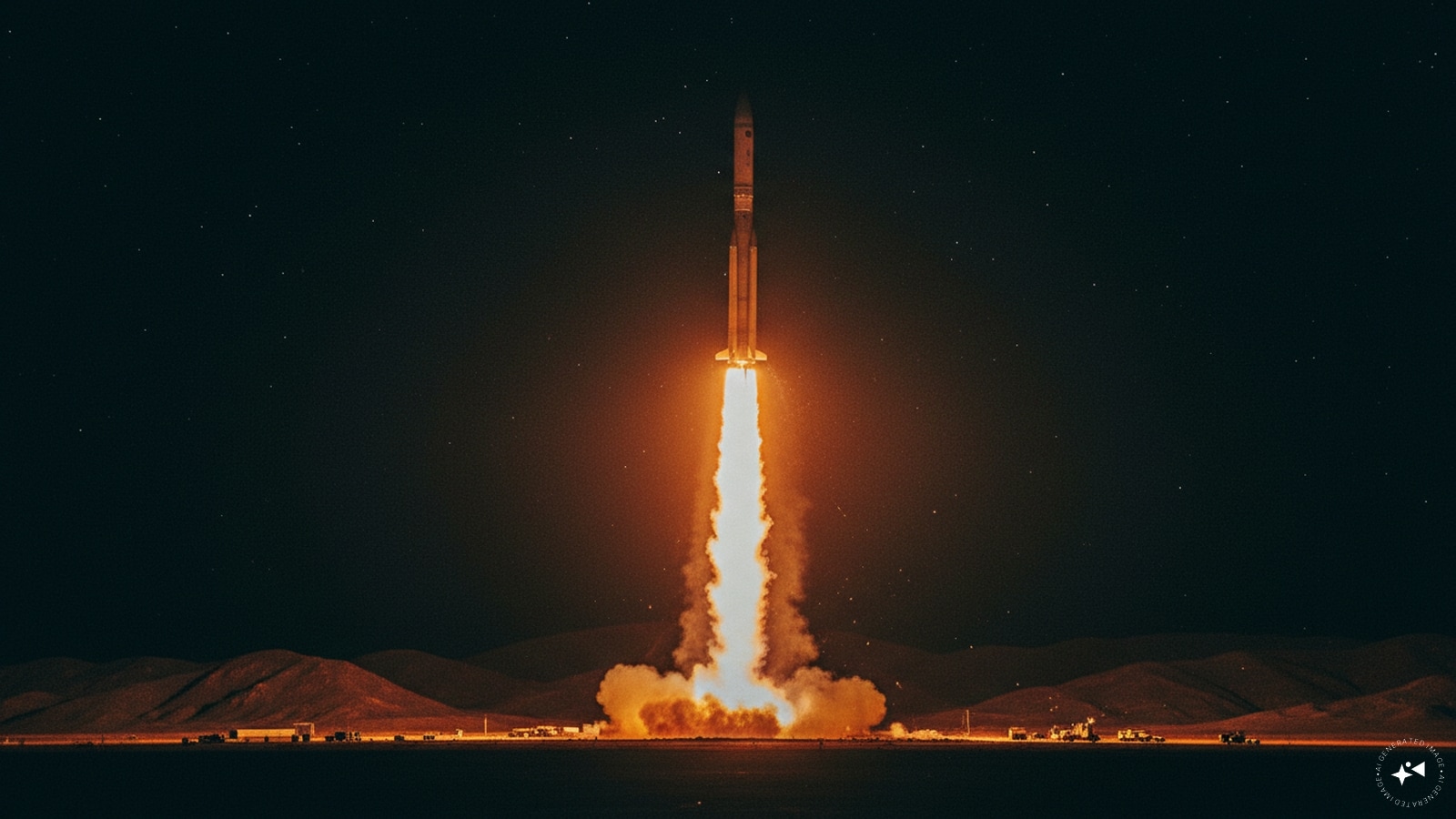
Far across the border, in the freezing shadows of the Korean peninsula's jagged northern interior, a metal tube longer than a city bus has just clawed its way out of a hidden silo
The Iron Sky Over Pyongyang
news
Dawn in Pyongyang does not break with birdsong. It breaks with the low, subterranean rumble of diesel engines and the rhythmic clicking of heels on cracked concrete. The sky is the color of wet slate, heavy with the sort of silence that precedes a storm.
Somewhere in the interior provinces, deep beneath granite arches hardened against the weight of modern ordnance, a launch crew is breathing recycled air. They are young men, mostly. Their uniforms hang loosely on frames thinned by chronic shortages, yet their hands move across control panels with the terrifying precision of watchmakers. They are not looking at the sky. They are looking at telemetry screens glowing with amber light.
This is the theater of the intermediate-range strategic missile drill.
To the wire services in Seoul, Tokyo, and Washington, the event was reduced to a sterile bulletin. A few paragraphs. A designation of distance. A calculated trajectory falling somewhere between the Korean Peninsula and the gray expanse of the Pacific. State media confirmed it later with the usual bombastic prose, praising the successful test of a solid-fuel engine designed to outpace early-warning systems.
Numbers do not capture the sound of a hillside shaking loose its soil.
Imagine standing thirty miles away from a cylindrical pillar of steel and fury. You do not just hear the ignition; you feel it in the marrow of your shins. The air compresses violently, sucking the breath from your lungs before the noise arrives—a tearing sound, like canvas ripping across the sky. Within seconds, a needle of white-hot fire punches through the cloud cover, leaving behind a greasy smudge of exhaust that lingers long after the machinery has vanished into the stratosphere.
State media called it a strategic warning. The neighboring capitals called it a provocation. Both descriptions miss the human core of the equation.
For the average citizen standing in a muddy marketplace in North Pyongan province, watching yet another jet stream scar the morning clouds, the reaction is not patriotic fervor. It is fatigue. It is the quiet, conditioned resignation of people who have lived beneath the shadow of a permanent siege for three generations. When your daily existence is governed by grain rations, electricity quotas, and the constant hum of ideological reinforcement, a missile test is not a geopolitical abstraction. It is the reason the lights flickered out last night. It is the reason the local factory missed its shift quota.
Economics in a garrison state obey a cruel, inverted gravity. Every successful combustion test of a high-thrust motor represents an astronomical diversion of national wealth. The steel could have reinforced a collective farm's irrigation canal. The chemical propellants could have been traded for fertilizer. Instead, they are burned into the upper atmosphere, converted into shockwaves that ripple across international stock exchanges and diplomatic dispatch boxes.
The engineers in the underground bunker do not think about the stock exchanges. They think about the calendar. They think about the anniversary dates, the party directives, the unspoken pressure to deliver proof of capability to a leadership that measures legitimacy in pounds of thrust and accuracy in meters of deviation.
Consider the mechanics of the machine itself. For decades, the regional deterrent relied on liquid-fueled systems—cumbersome, agonizingly slow to fuel, and vulnerable to preemptive strikes while sitting exposed on launch pads. The shift toward solid-fuel intermediate-range missiles, which state agencies highlighted in this recent test, represents a quiet, lethal evolution. Solid fuel means pre-packaged power. It means a missile can be rolled out of a mountain tunnel on a transporter-erector-launcher, raised, and fired within minutes.
It shortens the warning time to near zero. It turns the mountainous interior of the peninsula into a shell game where high-resolution satellites are forced to guess which patch of green foliage hides a weapon capable of altering the strategic balance of Northeast Asia.
This is why the diplomatic cables buzz with urgency in Washington and Seoul long after the smoke clears. The technical milestone is real. The capability is advancing, moving steadily past the clumsy, error-prone prototypes of the past into something streamlined, modular, and terrifyingly mobile.
Yet, as the afternoon sun struggles to pierce the industrial haze over the Taedong River, the grand strategy feels strangely distant from the reality on the ground.
In a small apartment overlooking an intersecting alleyway in central Pyongyang, an old woman sweeps her kitchen floor with a broom made of dried twigs. Her movements are methodical, unhurried by the news blaring from the radio box mounted on the wall. She has heard the announcements before. Different year, different missile, same heavy sky. She remembers the famine of the nineties; she remembers the endless parades that smelled of diesel and wet wool. To her, the strategic balance of power is measured not in intercontinental ranges or throw-weights, but in whether the cabbage stew tonight will have any salt in it.
The missile has long since splashed down into international waters, its telemetry data downloaded, analyzed, and filed away in secure cabinets across three continents. The diplomats have issued their statements, the analysts have drawn their vectors on whiteboards, and the news cycle has already begun to shift toward the next scheduled crisis.
Out on the horizon, the clouds close over the gap where the fire had been. The silence returns to the valleys, absolute and heavy, waiting for the next spark.