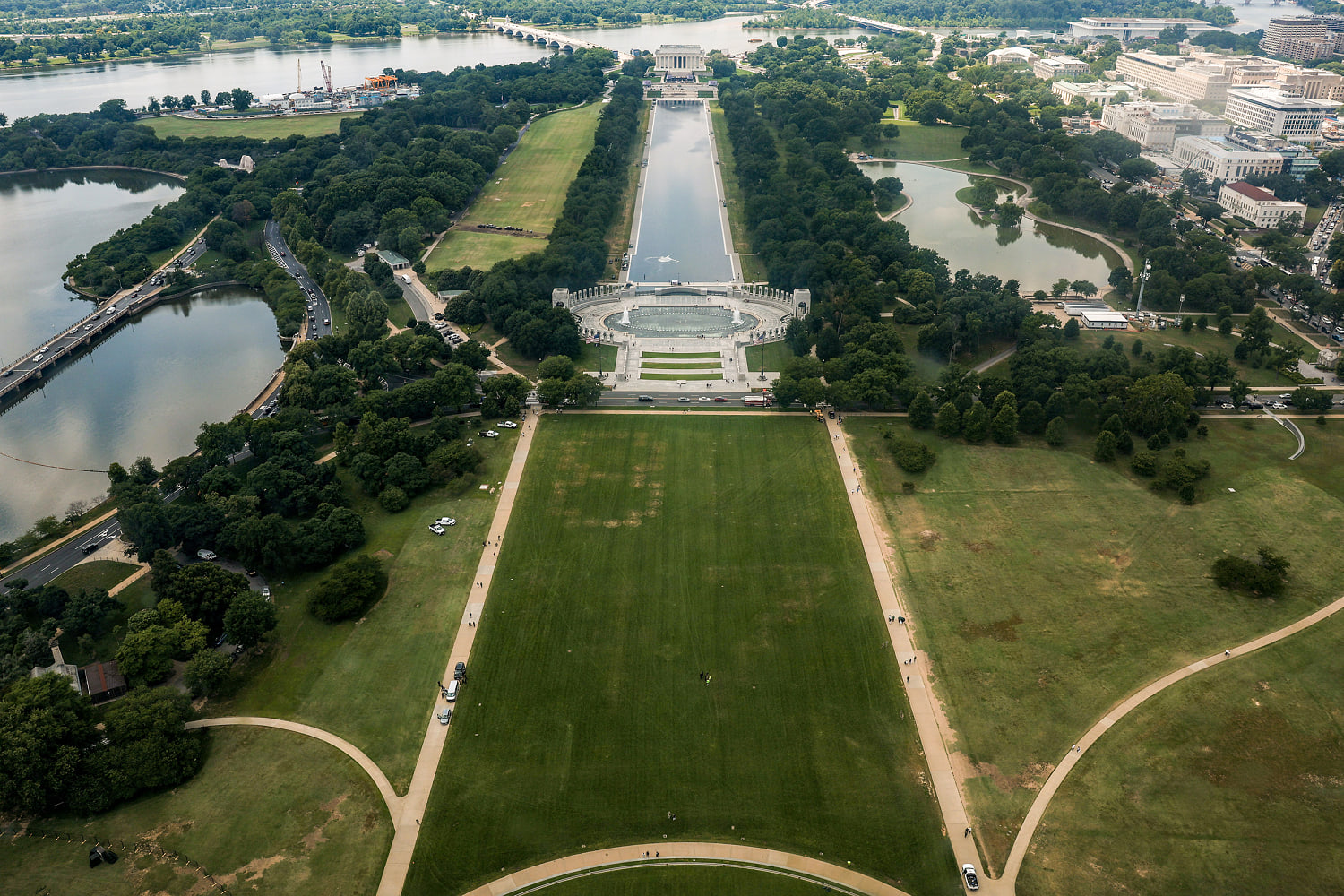
The grass on the National Mall usually whispers of predictable things. It smells of trodden fescue, spilled food-truck coffee, and the sharp, metallic tang of early autumn air drifting off the Potomac. On a normal Tuesday, the expanse between the Washington Monument and the Capitol building belongs to joggers tracking their paces and tourists tilting their foreheads back to measure the stone giants.
But a morning arrived when the predictable geometry of the nation’s front yard broke. For a different perspective, check out: this related article.
Imagine standing where the grass meets the gravel paths, looking down at four massive, pale digits burned or pressed into the sod. 8647. The numbers stretched across the green, huge enough to be read by passengers peering out the scratched acrylic windows of commercial airliners descending into Reagan National Airport. They weren’t spray-painted. They weren’t hastily dug trenches. The blades of grass themselves seemed altered, forced into a precise, chilling configuration that looked less like vandalism and more like a systemic error code stamped onto the earth.
By 7:00 AM, the standard morning hum of the capital dissolved. The park rangers arrived first, their boots clicking against the walkways, their usual welcoming nods replaced by tight, whispered huddles. Within the hour, the perimeter widened. White government SUVs parked haphazardly on the grass, their tires crushing the neat borders of the lawn. Men and women in dark windbreakers bearing federal insignias stepped out, carrying cases of equipment that looked entirely too clinical for a public park. Similar reporting on the subject has been published by The New York Times.
The crowd gathered at the yellow caution tape didn't talk much. They stared. The numbers possessed a strange, heavy authority. They didn’t shout for attention like a protest sign; they simply existed with the cold permanence of a barcode on a grocery item.
The Geometry of Suspicion
When a monument is defaced, the narrative is usually simple. We look for the cans of krylon, the political manifesto, or the chaotic fingerprints of a midnight prankster. This was different. The sheer scale of the markings required calculation, time, and an eerie level of precision.
To understand how something this massive appears overnight without triggering the labyrinth of surveillance cameras protecting the heart of American governance, you have to look at the tools we use to measure our world. Federal investigators quickly realized they weren’t looking at a traditional crime scene. They were looking at a massive, physical rendering.
Consider a hypothetical forensic surveyor—let’s call her Sarah—working with the team tasked with decoding the site. Sarah doesn't look at the grass; she looks at the angles. She sets up a digital transit, a high-precision optical instrument used in construction to measure distances down to the millimeter. When she sights the top curve of the '8', she isn't looking for paint pigment. She is looking for the exact geographic coordinates.
The data points she collects reveal a unsettling truth. The lines are perfectly straight where they need to be, and the curves follow exact mathematical radiuses. A human being with a rope and a can of marking foam could try to map this out in the dark, but the margin of error would be visible from a drone photograph. Here, the margins don't exist. The lines are true.
This precision points away from the lone eccentric and toward something far more organized. The equipment required to execute such a mark silently and swiftly suggests high-grade agricultural or surveying technology. Think of automated turf-management systems, GPS-guided agricultural drones, or commercial-grade laser leveling systems used in stadium construction. The mystery isn't just what the numbers mean, but how someone deployed industrial-grade precision in the most heavily monitored airspace and ground space in the Western world without anyone raising an alarm.
The Weight of the Digits
The human mind hates a vacuum, especially a numerical one. When we see a sequence of numbers, our brains immediately begin the work of sorting, matching, and desperate deciphering. Is it a date? A coordinate? A death toll?
The federal agencies remaining tight-lipped only fueled the vacuum. A brief press release from the National Park Service confirmed an ongoing investigation into "unauthorized turf modification," a phrase so dry it practically invited the public to invent its own wild theories.
The internet, predictable as ever, went to work dissecting 8647.
- The Bureaucratic Cipher: Some pointed to the Federal Register. Every regulation, every statute, every bureaucratic breath taken by the government is cataloged by number. Could 8647 refer to a specific piece of forgotten legislation regarding land rights, surveillance, or emergency powers?
- The Asteroid Hypothesis: Others looked to the skies. Minor planet 8647, known to astronomers as Apopophis or similar designations in deep-space catalogs, became a brief flashpoint for those convinced the sky was falling.
- The Ledger of the Missing: In certain corners of the city, the number was viewed through a human lens. People noted that 8647 roughly corresponds to the mileage between Washington D.C. and specific geopolitical hotspots, or worse, the estimated number of individuals affected by a recent, classified data breach.
But the real problem lies elsewhere. The danger of a mystery like this isn't the truth itself; it’s the mirror it holds up to our collective anxiety. When the state cannot explain four giant numbers on its own front lawn, the illusion of total control fractures just a little bit. We realize that for all our concrete, cameras, and security checkpoints, the world remains vulnerable to the strange, the unexplained, and the intensely deliberate.
The Silent Investigation
By mid-afternoon, the sun beat down on the Mall, baking the scent of disturbed soil into the air. The federal investigators changed their tactics. The high-visibility windbreakers disappeared, replaced by plainclothes personnel who moved through the crowd, listening to the theories being traded across the barricades.
They brought in soil core samplers. These are long, hollow metal tubes pushed deep into the earth to extract a vertical cross-section of the dirt. If the grass was killed by a chemical agent, the residue would be trapped in the upper layers of the soil matrix. If the grass was compressed by a heavy weight, the soil structure would show signs of severe compaction, its microscopic air pockets crushed flat.
Watch the technicians work, and you see the vulnerability inherent in modern security. They test for radiation. They test for biological agents. They find nothing but standard mid-Atlantic clay, earthworms, and dying roots. The numbers are clean. They are sterile.
This sterility is what bothers the people who live and work in this city the most. A political protest has noise. It has a face. It has a demand. The numbers 8647 offer no demands. They don't ask for change, nor do they threaten violence. They simply state themselves, leaving the rest of us to figure out whether we are looking at a promise, a threat, or a punchline to a joke we aren't smart enough to understand.
The Evening Fade
As the shadows of the Washington Monument lengthened, stretching like a dark finger toward the Capitol, the crowd began to thin. The commuters walked back to the Metro stations, their heads down, checking their phones to see if the news cycle had broken the code yet. It hadn't. The evening reports merely repeated the same sparse facts: an investigation was ongoing, the perimeter remained closed, and no suspects had been identified.
The floodlights came on, illuminating the National Mall in a stark, white glare. The numbers 8647 cast long, shallow shadows of their own across the compressed turf.
We tend to believe that everything in our modern world is logged, tracked, and explained. We trust that the people in the high stone buildings have a handle on the perimeter. But as the dark settled over the capital, the giant digits remained etched into the earth, a massive, silent reminder that sometimes the world writes things down that we aren't yet equipped to read.


