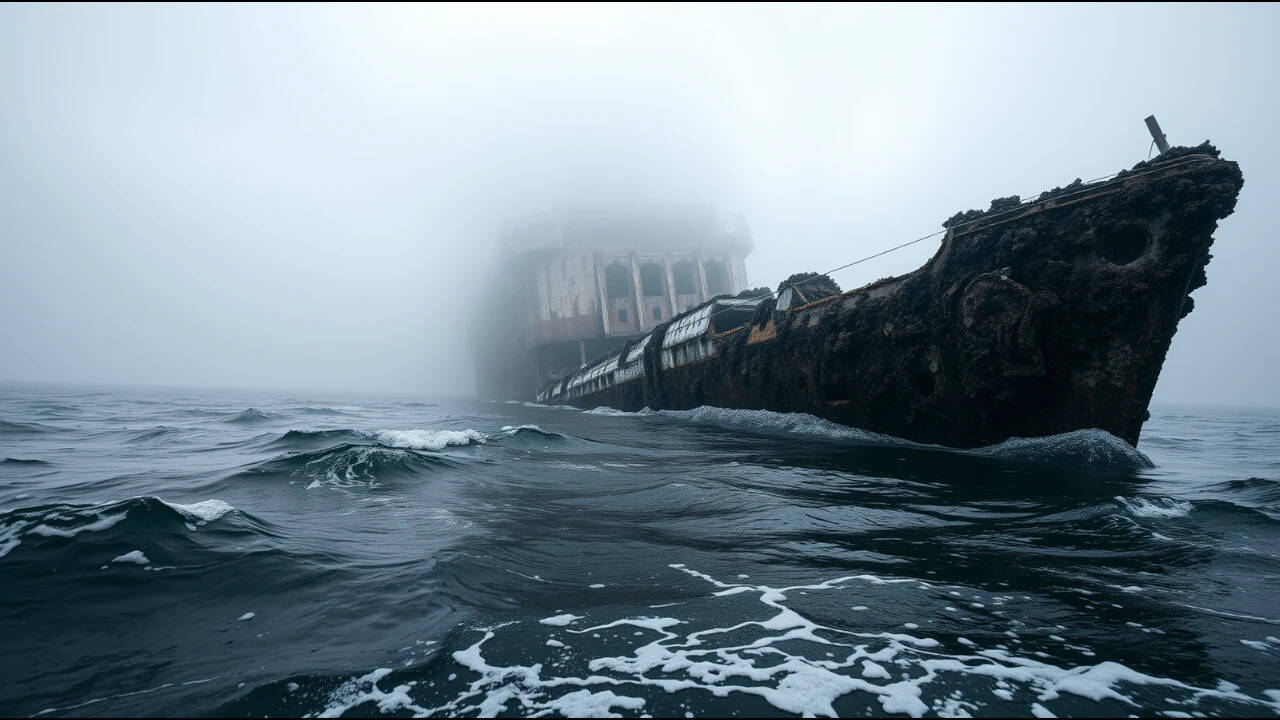
The Atlantic does not surrender its ghosts easily. Sixty nautical miles south of Nantucket, beneath two hundred feet of freezing, pitch-black water, lies the Italian luxury liner SS Andrea Doria. Once the pride of the Italian Line, a floating palace of mosaic tiles, Lalique glass, and silk drapes, it is now an iron tomb wrapped in ghost nets and rotted carpets.
Every summer, a small, stubborn fraternity of technical divers packs themselves onto charter boats in Montauk, New York, heading toward the coordinates of the collision. They come for the ultimate prize of deep wreck diving, often called the Mount Everest of the sport. They also come to court disaster. The Andrea Doria is not merely an underwater attraction. It is a hazardous, shifting maze of collapsed steel, zero visibility, and brutal currents that continues to claim equipment, time, and lives.
Understanding why anyone would willingly descend into this submerged labyrinth requires looking past the romantic mythology of sunken treasure. The reality is far grimmer, more technical, and much more dangerous than casual history books suggest.
The Collision That Broke the Golden Age
To understand the wreck, you must understand the tragedy that created it. On the night of July 25, 1956, the Andrea Doria was steaming through a dense fog bank off the coast of Nantucket. Bound for New York, the Italian flagship carried 1,706 passengers and crew. At the same time, the MS Stockholm, a Swedish American Line vessel equipped with a new, unproven radar system, sliced out of the mist on a collision course.
The Stockholm rammed the starboard side of the Andrea Doria at roughly twenty-two knots. The bow of the Swedish ship acted like a giant steel wedge, tearing deep into the Italian liner's hull, crushing fuel tanks and passenger staterooms alike.
Fifty-one people died in the initial impact and subsequent chaos. Thanks to frantic, heroic rescue efforts by surrounding ships like the French liner SS Île de France, the vast majority survived. But the Doria itself listed heavily to starboard, swallowing water through its open garage doors and gaping wounds. Eleven hours after the crash, the ship rolled onto its side and slipped beneath the surface, settling on a sandy bottom at a depth of two hundred and forty feet.
The disaster marked the end of the grand transatlantic liner era. It also birthed a modern obsession.
Inside the Submerged Labyrinth
Diving the Andrea Doria is nothing like exploring a sunlit coral reef in the Caribbean. The environment is hostile, disorienting, and physically punishing.
Water temperature at the surface might be a comfortable seventy degrees in July, but at two hundred feet, it plummets to forty-five degrees Fahrenheit. A drysuit is mandatory, accompanied by heavy thermal undergarments. Visibility is rarely predictable. On a good day, a diver might see twenty feet. On a bad day, suspended sediment, plankton, and silt reduce visibility to zero, forcing divers to navigate entirely by touch.
The ship is no longer the sleek ocean liner of 1956. Decades of heavy currents, commercial fishing nets, and structural fatigue have taken a heavy toll. Decks have pancaked inward. Bulkheads have rusted away into razor-sharp iron lace. Ghost nets—discarded commercial fishing trawls snagged on the wreck's highest points—hang like invisible curtains of death, capable of trapping a diver and stripping away their air supply in seconds.
To explore the Doria, divers use mixed gases. Compressed air becomes toxic due to nitrogen narcosis at depths past one hundred and thirty feet. Instead, teams rely on trimix, a blend of oxygen, helium, and nitrogen that keeps the mind clear at depth, paired with multiple decompression cylinders strapped to their sides containing nitrox or pure oxygen for the slow, agonizing ascent back to the surface.
The Economy of the Abyss and the China Hunt
Why take these risks? For decades, the primary allure of the Andrea Doria has been its cargo of wealth. Unlike military wrecks protected by war grave status, the Doria is a commercial vessel lying in international waters, making it an open game for salvagers and artifact hunters within legal parameters.
In the early days of Doria diving during the 1960s and 1970s, the ship was practically untouched. Divers hauled up massive silver-plated platters, bronze portholes, porcelain china stamped with the Italian Line logo, and crystal decanters.
Over the years, a distinct subculture of artifact recovery emerged. The most famous plates and tea sets recovered from the wreck routinely fetch thousands of dollars among maritime collectors. This commercial incentive turned the Doria into a battleground of egos, rivalries, and dangerous bottom-time competition. Divers would push their gas limits, bypass safety stops, and ignore structural warnings just to secure a rare ceramic cup or a silver water pitcher.
Today, the most prized artifacts are largely gone, buried under tons of collapsed superstructure or stripped away by decades of prior expeditions. Yet the hunt continues. Divers still descend into the silt, searching for unplundered cabins or personal items that tell the human story of the sinking.
The High Cost of the Mount Everest of Wrecks
The nickname is not an exaggeration. The Andrea Doria has claimed the lives of more than a dozen divers since exploration began.
The hazards are manifold. Nitrogen narcosis can impair judgment, leading divers to make fatal mistakes like miscalculating their gas consumption or forgetting to monitor their decompression schedules. The interior of the ship is a death trap for the unprepared. Silt stirred up by a careless fin kick can instantly turn a room into a blind chamber where finding the exit door is a matter of pure, terrifying guesswork.
Equipment failure at two hundred feet is a critical emergency, not a minor inconvenience. If a regulator freezes or a hose bursts, the diver must rely entirely on their buddy or their redundant air system, ascending slowly while stopping at predetermined depths to off-gas nitrogen safely. Rushing the ascent means facing decompression sickness, commonly known as the bends, which can cause paralysis, permanent neurological damage, or death.
In spite of these grim statistics, the charter boats keep booking trips out of Montauk. The allure of the iron monster lying in the dark Atlantic remains too powerful for those drawn to extreme exploration.
The Slow Decay of a Legend
Time is running out for the Andrea Doria. Saltwater, iron-eating bacteria, and crushing pressure are slowly winning the war against human engineering.
Major sections of the superstructure have already collapsed into flattened piles of rust. The hull continues to sag further into the seabed every year. Within another generation, the ship will likely experience a catastrophic structural failure, flattening the remaining standing framework into an unrecognizable debris field.
Until that day arrives, the ghostly hulk continues to sit in the cold Atlantic gloom. It remains a monument to human ambition, a tragic reminder of the sea's indifferent power, and the ultimate testing ground for those who refuse to leave its secrets buried in the dark.


