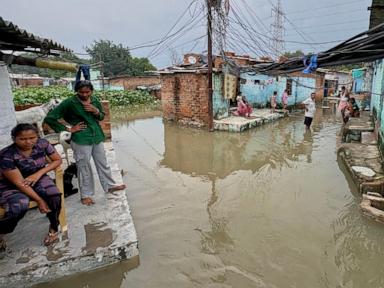
Water does not ask permission. It accumulates in the high, cold silence of the northern peaks, gathering drop by heavy drop until a threshold is crossed, and then it becomes a living thing. In the valleys of northern India, where the earth pushes violently into the clouds, rain is rarely just rain. For months, the sun bakes the soil into a hard, unyielding crust. Then the sky breaks open, and the transformation is instantaneous. What begins as a cooling mist turns into a heavy, blinding sheet, and within hours, ancient hillsides dissolve into liquid mud.
Sixty-two lives. That is the number recorded in the ledgers. Sixty-two breaths extinguished by the sudden weight of water and stone. But numbers are cold things, built to fit neatly into morning news bulletins and political briefings. They fail to capture the sound of a slate roof sliding off a stone cottage at three in the morning. They fail to measure the terror of a father clutching his child as the floor beneath them simply vanishes, pulled downward by an invisible, ravenous gravity.
To understand what happened when the rain turned northern India into a theater of grief, you have to look past the meteorological maps and into the valleys themselves.
Consider a hypothetical village clinging to the steep incline of a Himalayan ridge—call it Devprayag or any of the nameless hamlets that dot the incline. For generations, the residents understood the rhythms of the earth. They built homes of stacked stone and heavy timber, structures designed to flex with the wind and drain the seasonal moisture. They planted crops that held the soil with deep, tangled roots. They knew where the streams ran dry in winter and where they swelled in summer.
But memory is fragile, and the earth is no longer playing by the rules it followed a century ago.
Over the past few decades, the rhythm broke. The monsoons arrived late, bloated with moisture stolen from warming seas, dumping months of rain in a matter of hours. The old stone houses were replaced with concrete boxes built by contractors chasing the tourist dollar, heavy structures that poured concrete onto unstable toes of slopes that had been stable only because trees held them together. Roads were carved into mountain faces with dynamite and backhoes, leaving raw, bleeding scars of loose scree waiting for the first heavy downpour to give way.
When the cloudburst hit, it did not fall on a natural terrain. It fell on a compromised one.
The physics of a flash flood in steep country are terrifyingly simple. Water cannot infiltrate soil that has been baked dry and then paved over. Instead, it sheet-flows across the surface, gathering speed, picking up debris, ripping trees out by their shallow roots, and turning boulders into battering rams. When this slurry of mud and rock hits a village, it does not flood it the way a river overflows its banks. It buries it. It arrives like an avalanche of wet cement, moving with a dull, subterranean roar that drowns out screams.
By the time the sun crawled back over the ridge, the physical geography of the region had been rewritten. Bridges that had stood since the British Raj were snapped like dry twigs. Highways were severed in dozens of places, isolating communities on high-altitude islands with dwindling food supplies and no medical access.
In the immediate aftermath, the human cost began to emerge through the static of broken phone lines and patchy cellular signals. Rescue workers, wading through waist-deep torrents, found themselves fighting not just the environment, but the clock. Every hour delayed meant another life slipping away beneath the debris, another family searching frantically through the gray muck for a missing child, a lost parent, a wedding ring, a photograph.
We often speak of natural disasters as acts of God, a phrase designed to absolve us of our collective complicity. We call them unprecedented, as if repeating the word makes the recurrence any less predictable. But what is happening in northern India is not a surprise. It is the logical conclusion of a decades-long war between human expansion and ecological limits. Every time a forest is cleared for a resort, every time a riverbank is choked with unauthorized construction, every time carbon emissions push atmospheric temperatures a fraction of a degree higher, the mountain loses a little more of its structural integrity.
The mountains are old, patient, and indifferent. They do not care about gross domestic product, tourism revenues, or political promises. When they are pushed too far, they simply adjust. They let go.
And we are left to count the cost in numbers like sixty-two.
Yet, beneath the grief and the shock, something else persists in these high valleys. It is a quiet, stubborn resilience that predates modern infrastructure. On the third day after the deluge, long before the heavy machinery could clear the blocked tunnels and shattered roads, villagers were already out with shovels and bare hands. They were digging out their neighbors, sharing what little dry grain remained in their stores, carrying the injured on makeshift stretchers across swollen streams on fallen pine trunks.
They know that the monsoon will return next year. They know that the roads will wash out again if the rebuilding is done with the same reckless haste. But they also know that leaving is not an option; their history is rooted too deeply in the shale and the pine needles.
The water has receded now, leaving behind a thick, white dust that coats the leaves of the rhododendrons and turns the mountain air heavy with the smell of wet earth and crushed pine. The search parties are packing up their gear, and the news vans are moving on to the next crisis. But in the silence that follows the departure of the cameras, the hills remain watchful, holding their breath under skies that still heavy with clouds, waiting to see what we have learned.