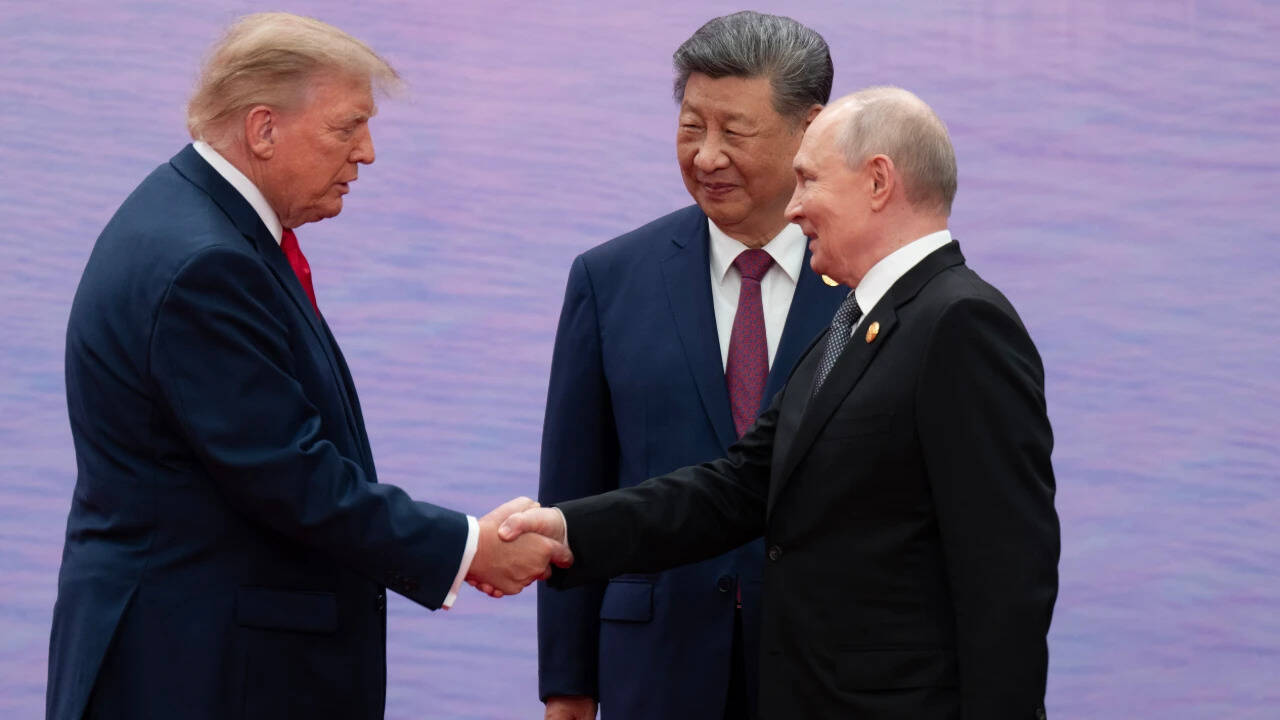
Mainstream foreign policy analysts treat diplomatic venues like interchangeable hotel conference rooms. They look at a headline about Donald Trump and Vladimir Putin meeting in China after the 2025 Alaska summit failed to end the Ukraine war, and they immediately reach for the same tired talking points about stalled negotiations, personal chemistry, and repetitive diplomatic theater.
They are missing the entire point.
When a bilateral summit between Washington and Moscow fails in Anchorage and reconvenes in Beijing, the venue is not a logistical footnote. The venue is the message. Conventional commentary focuses on whether two leaders can find common ground on territorial boundaries or security guarantees, completely ignoring the structural reality that the geographic shift from North American soil to East Asian soil fundamentally alters the leverage of every actor at the table.
To understand why the 2025 Alaska summit stalled and why a follow-up in China carries entirely different geopolitical weight, you have to strip away the personality-driven narratives that dominate cable news and examine the hard mechanics of third-party mediation, economic dependency, and multipolar signaling.
The Myth of the Neutral Venue
In traditional diplomacy, neutral ground—Geneva, Reykjavik, Vienna—exists to strip away home-field advantage. The 2025 Alaska summit operated on a different premise entirely. Hosting talks in Alaska placed the meeting on American territory while keeping it geographically proximate to Russia’s Far East, projecting a sense of direct, unmediated bilateralism between two superpowers.
The lazy consensus argues that the Alaska talks failed because the underlying positions of Moscow and Kyiv remained irreconcilable. While irreconcilable demands certainly played a role, focusing solely on the bilateral deadlock misses the structural flaw of the Anchorage format. Direct bilateral talks between Washington and Moscow operate under an outdated Cold War assumption that the United States and Russia alone hold the keys to European security.
That assumption no longer reflects reality. You cannot negotiate a durable settlement to a major Eurasian land war in isolation when the primary economic lifeline sustaining one of the belligerents sits thousands of miles away in Beijing.
Why Beijing Is Not Just Another Host
Moving the talks to China introduces a silent—or perhaps not-so-silent—third party into the room. Foreign policy observers often fall into one of two traps when analyzing China's role in the Russia-Ukraine conflict. The first trap is assuming Beijing is a purely neutral peacemaker eager to burnish its global statesmanship. The second trap is assuming Beijing and Moscow operate in lockstep as an unbreakable monolithic bloc.
Both views are overly simplistic. China’s strategic calculus is driven by cold, hard self-interest, and hosting a Trump-Putin summit serves multiple overlapping objectives for Beijing:
- Demonstrating Indispensability: By bringing the leaders of the United States and Russia onto Chinese soil to discuss European security, Beijing signals to the Global South and European capitals alike that major global conflicts cannot be resolved without Chinese participation.
- Managing Economic Exposure: Prolonged war and escalating secondary sanctions create friction for Chinese financial institutions and export sectors. Beijing benefits from a frozen or negotiated outcome that stabilizes global commodity flows without causing a catastrophic collapse of the Russian state.
- Shaping the Terms of Engagement: A host nation controls the diplomatic atmosphere, the framing of communiqués, and the subtle pressures applied behind closed doors. Unlike the United States, China possesses direct, immediate economic leverage over Moscow's wartime economy.
When Putin sat across from Trump in Alaska, Moscow faced pressure primarily from Washington—pressure it had already spent years absorbing and adapting to through sanctions evasion and wartime industrial mobilization. When those same talks occur in China, Moscow operates inside the territory of its single most critical economic partner.
Dismantling the "Personal Chemistry" Fallacy
A persistent misconception in political journalism is that high-stakes summits succeed or fail based on the personal rapport between leaders. Analysts spend endless hours dissecting body language, handshake durations, and off-the-cuff remarks, treating complex statecraft like an interpersonal drama.
In reality, leaders of major powers rarely abandon core national security doctrines because of a charismatic counterpart. I have watched countless policy teams over-index on leader-to-leader dynamics, pouring millions of dollars and months of preparation into scripting personal moments, only to watch the resulting agreements collapse the moment they hit bureaucratic and legislative reality back home.
The 2025 Alaska summit did not fail because of a lack of personal rapport, nor will a meeting in China succeed simply because of a change of scenery. Summits succeed when the underlying balance of costs and incentives shifts enough that compromise becomes less painful than continuation.
The Core Friction Points That Haven't Disappeared
Even with Beijing as the backdrop, any framework emerging from a Trump-Putin meeting faces massive structural hurdles that commentators routinely gloss over:
- The Legitimacy Deficit: Any bilateral understanding reached between Washington and Moscow—even with Beijing's backing—cannot be implemented without the compliance of Kyiv and European NATO members. Agreements negotiated over the heads of directly affected nations historically suffer from severe enforcement problems.
- Verification and Security Guarantees: Ceasefire lines mean nothing without credible enforcement mechanisms. Russia rejects Western peacekeepers, while Ukraine and its European backers view paper promises without hard deterrence as a temporary pause before renewed aggression.
- Sanctions Relief vs. Irreversible Concessions: Washington cannot easily snap its fingers and unwind multilateral sanctions regimes, particularly those codified into law by Congress or coordinated with the European Union, in exchange for reversible troop movements.
Answering the Questions Analysts Get Wrong
When news breaks of a major diplomatic pivot, public commentary immediately gravitates toward predictable questions. Most of those questions are framed around false premises.
Will a summit in China immediately end the war in Ukraine?
No. High-level summits rarely produce comprehensive peace treaties from scratch. At best, they establish a framework for a ceasefire, prisoner exchanges, or de-escalation channels that take months of grueling technical negotiations to formalize. Expecting an instant signature on a final settlement misunderstands how modern conflict resolution works.
Does holding talks in China represent a diplomatic defeat for the United States?
Only if you view international relations as a zero-sum game of prestige rather than an exercise in leverage. If Washington uses Beijing's desire for international stature to compel Beijing to apply quiet economic pressure on Moscow, the venue becomes a tool of American strategy rather than a concession. Conversely, if Washington arrives without a unified strategy with its European allies, Beijing walks away with the prestige while Moscow pockets tactical breathing room.
Why didn't the 2025 Alaska summit produce a breakthrough?
Because in 2025, both Moscow and Washington were still testing the limits of their respective leverage. Moscow believed time and attrition favored its territorial objectives, while Washington was recalibrating its approach to military aid and alliance burden-sharing. Without a mutual recognition of a hurting stalemate, summits serve as reconnaissance missions rather than closing tables.
The Uncomfortable Truth About Leverage
The contrarian reality that neither hawks nor doves want to acknowledge is that diplomatic leverage is rarely generated at the negotiating table. It is generated months earlier through industrial capacity, financial resilience, and alliance cohesion.
There is an obvious downside to relying on a Beijing-hosted summit to break the deadlock: it implicitly validates China's role as an arbiter of European security. European capitals, already anxious about transatlantic commitment and economic competition with China, view any U.S.-Russia-China triangle with deep suspicion. Bringing Beijing into the center of the diplomatic process risks widening fissures within the Western alliance even as it attempts to close a war on Europe's eastern flank.
Yet ignoring China's influence hasn't worked either. Years of attempting to isolate Moscow while treating Beijing's economic support as a secondary issue failed to force a Russian withdrawal. Engaging on Chinese turf acknowledges the multipolar reality that already exists in global trade and energy markets, whether Western policymakers like it or not.
Reading the Signals That Actually Matter
If you want to know whether the talks in China represent a genuine turning point or just another cycle of diplomatic theater, ignore the press conferences and watch three concrete indicators:
- The Composition of the Delegations: Watch who gets off the plane alongside the principals. If the delegations are heavy on intelligence chiefs, military logistics planners, and finance ministry officials rather than just protocol diplomats, substantive bargaining over ceasefire mechanics and sanctions architecture is underway.
- The Language of the Chinese Readout: Pay close attention to how Beijing characterizes the meeting in its official statements. Standard diplomatic boilerplate about "promoting peace and dialogue" signals a surface-level photo opportunity. Specific references to territorial sovereignty, security architecture, or economic reconstruction mechanisms indicate Beijing is actively underwriting a framework.
- European and Ukrainian Diplomatic Movements: Watch Warsaw, Berlin, Paris, and Kyiv in the 72 hours immediately following the summit. Quiet, urgent consultations among European defense ministers signal that Washington and Moscow have discussed concrete terms affecting European security—terms that Europe will either have to accept or actively resist.
The Real Stakes of the Beijing Shift
The failure of the 2025 Alaska summit proved that bilateral willpower alone cannot override entrenched military realities. Moving the conversation to China does not magically resolve the clash between Russian territorial ambitions and Ukrainian sovereignty, nor does it erase the deep mistrust between Washington and Moscow.
What it does do is strip away the illusion that the war in Ukraine remains a purely regional conflict managed solely by Atlantic powers. By stepping onto Chinese soil to negotiate the contours of European security, Washington and Moscow are acknowledging that the center of geopolitical gravity has shifted—and that the terms of peace in Eastern Europe may ultimately be shaped in East Asia.