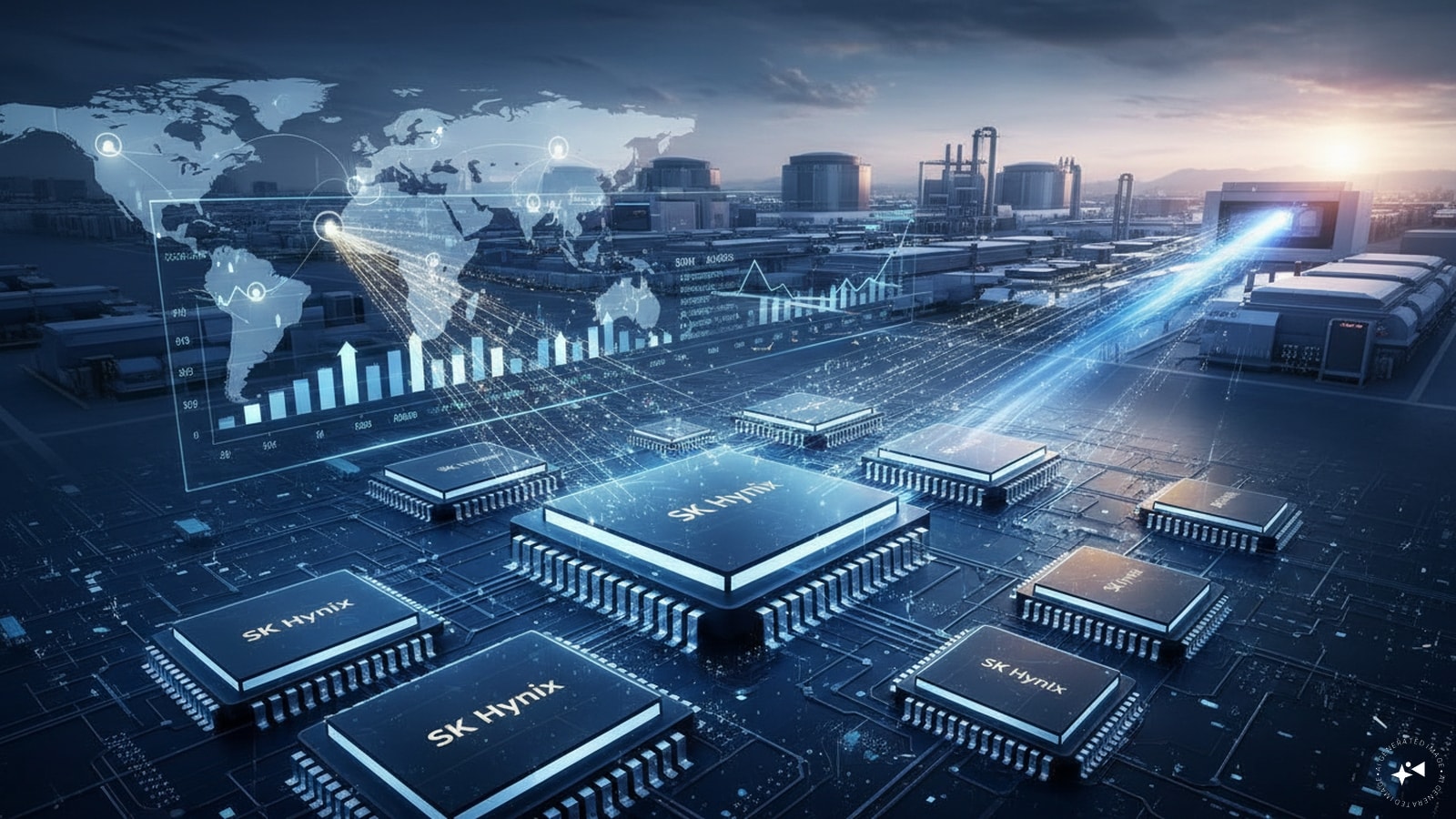
The yellow light of a lithography machine does not feel like the future. It feels like a darkroom. It smells like scorching chemicals and filtered air so dry your lips crack within an hour of walking onto the floor. In Icheon, South Korea, thousands of people spend their days shrouded in white bunny suits, breathing through synthetic fabric, staring at silicon wafers through thick glass. They are trying to solve a problem that is stubbornly physical.
We talk about artificial intelligence as if it lives in a cloud. We imagine it floating above us, a weightless, omniscient presence born from nothing but pure mathematical code. That is an illusion. AI is heavy. It is hot. It requires unimaginable amounts of electricity, and more than anything else, it requires memory. Not the kind of memory that lingers in human brains, but High Bandwidth Memory. HBM. It is the physical pipeline that feeds data to the insatiable processors designing the modern world. Without it, the most advanced artificial intelligence models are just incredibly fast engines running without a fuel pump. You might also find this similar coverage insightful: Why Wall Street Is Completely Wrong About Samsung's Capex Panic.
Right now, a single company finds itself sitting at the center of this sudden, desperate bottleneck. SK Hynix, a name that rarely registers with the average consumer buying a smartphone or a laptop, has become the gatekeeper of the AI boom. But staying at the front of a gold rush requires an astronomical amount of cash. You cannot build the infrastructure of tomorrow with promises. You need factories. You need equipment that costs more than commercial airliners.
To fund this relentless appetite, the company just launched one of the largest share sales the corporate world has seen in years. They are asking global investors to hand over billions of dollars. It is a massive, high-stakes gamble on the belief that the world's hunger for silicon will not peak anytime soon. As reported in recent reports by Mashable, the implications are widespread.
Consider the scale of what is happening inside those pristine, vibrating fabrication plants.
Imagine a highway. For decades, the tech industry focused on making cars faster. They made processors that could crunch numbers at blinding speeds. But as software grew more complex, those fast cars hit a massive traffic jam. The road leading from the data storage to the brain of the computer was too narrow. Data sat idling in the heat, waiting its turn.
To fix this, engineers did something radical. They did not just widen the road. They stacked highways on top of each other. They took thin sheets of dynamic random-access memory, shaved them down until they were thinner than a human hair, and stacked them vertically. Then, they drilled microscopic holes through the entire stack, linking them with thousands of tiny columns of copper.
This is High Bandwidth Memory. It is a skyscraper of data.
But building a skyscraper on a microscopic scale is an exercise in agonizing precision. If a single copper column is misaligned by a fraction of a micrometer, the entire stack becomes a useless piece of rock. The rejection rate for these chips during the early manufacturing runs was notoriously high. Rumors floated through the industry of yield rates that would make a traditional accountant weep. Every ruined wafer represented millions of dollars dissolved into thin air.
That is where the human anxiety enters the ledger.
Behind the corporate announcements and the sterile stock market tickers are teams of engineers working eighty-hour weeks under yellow light. They know that a competitor in Taiwan or a domestic rival in Suwon is staring at the exact same physical limitations. The race is not measured in years anymore. It is measured in weeks. If you fall behind on the next generation of memory packaging, your customers—the tech giants pouring hundreds of billions into data centers—will simply change their order forms. They cannot afford to wait.
The decision to sell a massive block of shares is never made from a position of relaxed comfort. It is a tactical move born from urgency. By issuing new shares or liquidating massive stakes, a company dilutes its existing ownership. It tells the market that it needs liquidity immediately.
Why the rush? Because the machinery required to print these advanced chips is monopolized by a handful of suppliers. The lead times for these machines stretch out for months, sometimes years. If you do not place the down payment today, you do not get the equipment next year. If you do not get the equipment next year, you drop out of the race entirely.
It is easy to look at the stock charts and see nothing but green arrows pointing toward the sky. The demand for hardware capable of running massive language models has pushed valuations to historic heights. But anyone who has watched the semiconductor industry for more than a decade knows that silicon is a cyclical beast. It breathes in, and it breathes out.
Periods of frantic undersupply are almost always followed by periods of brutal oversupply. Companies build massive factories, fill them with expensive tools, and then wake up one morning to find that their customers have filled their warehouses and stopped buying. Prices plummet. Profit margins evaporate. The history of memory chips is littered with the corpses of companies that expanded too quickly at the top of the market.
This share sale is an attempt to bridge that terrifying chasm. It is a play to lock in capital while the sun is shining, ensuring that when the market inevitably cools down, the factories will already be built, paid for, and running.
Look at the numbers through a broader lens. The capital raised in these massive transactions does not sit in a bank account. It transforms into concrete and steel. It funds giant, multi-billion-dollar complexes in places like Yongin, where entire mountains are being leveled to create mega-clusters of semiconductor manufacturing.
The scale of these projects is difficult to comprehend from a spreadsheet. They require their own dedicated power substations, capable of consuming as much electricity as a medium-sized city. They require water filtration systems that process millions of gallons of ultra-pure water a day, ensuring that not a single speck of dust touches the silicon.
When you buy a share in a company during an AI-driven frenzy, you are not just betting on an algorithm. You are buying a tiny piece of that massive, vibrating infrastructure. You are betting that the world will continue to value data more than almost any other commodity on earth.
But what happens if the software side of the equation stalls?
Right now, tech companies are spending billions on chips, but the consumer applications that justify that spending are still evolving. We use these tools to summarize emails, write code, and generate images. Those are useful tasks. But do they justify a trillion-dollar restructuring of global infrastructure? That is the unspoken question that hangs over every boardroom meeting in Seoul, Taipei, and Silicon Valley.
If the software companies fail to monetize their investments, the demand for hardware could dry up with shocking speed. The skyscraper chips would sit on shelves. The yellow-lit factories would slow their lines.
The engineers in Icheon do not have time to worry about the macroeconomic cycle. They are focused on the next iteration of the stack. They are trying to figure out how to layer twelve, sixteen, or twenty sheets of silicon together without the heat destroying the fragile circuits inside. The physical limits of materials are closing in. Copper expands when it gets hot. Silicon warps. The closer you bring these components together, the more they fight against the laws of physics.
Solving these problems requires a rare mix of corporate stamina and individual obsession. It requires a willingness to fail thousands of times in pursuit of a three percent increase in efficiency.
That three percent is the difference between winning a contract worth ten billion dollars and watching your rival take it all.
When the news of a massive share sale hits the wires, the reaction is usually measured in basis points and volume metrics. Analysts talk about dilution risks and capital allocation strategies. They use cold language to describe a deeply volatile human endeavor.
But if you strip away the financial jargon, the reality is much simpler and far more dramatic. A group of executives looked at the future, realized they were holding a tiger by the tail, and decided to double down. They are betting that the hunger for artificial intelligence is not a temporary bubble, but a permanent shift in how human civilization functions.
They are building the foundation for a digital world that is expanding faster than our ability to regulate or fully understand it. The cash pouring in from global investors will be converted into heat, light, and hyper-pure water within months. The wafers will keep moving through the machines. The yellow light will keep shining on the white suits.
We are watching a quiet reconstruction of the global economy, written in microscopic lines of metal on a surface no larger than a postage stamp. The stakes could not be higher. If they are right, this capital injection will solidify a technological empire. If they are wrong, it will stand as one of the most expensive monuments to overconfidence ever built.
The line between those two outcomes is incredibly thin. It is measured in micrometers, maintained by exhausted engineers, and funded by billions of dollars of capital that cannot afford to look back.