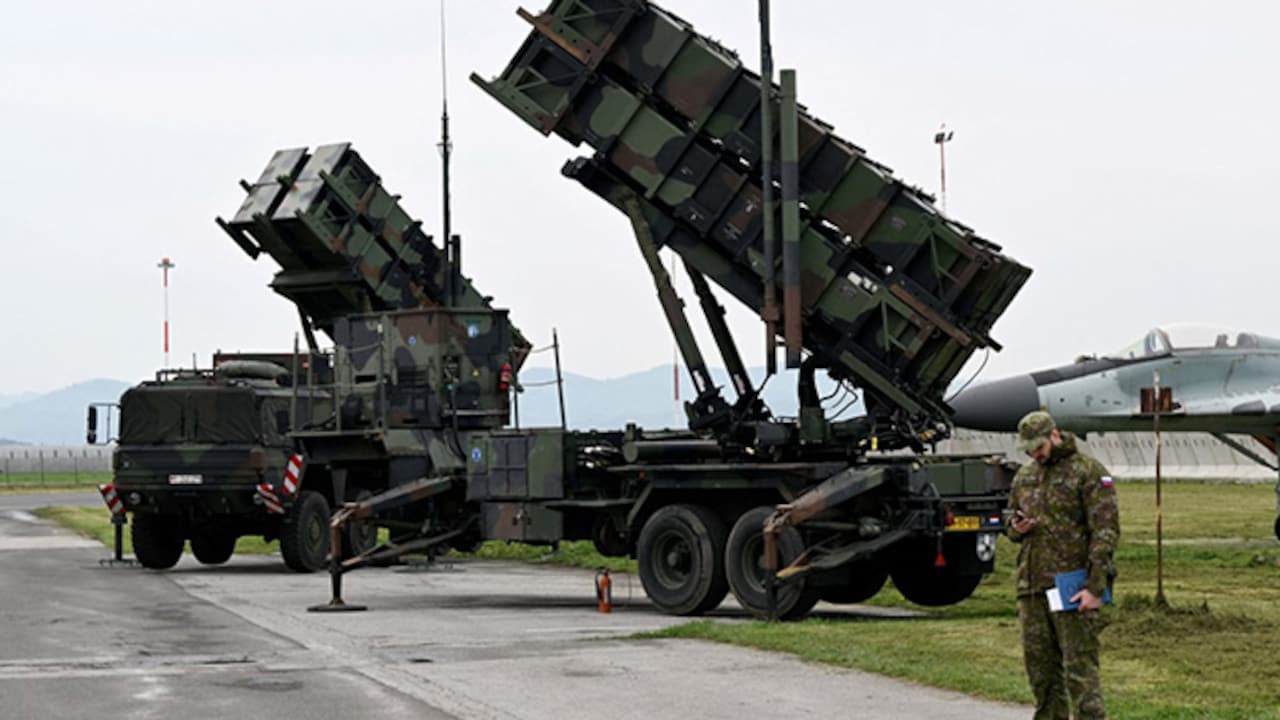
Everyone reading the headlines about the latest U.S. approval of Patriot missile systems for Ukraine is falling for the oldest trick in defense journalism. They see the words "delivery could take years" and immediately cry bureaucratic incompetence, industrial decay, or political stalling.
They are completely missing the board. Expanding on this idea, you can find more in: Behind Closed Doors at the G20 Why Jaishankar’s Bilateral Blitz Matters More Than the Main Summit.
When the State Department clears a Foreign Military Sale (FMS) with a three-to-five-year delivery window, the timeline isn't a bug in the procurement system. It is the entire point of the transaction. Mainstream defense coverage treats weapons transfers like Amazon Prime orders—if it doesn't arrive in two days, the supply chain is broken. That is a child's understanding of grand strategy and defense economics.
In reality, approving a multi-year Patriot contract isn't about shooting down tomorrow morning's cruise missiles. It is a binding financial and geopolitical poison pill designed to lock Ukraine into the Western security architecture long after current political administrations leave office, while simultaneously forcing European allies to underwrite the expansion of the American industrial base. Analysts at TIME have shared their thoughts on this trend.
The Lie of the "Delayed" Delivery
Let’s dismantle the lazy consensus first. Whenever a major defense package is announced with a long lead time, pundits immediately point to the production bottlenecks at Raytheon (RTX) and Lockheed Martin. Yes, building an AN/MPQ-65 radar set, an engagement control station, and PAC-3 MSE interceptors takes time. You cannot conjure gallium nitride semiconductors and solid-fuel rocket motors out of thin air.
I have spent enough years watching defense primes scramble to expand tooling lines to know that cold-starting a complex manufacturing ecosystem is brutal, expensive work. When I worked alongside procurement analysts in the early 2010s, we watched Washington slash interceptor orders to save pennies, gutting second- and third-tier sub-suppliers who made specialized seeker heads and composite casings. Those small machine shops went bankrupt or pivoted to commercial aerospace. You don't rebuild that overnight.
Here is what the surface-level reporting ignores: FMS contracts are not warehouse clearances.
When Washington wants to send hardware immediately, it uses Presidential Drawdown Authority (PDA). PDA pulls existing gear straight off Pentagon shelves. Foreign Military Sales, by contrast, are direct contracts for new production. Criticizing an FMS approval because the missiles won't arrive next week is like criticizing a mortgage approval because the house hasn't been framed yet.
More importantly, the delayed timeline serves three massive strategic functions that immediate transfers never could:
- Multi-Year Production Certainty: Defense contractors will not invest hundreds of millions of their own capital into new factory floor space based on promises. They require signed, funded FMS backlog. By locking in multi-year contracts, the Pentagon gives Lockheed Martin the financial runway to push PAC-3 MSE production toward 650+ units annually without risking shareholder revolt.
- Allied Burden-Sharing: Most of these massive FMS packages aren't paid for with blank checks from the U.S. Treasury; they are financed through complex consortiums of European allies, frozen asset mechanisms, or long-term loan guarantees.
- Strategic Deterrence Through Permanence: Moscow's entire theory of victory rests on outlasting Western political will. A multi-year production contract signals to the Kremlin that Ukraine's air defense network isn't a temporary wartime patch—it is a permanent, maturing NATO-standard fortress.
Understanding the Anatomy of a Patriot Battery
To grasp why the "delivery takes years" complaint is so misguided, you have to understand what is actually being bought. The media throws around the word "Patriot" as if it’s a single tube on a flatbed truck. It isn't.
A single Patriot fire unit is an intricate, mobile nervous system comprising:
- The Radar Set (AN/MPQ-65 or the newer LTAMDS): The eyes of the system, capable of tracking dozens of targets simultaneously while resisting heavy electronic jamming.
- The Engagement Control Station (ECS): The only manned station in the battery, where human operators make split-second life-or-death decisions alongside automated fire-control algorithms.
- The Electric Power Plant (EPP): Two 150-kilowatt diesel generators mounted on a heavy tactical truck. Without clean, uninterrupted power, the radar is just an expensive windbreak.
- The Antenna Mast Group: The communications backbone that links the battery to broader NATO air-defense networks (Link 16).
- The Launching Stations (M901/M902/M903): Up to eight launchers per battery, positioned kilometers away from the radar to ensure that an enemy anti-radiation missile homing in on the radar doesn't wipe out the missiles.
When you approve a new Patriot sale, you aren't just buying interceptors. You are buying the industrial output of over a hundred specialized suppliers across dozens of states.
If the Pentagon stripped active U.S. Army battalions to send every single one of those components to Eastern Europe tomorrow, it would create an immediate, catastrophic readiness gap in the Indo-Pacific. Think about that. Every Patriot battery pulled from active U.S. rotation leaves a hole in the air defense umbrella protecting Guam, Okinawa, and carrier strike groups operating in the Western Pacific.
The Pentagon is playing a two-theater chess match. Critics screaming for instant transfers are looking at a single square on the board.
Why "Just Send More Now" Is a Suicidal Strategy
Let’s run a thought experiment. Imagine a scenario where Washington caves to public pressure, bypasses the multi-year production queue, and strips 30 percent of the U.S. Army’s active Patriot batteries to ship them immediately to Kyiv.
What happens next?
First, Ukraine does not have the trained crews to operate them sustainably. Training a Patriot operator isn't like teaching someone to fire an anti-tank missile in a weekend. Even on the accelerated wartime curriculum at Fort Sill, Oklahoma, turning raw recruits into competent air-defense crews capable of executing complex radar maintenance and electronic counter-countermeasures takes months of grueling, round-the-clock instruction. Dumping hardware into a combat zone faster than trained crews can absorb it is how multi-billion-dollar assets get destroyed on the ground by cheap reconnaissance drones and Iskander ballistic missiles. We have already seen what happens when air-defense assets are pushed too close to the front without layered short-range protection.
Second, you run out of interceptors before the factories can catch up. A Patriot battery without PAC-3 MSE or GEM-T interceptors is just a high-priority target. Russian operational planners understand missile math. If you launch waves of cheap Shahed-136 drones mixed with ballistic missiles, the defender is forced to burn million-dollar interceptors to protect critical infrastructure. Without a multi-year production pipeline feeding the front, sending extra launchers today simply accelerates the date when the magazines run dry.
Third, you hand Beijing a massive strategic gift. Every time the U.S. depletes its active interceptor stockpiles without a locked-in replacement pipeline, planners in the People's Liberation Army Rocket Force take notes. Deterrence in the Taiwan Strait relies heavily on the credibility of U.S. integrated air and missile defense. Hollowing out active inventories to score short-term headlines in Europe weakens global deterrence everywhere else.
The Unspoken Industrial Playbook
Look closely at who actually benefits from the "slow" FMS model.
The U.S. defense industrial base spent thirty years consolidating after the Cold War. In 1990, there were dozens of major defense contractors competing for Pentagon dollars. Today, there are five. That consolidation created immense efficiency during peacetime, when Washington fought low-intensity counterinsurgencies against enemies with no air forces. It became a glaring vulnerability the moment high-intensity peer warfare returned to Europe.
By structuring Ukraine's air defense upgrades as multi-year Foreign Military Sales, the Pentagon is essentially using foreign and allied capital to recapitalize American manufacturing.
Consider how Lockheed Martin and RTX operate. Their boards of directors answer to institutional investors—BlackRock, Vanguard, State Street. Those investors demand predictable margins and multi-year cash flow visibility. They despise boom-and-bust defense spending. If the government buys 500 missiles in one frantic year and zero the next, the contractors won't build a new factory; they will just run overtime shifts at existing plants, pocket the cash, and buy back stock.
When the U.S. government signs off on a massive, multi-year FMS package, it creates a guaranteed order book stretching into the 2030s. That order book is what unlocks capital expenditure. It justifies building new automated propellant mixing facilities in Camden, Arkansas. It justifies qualifying second-source suppliers for precision-machined titanium components.
The slow delivery timeline isn't a failure of the system. It is the mechanism that forces Wall Street to fund the expansion of Western arsenal capacity.
What Everyone Gets Wrong About Cost and Value
Another tired trope in coverage of these deals is sticker shock. Pundits love to divide the total contract value by the number of launchers and gasp at the price tag. "Four million dollars per missile!" they shout, comparing it to the $50,000 cost of an Iranian-designed drone.
This is the most pervasive fallacy in modern military analysis: judging an interceptor by the cost of the projectile it destroys, rather than the value of the target it saves.
You do not fire a PAC-3 MSE at a $50,000 drone unless that drone is about to hit a Patriot radar or a nuclear substation. You use Gepard anti-aircraft guns, Vampire laser-guided rockets, or mobile machine-gun teams for cheap drones. You save the Patriot for Kinzhal aero-ballistic missiles, Iskander-M ballistic missiles, and high-altitude bombers dropping glide bombs.
What is the cost of not intercepting an Iskander missile aimed at a major thermal power plant or an ammunition depot?
- Rebuilding a destroyed turbine hall costs upwards of $300 million and takes two years.
- The economic paralysis caused by rolling blackouts in a major industrial city costs tens of millions of dollars per day.
- The loss of a brigade's worth of stored artillery shells can collapse an entire sector of the front line.
Against those numbers, a $4 million interceptor isn't expensive. It is the cheapest insurance policy on earth. The people complaining about the unit cost of Patriot missiles are calculating the price of the medicine while ignoring the cost of the funeral.
The Honest Downside Nobody Wants to Admit
Of course, playing the long industrial game carries a brutal, undeniable risk.
A multi-year delivery schedule assumes the defender survives the years in between. No factory expansion in Arkansas or Massachusetts stops a ballistic missile inbound tonight. By prioritizing sustainable, long-term industrial scaling over reckless short-term inventory stripping, Washington is making a cold, calculated bet: that Ukraine can endure years of attrition using a patchwork of legacy Soviet systems (S-300s, Buks), European mid-range batteries (IRIS-T, NASAMS, SAMP/T), and tight firing discipline while the American production lines spin up.
If Ukraine’s energy grid or front-line morale collapses before those new batteries roll off the assembly lines, the finest multi-year FMS contract in history becomes an expensive paperweight. That is the razor's edge of grand strategy. You are constantly trading immediate tactical relief against long-term strategic survival. Anyone who tells you there is a painless way out of that trade-off is selling you a fantasy.
How to Actually Read Defense Procurement News
Stop reading defense announcements like sports scores. When you see a headline screaming about multi-year delays on major weapons approvals, run it through a reality filter:
- Check the funding mechanism: Is it PDA (immediate shelf pull) or FMS (new factory build)? Never confuse the two.
- Look at the sustainment package: A contract heavy on spare parts, test equipment, and technical support services is far more significant than raw launcher counts. Hardware without maintenance contracts breaks down in ninety days.
- Watch the sub-tier bottlenecks: Pay attention to solid rocket motor production (Aerojet Rocketdyne/L3Harris and Northrop Grumman) and radar seeker capacity. That is where the real timeline lives, regardless of what politicians promise at press conferences.
- Track allied co-production: Notice how Germany, Japan, and other partners are now licensed to produce Patriot missiles and components locally. The U.S. is decentralizing the supply chain so a single bottleneck in America can no longer choke off global supply.
The pundits lamenting the multi-year wait for Patriot deliveries are stuck in a 24-hour news cycle, desperate for instant gratification in an industrial war of attrition. Washington isn't dragging its feet. It is locking in a decade of Western air dominance, forcing allies to foot the bill, and rebuilding a hollowed-out manufacturing base on someone else's dime.
If you think that’s a failure, you aren't paying attention to who actually wins long wars.