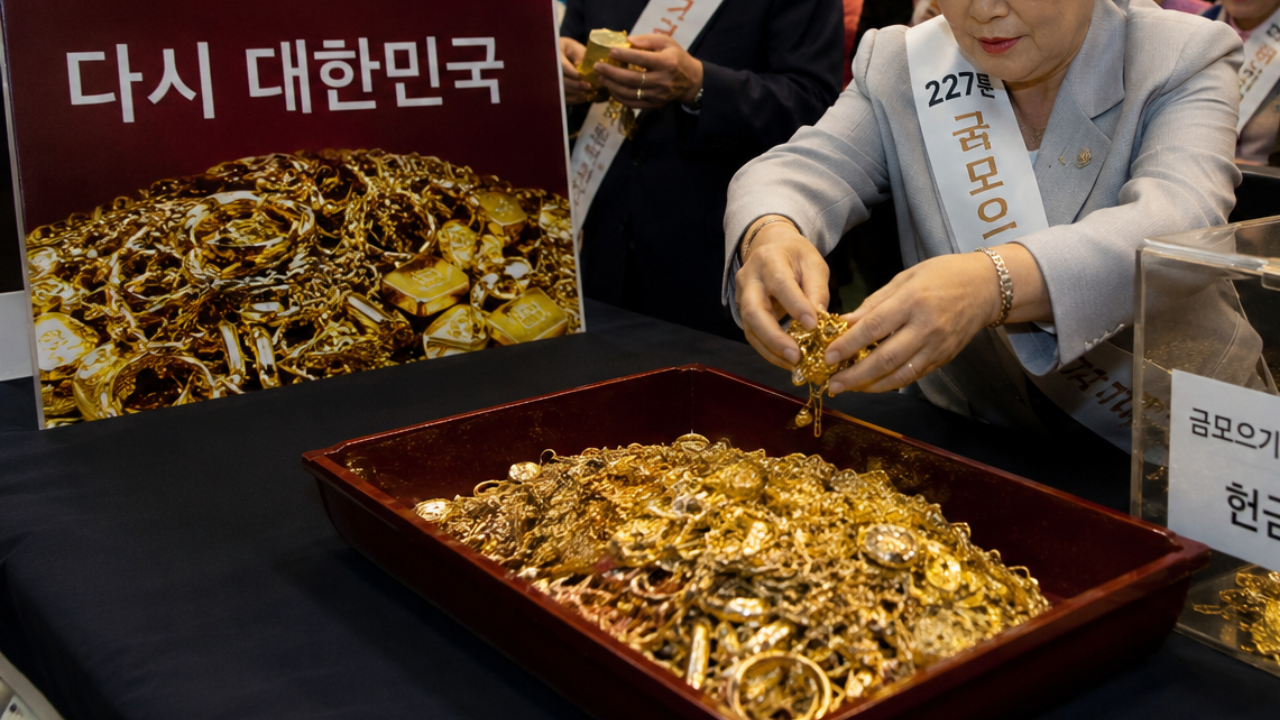
The history books love a tear-jerker, and the 1997 Asian Financial Crisis handed them a masterpiece. You know the narrative: a proud nation brought to its knees by currency speculators, an emergency $58 billion IMF bailout package, and millions of ordinary South Korean citizens lining up in the freezing cold to donate their wedding rings, concept gold bars, and athletic medals.
We are told this collective sacrifice of 227 tonnes of gold saved the country. It is packaged as the ultimate triumph of civic nationalism over economic ruin.
It is a beautiful story. It is also a complete economic delusion.
The standard narrative surrounding the gold collection campaign gets the mechanics of international finance completely backward. The citizens of South Korea did not save their economy; they inadvertently liquidated their domestic wealth to subsidize foreign institutional creditors.
I have spent decades analyzing sovereign debt restructurings and macro liquidity crises. When you strip away the emotional propaganda of the "Gold Collecting Campaign" (Geummoatgi), the numbers tell a radically different, far more cynical story.
The Cold Math of 227 Tonnes
Let us look at the raw data instead of the emotional footage of weeping grandmothers giving away their family heirlooms.
The campaign collected roughly 227 tonnes of gold from roughly 3.5 million citizens. At the prevailing market prices in early 1998, that gold was worth approximately $2.1 billion to $2.2 billion.
Now, look at the scale of the crisis. The IMF package was worth $58 billion. South Korea’s total external debt at the end of 1997 hovered around $150 billion, a massive chunk of it short-term obligations held by domestic banks that were rolled over daily.
The gold campaign generated a sum that covered less than 4% of the IMF loan alone, and barely 1.5% of the nation's total external liabilities. To claim this campaign "rescued the economy" is mathematically absurd. It is the financial equivalent of trying to put out a forest fire with a backyard garden hose.
Worse, the gold was liquidated at the absolute bottom of a twenty-year bear market. The Bank of Korea and the commercial banks driving the campaign exported the physical gold immediately to generate foreign currency reserves. They dumped massive tonnage into a depressed market, fetching around $280 to $300 per ounce.
Had those citizens held onto their private gold reserves until the late 2000s or 2010s, that same generational wealth would have been worth four to six times more. The campaign effectively forced a massive wealth transfer from Korean households to international gold traders at rock-bottom prices.
Who Actually Benefited From Your Grandmother's Rings?
To understand who really won, you have to look at where the cash went.
The structural flaw of the Korean economy in 1997 was not a lack of household wealth. The country was highly productive. The flaw was an insane corporate capital structure. The giant conglomerates (chaebols) like Daewoo, Hyundai, and Samsung were running debt-to-equity ratios exceeding 400%. They had borrowed aggressively in short-term US dollars to fund long-term domestic expansions.
When the Thai Baht collapsed in July 1997 and triggered a regional contagion, foreign merchant banks panicked. They refused to roll over South Korea's short-term dollar loans. The Korean Won plummeted, making those dollar debts unpayable.
When the IMF stepped in, they did not design a program to protect Korean citizens. They designed a program to ensure Western and Japanese commercial banks did not take a haircut on their reckless lending to the chaebols. The conditionalities imposed by the IMF—skyrocketing interest rates up to 30%, strict fiscal austerity, and the forced opening of domestic financial markets—were engineered to stabilize the exchange rate long enough for foreign capital to exit safely or buy up distressed assets on the cheap.
The gold collected from citizens was rapidly melted down, refined into London Good Delivery bars, and shipped overseas to bolster foreign exchange reserves. That hard currency went straight out the door to pay off short-term foreign creditors.
The patriotic sacrifice of the Korean working class functioned as a giant sovereign backstop for bad corporate debt. Private citizens emptied their safety deposit boxes to socialize the losses of over-leveraged conglomerates and foreign speculators.
Dismantling the Premise: The Wrong Questions About 1997
If you look at the internet's most frequent queries regarding this historical event, the structural misunderstanding becomes glaringly obvious. The questions asked reveal how deeply the romanticized narrative has hijacked economic reality.
"Did South Korea pay off its IMF loan early because of the gold?"
No. This is a complete chronological fallacy. The gold campaign wrapped up its main phase by April 1998, netting just over $2 billion. South Korea did not fully repay its final obligations to the IMF until August 2001.
The real engine of South Korea's recovery was a brutal structural adjustment, massive currency depreciation that made Korean exports incredibly cheap globally, and a rapid restructuring of the chaebols (including the outright liquidation of Daewoo). The economy recovered because global demand for electronics, semiconductors, and automobiles surged in the late late-90s tech boom. The gold was a rounding error on the balance sheet.
"Why don't other countries just collect gold during a financial crisis?"
Because as an actual economic tool, it is incredibly inefficient and destructive. The only reason it worked as a political stunt in South Korea is due to a highly specific cultural landscape of civic nationalism and institutional collectivism that does not exist in most Western economies.
If a government attempted this today, it would trigger massive capital flight. Citizens would interpret the move as a sign of imminent state collapse and hoard their gold or smuggle it across borders, further crashing the local currency.
The Real Utility: A Masterclass in Psychological Warfare
If the gold campaign was a failure in terms of raw liquidity, why did the government and the media push it so aggressively?
Because it was an extraordinary piece of theater directed at two specific audiences: foreign investors and the domestic labor force.
By January 1998, international markets viewed South Korea as a systemic hazard. The country's credit rating had been cut to junk status. Capital was fleeing at an alarming rate.
The images of millions of citizens voluntarily surrendering their personal wealth sent a powerful psychological signal to Wall Street and the IMF. It demonstrated absolute societal compliance. It proved to foreign creditors that the Korean population was willing to accept extreme financial pain, wage cuts, and layoffs without triggering a destabilizing civil war.
"The gold campaign did not save Korea because of its monetary value. It saved Korea because it served as the ultimate collateral: proof of total societal submission to the restructuring regime."
For domestic consumption, the campaign served an even more brilliant political purpose. It shifted the blame. By framing the crisis as a national emergency requiring collective sacrifice, the political and corporate elites who actually caused the crisis managed to diffuse guilt. Instead of focusing anger on the corrupt relationship between the state and the chaebols (政經揉合), the narrative became about collective national survival. It converted class anger into national solidarity.
The True Cost of the Bailout
The long-term consequence of the 1997 IMF intervention was not the loss of 227 tonnes of physical gold. It was the permanent rewriting of South Korea's social contract.
Before 1997, the chaebols operated under a system of lifetime employment. In exchange for intense dedication, workers received security. The IMF tore that model to shreds. The restructuring forced the legalization of mass layoffs, the explosion of irregular or temporary employment, and the decimation of the middle class.
Today, South Korea suffers from some of the highest elderly poverty rates in the OECD, an ultra-competitive corporate monoculture, and the lowest fertility rate on the planet. These are the direct structural inheritances of the post-1997 economic order.
The gold campaign is remembered fondly because it is easier to celebrate a myth of unity than to confront the reality: the citizens gave up their gold, and in return, they received a hyper-financialized economy that treats labor as a disposable commodity.
Stop looking at the 1997 gold drive as an inspirational blueprint for economic recovery. It was a masterclass in crisis PR that converted private family wealth into a safety net for international finance.